
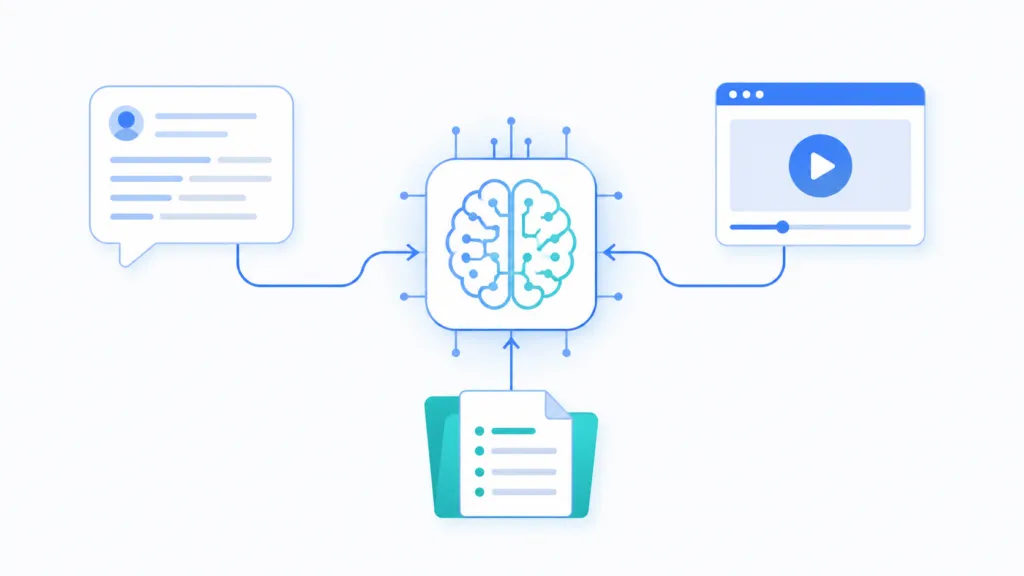
The best way to prepare your business for AI is to start collecting and organizing three types of data right now: call transcripts, standard operating procedures, and any guidance or advice your team produces. No matter how capable AI models become, they will always need accurate, detailed information about your specific business to produce anything valuable.
At TJ Digital, where we manage AI-powered marketing systems for roughly 40 to 50 client websites, this is the foundation of everything we do. Every client engagement starts with building what we call a Brand Ambassador, a curated set of documents that teaches AI how to accurately represent a specific brand.
The companies that have this data organized are already seeing results. The ones that don’t are starting from scratch every time they try to use AI for anything meaningful.
Right now, most businesses are scrambling to keep up with AI. They build complex workflows or custom software, and then next month one of the major model makers releases a feature that completely replaces what they built. Most of this effort ends up being wasted.
Your business data is different. It’s the one thing that will never become obsolete, because it’s the one thing AI models will never have on their own.
Table of Contents
ToggleWhy Most AI Preparation Efforts Don’t Last
Everyone wants to get ahead of AI. The problem is that AI is changing so fast that most of what you build today will be replaced tomorrow. You spend a week creating an automation, and then OpenAI or Anthropic ships a new feature that does the same thing natively.
This is frustrating, but it also reveals where you should be focusing. The tools and models will keep changing. Your data about your own business will not.
That data, your processes, your customer interactions, your internal decision-making, is something no AI company will ever have access to. It’s your competitive advantage.
IBM’s research on proprietary data in AI confirms this. Companies that customize AI models with their own internal data consistently outperform those relying on generic, off-the-shelf tools. One analysis found that organizations using proprietary data to fine-tune AI see significantly better results than those using only public models.
@tjrobertson52 Most AI prep is wasted effort. Here are 3 things actually worth doing. Which one are you already on? #AI #BusinessTips #AITools #Productivity
♬ original sound – TJ Robertson – TJ Robertson
What Types of Business Data Should You Collect for AI?
There are three categories of data that every business should be collecting right now. Each one serves a different purpose, and together they give AI everything it needs to actually understand your business.
| Data Type | What It Includes | Why AI Needs It | How to Start |
| Call transcripts | Sales calls, client meetings, team discussions | Contains real customer language, objections, and decisions | Use a transcription tool on every call and store transcripts in a central location |
| Standard operating procedures | Step-by-step documentation of every repeatable process | Teaches AI how your team actually does the work | Record a screen capture video of each process, then convert the transcript into an SOP |
| Guidance and advice | Emails, Slack messages, social content, internal memos | Captures institutional knowledge and decision-making rationale | Save any communication where expertise or judgment is shared |
None of this data needs to be clean or polished right now. Modern AI models can extract meaning from messy, unstructured sources. The important thing is that the data exists and is stored somewhere accessible.
How to Build SOPs from Screen Recordings
The easiest way to document a business process is to record yourself doing it. Open a screen recording tool like Loom, start the task, and think out loud the entire time. Narrate every decision, every click, every judgment call.
When you’re done, the tool generates a transcript automatically. Take that transcript and give it to Claude or ChatGPT with a prompt like “turn this transcript into a step-by-step SOP.” You review it, add any missing context, and you have a documented process that didn’t require you to sit down and write anything from scratch.
I recommend doing this for every task in your business, including the ones you think are too complex to ever hand over to AI.
For complicated tasks, record yourself every time you go through the process. Over time, you’ll have dozens or even hundreds of examples of yourself working through that task and thinking through each step out loud. Someday, you’ll be able to give those 100 transcripts to an AI much more powerful than what we have today and have it figure out how to automate that process with all of the nuance and intuition that you bring to it.
I’m currently doing this with our quarterly SEO strategy process. It can take up to half a day per client, and it’s incredibly nuanced. I could never turn it into a standard step-by-step SOP.
But I believe that with enough examples, those recordings will become incredibly valuable to a future AI.
Why You Should Transcribe Every Business Call
This is something most businesses are already doing to some extent, but very few are doing it with AI in mind. Every time you have a call, whether it’s a sales call, a client check-in, or an internal meeting, you should be transcribing it and storing that transcript somewhere organized.
Eventually, you’ll want to process the information in those transcripts so you don’t just have a pile of messy text files. But right now, just make sure you’re recording them and organizing them in a way that’s easy to find later.
The metadata matters too. Tag each transcript with the meeting type, the client or project it relates to, who was on the call, and what topics were covered. This makes it much easier to search and retrieve relevant information when you need it, whether that’s a human looking for it or an AI parsing your knowledge base.
Tools like Otter.ai and Circleback can handle the recording, transcription, and basic organization automatically. The important thing is consistency. If you’re only transcribing some calls, you’re leaving gaps in your institutional knowledge.
How to Capture Institutional Knowledge from Email and Slack
The third type of data is the hardest to pin down, but it might be the most valuable over time. It’s every piece of guidance, advice, or decision rationale that flows through your organization every day.
This includes interactions with customers or team members in email or Slack, videos you’ve posted to YouTube or Instagram, voice memos you’ve sent, strategic decisions you’ve made and the reasoning behind them. All of it represents institutional knowledge that typically lives in someone’s head or gets buried in a message thread.
Just make sure you’re storing it all somewhere. It doesn’t need to be organized perfectly right now. The goal is to prevent knowledge from disappearing when someone leaves, when a Slack thread gets archived, or when an email gets buried under 10,000 newer messages.
Some companies are using Slack bots that let team members flag important messages and save them to a central knowledge base. Others are setting up simple folder structures in Google Drive or Notion where team members can drop transcripts, screenshots of important conversations, and decision summaries.
Will This Data Actually Be Worth the Effort?
All of this data is already valuable today. But the value is going to grow significantly as AI tools improve.
Right now, you can take a collection of call transcripts and ask AI to identify patterns in customer objections, summarize decision history for a specific client, or surface information you forgot you had. Companies that have automated search across their email archives have cut resolution times by roughly 70% because the AI could pull answers directly from historical conversations.
The ROI case is straightforward. You already own this data, and collecting it costs almost nothing. The upside grows every time a new, more capable AI model is released.
You’re building an asset that becomes more useful over time. The businesses that start now will have a significant head start. The ones that wait will eventually find themselves trying to reconstruct years of institutional knowledge from memory.
Common Questions About Collecting Business Data for AI
What tools should I use to transcribe business calls?
Any tool that records and auto-transcribes is fine. Popular options include Loom for screen recordings, Otter.ai for meetings, and Circleback for automated meeting documentation. The specific tool matters less than the habit of recording everything consistently and storing it in a searchable location.
Do I need to organize my data before AI can use it?
Not perfectly, but some structure helps. At minimum, store transcripts with basic metadata like the date, participants, and topic.
AI models can work with messy data, but adding tags and filing things in logical folders makes retrieval faster and more accurate. You can always clean things up later.
What if a process is too complex to turn into an SOP?
Record yourself doing it anyway. Even if you can’t reduce a complex, judgment-heavy process to a checklist, collecting dozens of examples of yourself working through it creates training data for future AI. The nuance lives in the narration, in hearing you explain why you made each decision as you made it.
How much business data does AI actually need to be useful?
More is better, but even a small collection delivers results. A set of 10 to 15 well-organized documents about your brand, services, audience, and processes is enough to dramatically improve the quality of AI output. From there, every additional transcript, SOP, or piece of guidance you add makes the system more accurate.
Start Building Your AI Data Asset Today
The companies that will benefit most from AI are the ones quietly building a library of business knowledge that AI can actually use. Start now, and you’ll have a head start that compounds every time a more capable model is released.
Reach out to TJ Digital to see exactly what we build for our clients and how a structured AI knowledge base works in practice.