
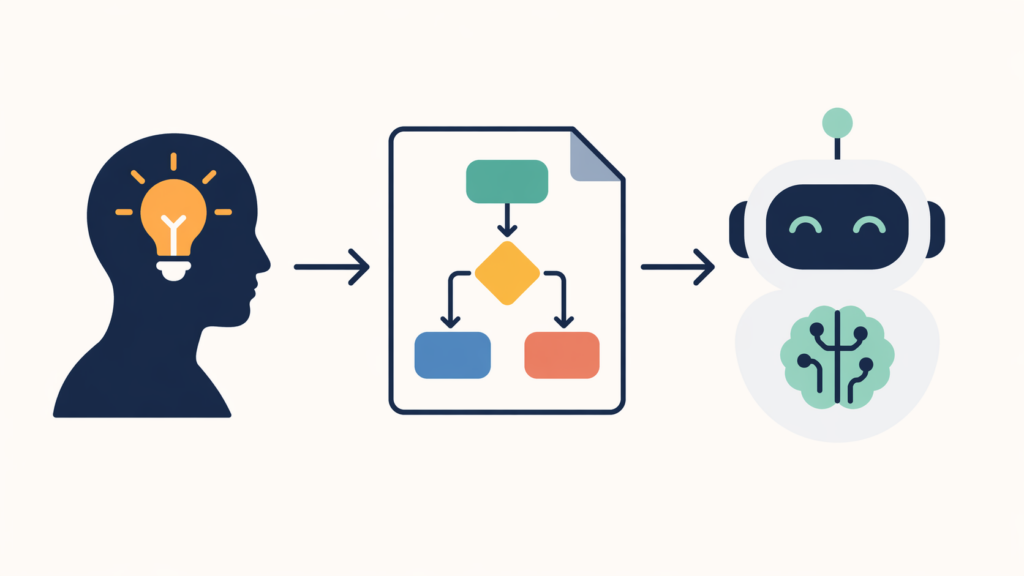
You can replace yourself with AI, including the hard parts. The intuitive decisions, the judgment calls, the tacit knowledge that only comes from years of experience. All of it can be codified into a Claude Skill that your team can use without you in the room.
At TJ Digital, we have been building AI-powered marketing systems for roughly 40 client campaigns. I have spent the last year developing about half a dozen of these skills for my own decisions, and the results have been close enough to my own judgment to hand off to the team. This article walks through exactly how I have been doing it.
Table of Contents
ToggleWhy are experts always the bottleneck?
@tjrobertson52 You can literally train AI to think like you. Document your decision process, build it into a skill, then correct every mistake until it gets it right. I’ve got 6 running right now 🤯 #AIAutomation #AITools #FounderTips #WorkSmarter
♬ original sound – TJ Robertson – TJ Robertson
If you have 5, 10, or 20 years of experience, you have developed a strong intuition. When someone brings you a difficult problem, you just know. You have seen it before. You can take all the context and nuance and quickly arrive at a plan.
The decision framework is mostly invisible to you. That is not magic. Your brain is processing information and outputting a result. The challenge is that the framework is undocumented, which makes you irreplaceable in a way that does not actually serve your business.
Every question that requires your judgment is a bottleneck.
What is tacit knowledge?
Tacit knowledge is the expertise you carry around that you have never written down. The thing you “just know” from experience. And for a long time, it felt like the one category of knowledge AI genuinely could not handle.
The problem was never that AI lacked the reasoning ability. The problem was that no one had translated the expertise into a format AI could work with. Your intuition is not magic. It is a set of weighted decision criteria built up over thousands of repetitions. You just have not written it down yet.
Once you write it down, AI can follow it.
How do you build a Claude Skill that thinks like you?
Here is the process I use. It takes some upfront investment, but once the skill is built, it compounds.
Step 1: Pick one specific problem
Do not try to replace all of your judgment at once. Pick one category of decision. For me, early examples were keyword research, internal linking strategy, and proposing site map structures. Small, specific, and clearly defined.
A good test: can you explain the problem to someone in one sentence? If yes, it is small enough to start with.
Step 2: Build the skill in Claude
Open Claude and tell it exactly what you are trying to do. “I need to build a skill that solves this problem.” Then write out your best first draft of the framework.
Set aside an hour. Walk through your decision process out loud, in writing. What factors do you consider? What are the edge cases? What are the common mistakes? If you have any past examples of yourself solving this problem, include those too.
Claude handles messy input well. You do not need to organize it perfectly. Dump everything in.
Then ask Claude what follow-up questions it needs to finalize the skill. It will package everything into a clean, organized skill file. That is Claude AI Skills working exactly as designed.
I recommend Claude with Opus 4.6 for this. The 1-million-token context window means your entire framework, edge cases, examples, and all, fits in a single session without truncation. The extended thinking mode handles problems with many simultaneous constraints, exactly where other models tend to drift.
Step 3: Run the feedback loop
Now use the skill on real problems. Every time you are dealing with this category of decision, paste the context into Claude and run the skill.
It will make mistakes. It will handle things differently than you would. That is expected and fine.
Your job is to itemize each discrepancy. Write down what Claude got wrong and what you would have done instead. At the end of that session, say: “Go back through our entire conversation, take everything you have learned, and update the skill.”
That is the step that makes this powerful.
Do this 10 to 20 times. Each round, the skill gets closer to your actual judgment.
How long does it take to get to 90% accuracy?
The benchmark worth aiming for is 90% reliability. That means roughly 9 out of 10 relevant cases should be handled the way you would handle them, without any hand-holding.
In my experience, most skills get close within 10 to 15 feedback sessions. Some take more, depending on complexity. The table below gives a rough sense of how different problem types tend to progress.
| Problem Type | Typical Sessions to ~90% | Complexity Drivers |
| Keyword research decisions | 8-12 | Moderate – clear criteria, some nuance |
| Internal linking strategy | 10-15 | Moderate – depends on site context |
| Technical issue triage | 15-20 | High – many edge cases |
| Site map structuring | 12-18 | High – requires brand judgment |
| Ad copy evaluation | 6-10 | Lower – criteria are more explicit |
These are rough estimates based on my own experience. The more nuanced the expertise, the more feedback rounds it takes. But all of them get there.
What happens once the skill reaches 90%?
At that point, you can hand it off.
Your team members, even those without your background, can paste in context, run the skill, and get a decision that matches your judgment most of the time. They still need to verify critical outputs. But the bottleneck is gone.
This is how AI agents are already reshaping how teams operate. The most experienced person’s judgment gets encoded into a system and made available to everyone on the team.
I currently have about half a dozen processes in various stages of this development simultaneously. Some are already running without me. Others are still in the feedback loop phase. The ones that are done have measurably changed how my team operates.
Which AI model should you use for this?
I have tried this across models. For expert-level workflows, Claude Opus 4.6 is the one I recommend.
The context window is a practical advantage. Messy expert frameworks with dozens of variables, edge cases, and examples fit in one session without truncation. The extended thinking mode handles constraint-heavy problems where other models tend to drift or oversimplify.
ChatGPT’s thinking mode is useful for initial planning and broad research. Gemini handles math and Google Workspace tasks well. But for holding every requirement in your head and applying expertise consistently across many decisions, Claude leads.
You can also combine them. I use ChatGPT for initial research sometimes, then hand the output to Claude for execution. But the skill itself lives in Claude.
Questions about replacing yourself with AI
Can I build a Claude Skill without technical experience?
Yes. Claude walks you through the whole process in plain conversation. You describe what you want the skill to do, explain your decision framework, and Claude packages it into a skill file. No coding required.
What kinds of decisions work best for this?
Decisions that are repeatable and bounded work best. If you make the same category of judgment call more than once a week, it is worth building a skill for. Keyword research, content strategy decisions, client onboarding assessments, technical issue triage, and internal linking are all good starting points.
Does the skill improve on its own over time?
No. The skill only improves when you provide explicit feedback and instruct Claude to update it. The feedback loop is manual. That said, Anthropic’s complete guide to building Claude Skills outlines exactly how to structure those update sessions for maximum efficiency.
What if the skill makes a critical mistake?
You correct it the same way you would any other discrepancy. Explain what went wrong and what the correct decision would have been. Then ask Claude to update the skill. The instructions get revised, and the mistake is less likely to recur.
Is this only useful for founders?
No. Any specialist whose judgment creates a bottleneck, whether that is a senior engineer, a lead designer, or an experienced account manager, can use this process to scale their expertise across a team.
If you want to see how AI-powered systems like this could work for your marketing specifically, contact TJ Digital for a free audit.