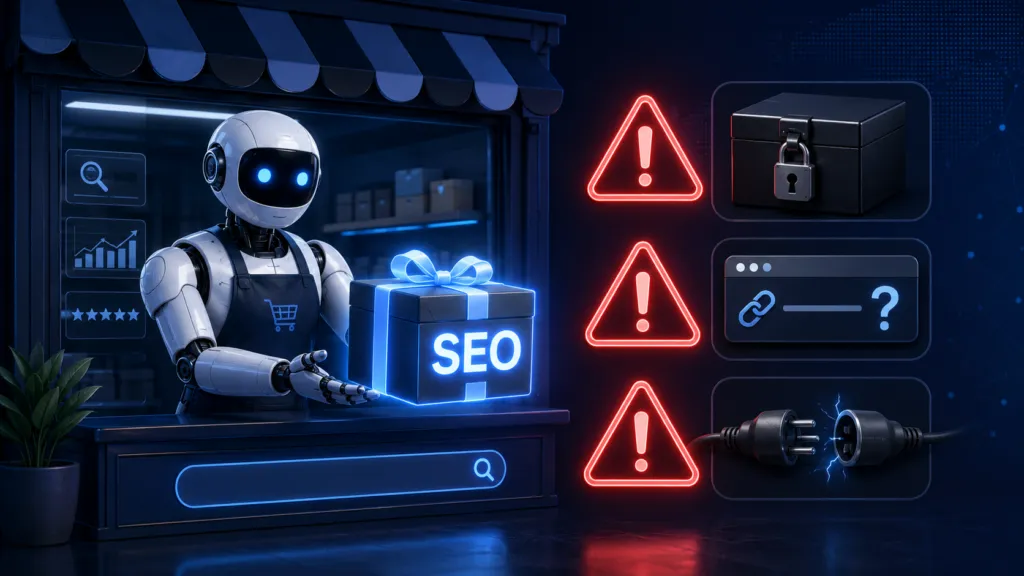
The three clearest signs of an AI SEO scam are easy to check before you pay anyone:
- The provider sells AI SEO as a separate, secret service with no link to regular SEO.
- They can’t show you which pages AI cites when people search for your product.
- They treat the whole thing as a technical install and skip the content work.
At TJ Digital, we track the exact pages ChatGPT, Perplexity, and Google’s AI cite for every client. We started doing that because AI-referred visitors convert at about 8x the rate of traditional search visitors. After 17 years in SEO, that number is why we treat AI search as the main event.
Table of Contents
ToggleWhy AI SEO Attracts So Many Scams
The internet is full of people selling AI SEO services right now. The field is new and moves fast. Most business owners have no easy way to check the work.
That combination makes it simple to sell things that don’t exist.
I’ve done SEO for 17 years, and I now run one of these agencies myself. So I want to hand you the warning signs I see, so you can avoid paying for work that isn’t real. Most of this applies whether someone calls it GEO, AI SEO, or AI optimization.
@tjrobertson52 How to spot an AI SEO scam: if they sell GEO as totally separate from SEO, that’s your first red flag. #GEO #AISEO #SEOtips
♬ original sound – TJ Robertson – TJ Robertson
Does AI SEO Work Differently From Regular SEO?
Not at the foundation. To get recommended by an AI, your business first has to show up in a search engine. AI uses a search engine to find the information it needs to recommend you or one of your competitors.
The real difference is in how AI uses those search engines. A human scans a page of blue links. An AI runs many searches at once, then pulls chunks from the pages it trusts.
So a real AI SEO strategy is built on SEO fundamentals. Google says the same SEO fundamentals that work in search also apply to its AI features.
Anyone selling AI SEO as a totally separate, mysterious product is waving a red flag. For more on why secret AI systems rarely hold up, read our take on no AI optimization experts.
Should Your AI SEO Provider Track AI Citations?
Yes, and this might be the biggest test of all. If a provider can’t tell you which pages AI cites when people search for your product, they can’t really do the work.
When someone types a prompt into an AI, that AI runs a query fan-out. It fires several separate searches, often three to twelve of them.
It then scans a hundred or more results. It cites only a handful in its answer.
Most AI assistants cite only about four sources per answer. If your brand appears more often than competitors on those cited pages, the AI recommends you. If not, it recommends them.
Common queries are a distraction here. Tools like Ahrefs show how often you appear for popular searches. The prompts people type into AI are rarely popular.
You want a tool that tracks the specific prompts that matter for your business. We use Peec.ai to track citations across ChatGPT, Perplexity, and Google’s AI. Profound is another well-known option.
A provider with no citation tracking at all is the clearest warning sign on this list.
Is AI SEO a Technical Fix or a Content Problem?
Mostly content. About 90% of AI SEO comes down to content, both the content on your site and the content on the other pages AI cites. If a campaign isn’t focused on creating or improving content that earns citations, it isn’t really AI SEO.
The research backs this up. Studies on AI visibility found that adding clear structure, statistics, and citations to a page produced the biggest gains. Keyword stuffing made pages less likely to be cited.
Technical work still has a place. Chatbots, schema, and agent integrations can improve your website. They do not get you recommended by an AI on their own.
What Legitimate AI SEO Looks Like
Real AI SEO is transparent and built on SEO. It gets measured by the pages AI cites. The table below sums up the difference between a legitimate provider and a scam.
| What to Check | Legitimate AI SEO | Scam Signal |
| Link to SEO | Built on SEO fundamentals | Sold as a separate “secret” |
| Citation Tracking | Tracks the exact pages AI cites | No citation tracking |
| Main Focus | Creates content that earns citations | Focuses on technical installs and plugins |
| Guarantees | Acknowledges that AI search results change over time | Guarantees a top spot in AI search |
| Transparency | Shows the work, methodology, and supporting data | Makes vague claims about “AI access” |
Transparency is your best protection here. The same warning signs apply to any agency, which we cover in our post on ripping you off.
What to Ask Before You Pay for AI SEO
Before you sign with any AI SEO provider, get clear answers to these questions.
Is AI SEO the same as GEO?
Mostly yes. GEO, or generative engine optimization, is one label for getting recommended by AI, and it runs on the same SEO fundamentals.
Can anyone guarantee AI rankings?
No. AI answers are probabilistic and shift from month to month, so any guaranteed placement in AI results is a warning sign.
How do you track ChatGPT citations?
With tools built for AI search, like Peec.ai or Profound. They monitor the specific prompts you care about and the pages each AI cites.
What is a query fan-out?
It’s when an AI turns one question into several searches, scans many pages, and cites only a few in its answer. Tracking those cited pages is how you measure real progress.
Get an Honest Look at Your AI Visibility
Get a free digital marketing audit from TJ Digital. We’ll show you which pages AI cites for your competitors and where you can win those recommendations.