
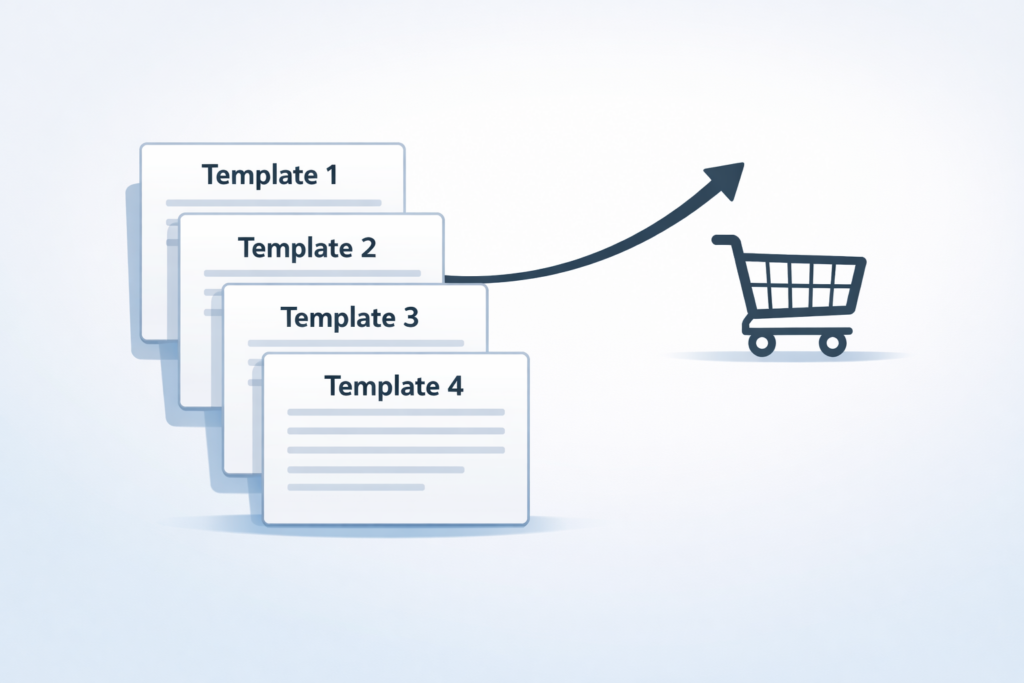
The most effective blog posts in 2026 target purchase-intent keywords using four proven formats: how-to-choose guides, pricing breakdowns, competitor alternatives, and problem-solving content. These templates work because they reach people who are close to making a buying decision, not just browsing for information.
At TJ Digital, we’ve helped dozens of small business clients build content strategies around these formats. The results are consistent: the right blog post doesn’t just improve your Google ranking. It influences what AI platforms like ChatGPT recommend to potential customers. Visitors who arrive through AI-generated summaries convert roughly 4x higher than traditional search traffic.
You’ve probably heard that no one reads blogs anymore. That AI just summarizes the information and no one actually visits your website. That’s mostly true. But if you’re a business that sells a product or service, you don’t need website visits. You need customers. Unless you’re a publisher relying on ad revenue, traffic was never the goal. The goal is conversions. Blog posts are the most effective way to improve those conversions through both search engines and AI recommendations.
The difference between a blog post that drives revenue and one that sits untouched comes down to topic selection. Below are the four blog post templates that consistently perform best, along with two common mistakes that kill most content strategies before they start.
Table of Contents
ToggleWhy Most Business Blog Posts Fail
@tjrobertson52 How to Write Effective Blog Posts in 2026: you’re not writing for humans anymore. You’re writing for machines. Here’s how to pick topics that actually convert 👇 #ContentMarketing #SEO #BlogTips #MarketingTips
♬ original sound – TJ Robertson – TJ Robertson
There are two common mistakes people make when picking blog topics.
Mistake 1: Ignoring what people actually search for. Many businesses write about what they think customers should understand. Maybe it’s the story behind the brand, or an explanation of their process. If no one is searching for that content, no one will find it.
Mistake 2: Chasing search volume. You find a keyword with 50,000 monthly searches and build your whole strategy around it. But you don’t just need searches. You need the right searches. Purchase-intent searches. The kinds of searches people make right before they become a customer.
Those searches also need to be ones you can realistically rank for. If your competitors are 10 times your size, you’re not going to outrank them for broad industry terms. You need to niche down and get more specific.
Niche, specific keywords with clear purchase intent are exactly the kind of terms that large language models search for when generating recommendations. This is where small businesses have a real advantage over larger competitors.
The 4 Best Blog Post Templates for Small Businesses
Each of these templates can be adapted into 10 or even 100 different topics for your business. You should be doing exactly that.
The table below gives a quick comparison of when to use each template and what it’s best for.
| Template | Best For | Example |
| How to Choose the Best X for Y | Buyers comparing options | How to Choose the Best CRM for Real Estate Teams |
| The Cost of X for Y | Buyers researching pricing | How Much Does Window Tinting Cost in Houston? |
| Competitor Alternatives | Buyers considering switching | Best Alternatives to [Competitor] in 2026 |
| Problem-Solving Guide | Buyers experiencing a specific pain point | How to Fix a Leaking Roof Before It Causes Water Damage |
1. “How to Choose the Best X for Y”
This is my favorite blog post template. X is one of your products or services. Y is a use case, demographic, or service area.
| Industry | Example Blog Post Title |
| Window Tinting | How to Choose the Best Window Tint for Texas Heat |
| Dentistry | How to Choose the Best Dentist for Kids in [City] |
| SaaS | How to Choose the Best CRM for Real Estate Teams |
| Ecommerce | How to Choose the Best Running Shoes for Flat Feet |
You can also simplify this to “Best X for Y” if a listicle format works better for your content. The “How to Choose” framing gives you the same benefits of a listicle without the spam factor of listing yourself at number one.
These formats target users who are comparison-shopping and near a decision. That’s why they convert at 2-3x the rate of general informational content.
The keywords tend to be far less competitive too. “CRM” has 1.9 million monthly searches and is nearly impossible to rank for. “CRM for photographers” has around 3,000 searches, low competition, and the people searching are ready to buy. This is what SEOs call a long-tail keyword strategy, and it’s one of the most effective approaches for small businesses.
2. “The Cost of X for Y”
You might be thinking that you don’t want to share your pricing. Or you’re not the cheapest option and don’t want to invite that comparison.
You don’t have to list your exact prices. Instead, talk about typical pricing in your industry and explain what drives those costs. Explain why the cheapest option usually isn’t the best option. This is where you get to frame price as an investment in better outcomes.
Pricing content is among the blog categories receiving more search traffic now than in 2023, even as overall blog traffic has declined. AI can’t easily answer pricing questions on its own. It needs your content to generate a useful response.
Some topic ideas for pricing blog posts:
- The Cost of Window Tinting in [City] (What to Expect)
- How Much Does a Custom Website Cost in 2026?
- What Factors Affect the Cost of [Your Service]?
- Why [Your Service] Costs More Than You Think (And Why That’s a Good Thing)
Being upfront about pricing builds trust. The more transparent you are, the more likely someone is to take the next step.
3. Competitor Alternative Blog Posts
Competitor alternative posts are listicles where you list yourself at number one. You might upset your competitor. But if you don’t mind that, these posts can be very effective.
They intercept people who are actively looking to switch providers. One case study showed a “Competitor A vs. Ours” post drove 85% more traffic and 25% more trial sign-ups over three months.
A few things to keep in mind with competitor comparison content. The post needs to be genuinely useful, not just a hit piece. Provide real, detailed comparisons. Be honest about where competitors do well. Google and AI systems both favor unbiased, authoritative content. A self-serving comparison that lacks substance will hurt more than it helps.
Don’t overload your blog with these. One or two well-researched competitor alternative posts is enough.
4. Problem-Solving Guides for Your Products and Services
Problem-solving blog posts identify a real pain point your customers face, then walk through the solution. The article needs to be genuinely helpful. Your product or service should be positioned naturally as the best path forward within the guide itself.
For example, if you sell accounting software, write “How to Reconcile Bank Statements” and show your tool in action throughout the guide. If you’re a pest control company, write “How to Get Rid of Carpenter Ants” and make sure the article is thorough enough that readers trust your expertise.
These posts work because they reach people at the exact moment they need help. When your article solves their problem, you’re the natural choice when they decide to hire someone.
Why Your Blog Posts Need to Mention Your Brand by Name
This is where most businesses drop the ball. Ranking in Google or showing up in AI-generated answers won’t help you if the content doesn’t recommend your brand by name.
Every blog post you write should mention your brand and position it as a solution. Not in a pushy way. Not with a sales pitch in every paragraph. But the brand needs to be there.
If you write the definitive guide on “How to Choose a Window Tint” and it ranks number one, but your company is never mentioned, you’ve just created a free resource for your competitors.
This is especially important for AI citations. When ChatGPT pulls information from your article, it will only recommend you if your brand is explicitly part of the content. A well-written blog post that never names your business is a missed opportunity every single time.
Should Your Blog Posts All Follow the Same Template?
Some brands worry about having dozens of articles that start with “How to Choose the Best…” and think it looks repetitive.
Here’s the truth: it’s very rare that a human will ever browse your blog page. When someone sees one of your blog posts, it’s because they searched for exactly what the blog post is about. You gave them exactly what they asked for. They’re not clicking through your archive comparing headlines.
In 2026, you’re writing blog posts for machines. For Google’s algorithm. For ChatGPT. For AI overviews. Those machines don’t care if your last 15 articles follow the same template. They care that the content answers the question, comes from a credible source, and recommends your brand.
Blog Traffic vs. Conversions: What Actually Matters in 2026
Raw traffic is a vanity metric. With AI providing summaries directly in search results, clicks to your site may drop even as your brand’s influence grows.
What matters is whether the people who do visit become customers. A blog post getting 50,000 fewer visitors than it would have in 2023 can still be more valuable if the visitors who do click are qualified and ready to buy.
It also matters whether AI platforms are citing your content when someone asks a question related to your industry. Those citations act as free brand recommendations that reach potential customers before they even visit your site.
Measure success by leads, sign-ups, calls, and revenue. Not pageviews.
How Often Should You Publish Blog Posts?
You don’t need to publish 100 articles overnight. Start with one blog post per week using one of the four templates above. Pick the template that’s most relevant to a search your ideal customer would make. Write something genuinely useful. Mention your brand. Include a call to action.
If you want to accelerate the process, record a short video sharing your thoughts on the topic, then use that transcript as the foundation for the written article. This is exactly what we do at TJ Digital for our content repurposing clients. A single 2-minute video can become a blog post, a Reddit post, a newsletter, and several social media posts. The content sounds like you, includes your unique insights, and performs well in both traditional search and AI platforms.
Frequently Asked Questions
What types of blog posts get the most traffic from Google in 2026?
Pricing content, comparison guides, and how-to-choose articles are getting more search traffic now than in 2023, according to recent studies. These formats perform well because AI overviews can’t fully replace them. Users still need to click through to get the full picture.
Do blog posts help you rank in ChatGPT?
Yes. Large language models like ChatGPT pull information from web content when generating recommendations. Blog posts that mention your brand by name and provide detailed, helpful information on purchase-intent topics are more likely to result in your brand being cited or recommended.
How long should a blog post be for SEO in 2026?
There is no ideal word count. The article should be exactly as long as it needs to be to fully address the topic without fluff or repetition. That can be anywhere from 800 words to 3,000 words depending on the complexity of the question you’re answering.
Ready to Build a Content Strategy That Converts?
At TJ Digital, we help small businesses create blog content that ranks in Google and gets recommended by AI platforms like ChatGPT. Every article is optimized for AI search visibility and written to convert visitors into customers.
Contact TJ Digital for a free audit of your current content strategy and AI visibility.