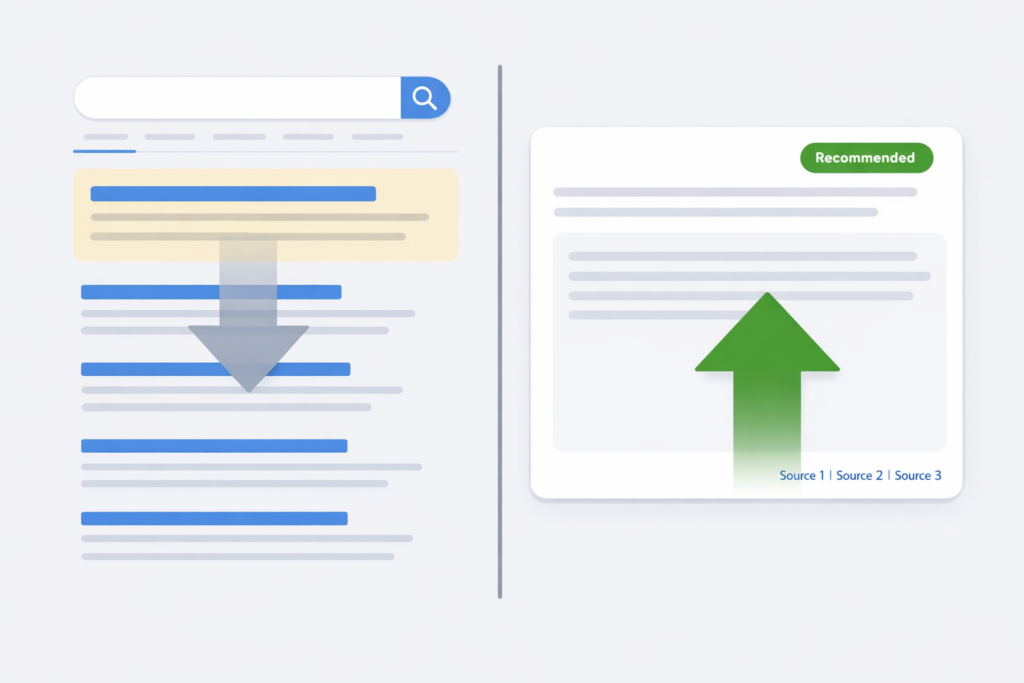
For most businesses right now, being recommended in Google’s AI overview is about as valuable as ranking number one organically. That’s the honest assessment after tracking this shift across roughly 40 brands at TJ Digital, where AI SEO is now the primary focus of every campaign we run. The data is pointing in one direction, and it has been for a while.
We’ve crossed what I think of as the halfway point: roughly 50% of Google searches now trigger an AI overview at the top of the results page. That number is still climbing. So the question isn’t really whether AI visibility matters. It’s whether it matters more than traditional rankings yet, and what to actually do about it.
Table of Contents
ToggleHow Many Google Searches Now Show an AI Overview?
When half of searches surface an AI overview, the traffic pool effectively splits. The classic #1 organic result captures clicks from the queries where no AI box appears. But for the other half, the AI recommendation is the first thing users see, often the only thing they need.
McKinsey estimates that roughly 50% of Google searches already include AI summaries, with projections exceeding 75% by 2028. Google has also rolled out AI Mode, which can replace the traditional SERP entirely for many query types.
For businesses that built their lead flow on organic rankings, this is a structural change, not a temporary blip.
Why AI Visitors Are Worth More Per Click
@tjrobertson52 Half of Google searches now show an AI overview. Being recommended there is about as valuable as ranking 1 organically — and AI visits convert 4-20x better. Which would you choose? #SEO #AISearch #GoogleAI #DigitalMarketing
♬ original sound – TJ Robertson – TJ Robertson
The most important thing to understand about AI-referred traffic is how it converts. People who click through from an AI summary have already read a synthesized answer. The AI compared options, mentioned your brand, and that person decided to learn more. They arrive pre-qualified in a way that organic visitors almost never do.
Semrush’s research found that the average AI search visitor converts at 4.4x the rate of the average organic visitor. Seer Interactive found ChatGPT referrals converting at 15.9% compared to 1.76% for comparable Google organic queries. In B2B and services, some are reporting AI traffic converting 3 to 4 times better than traditional SEO.
Ahrefs reported that AI clicks, which represented just 0.5% of their sessions, drove 12.1% of signups, a 23x conversion lift over organic. Even a trickle of AI-referred traffic can generate more business than a much larger volume of organic clicks.
How AI Overviews Drive Branded Search (Even Without Clicks)
Most people who see your brand in an AI overview won’t click through to your website. But a meaningful portion of them will search for your brand name later. That’s a visit that shows up as a branded organic search or direct traffic, with no trace of the AI overview that prompted it.
Industry data suggests branded search volume can spike to 3 to 5 times the AI referral click volume in the weeks following a citation surge. One case study reported a 40% jump in demo requests from pages that started appearing in AI overviews, most of that showing up in direct or branded organic channels.
This is one reason the true value of AI visibility is systematically undercounted. Standard analytics tools don’t connect the AI mention to the brand search that happened ten days later.
What’s Happening to Organic CTR
AI overviews aren’t just competing for attention. They’re measurably eating into organic click-through rates.
Seer Interactive’s analysis of data from January through September 2025 found that average organic CTR for queries with an AI overview dropped from about 1.41% to 0.64%. For brands not cited in the AI answer, that number fell further to around 0.52%. Compare that to the roughly 1.45% CTR for the same types of queries with no AI box present.
Organic is not dead. It still accounts for the majority of sessions. But the value of a #1 ranking is compressing, and it will keep compressing as AI overview coverage expands.
| Scenario | Average Organic CTR |
| Query with no AI overview | ~1.45% |
| Query with AI overview, brand cited | ~0.70% |
| Query with AI overview, brand not cited | ~0.52% |
| Baseline (before AI rollout) | ~1.41% |
Source: Seer Interactive, September 2025
Being cited in the AI answer cushions the drop. Cited brands see roughly 35% more organic clicks than uncited brands on the same queries. The citation itself signals authority, and users who recognize your brand are more likely to click the organic link below.
AI Recommendation vs. Ranking #1: How They Compare
| Factor | Ranking #1 Organically | Being Cited in AI Overview |
| Click volume | Higher | Lower |
| Conversion rate | Baseline | 4x to 20x higher |
| Branded search lift | Minimal | 3x to 5x referral volume |
| Measurability | Easy (Google Search Console) | Difficult (mostly indirect signals) |
| User trust | Moderate | High (feels like a recommendation) |
| Coverage (% of queries) | Declining | Growing (~50% of searches) |
For most businesses, the right answer is to compete in both channels. But if I had to pick one for a client starting from zero, the trajectory of this trend makes AI visibility the higher-priority investment.
How to Track AI Visibility When There’s No Direct Click
Since most AI overview impressions never produce a trackable click, you need indirect signals to measure impact. Here’s the approach we use:
Branded search tracking. Monitor Google Search Console for increases in brand-name queries after publishing or updating content. A meaningful uptick in branded searches 1 to 2 weeks after a content push is often a sign of AI-driven awareness, not organic discovery.
GA4 AI referral segments. Create custom segments in GA4 for known AI sources: chat.openai.com, gemini.google.com, perplexity.ai, and others. These sessions are small in volume but high in intent. Track conversion rates separately.
Direct traffic anomalies. When a page starts appearing in AI overviews, direct sessions often climb. Users copy or type the URL they saw in an AI answer. Page-level direct traffic spikes can reveal AI exposure that no referral tag would capture.
Conversion rate changes on cited pages. If a specific page starts getting recommended by AI tools and its form fill or demo request rate jumps, that’s a measurable signal even if the referral source is ambiguous.
Should You Prioritize AI SEO or Traditional SEO?
The fundamentals that make a page rank well in Google still largely apply to AI recommendations. Quality content, authoritative sources, good technical structure. But there are a few additional layers worth understanding if AI visibility is the goal.
I covered the full strategy side of this in a separate post on how to optimize for AI search. The short version: AI systems favor content that’s structured for direct extraction, written by recognizable entities, and cited by other trusted sources.
Traditional SEO isn’t going away. Organic still drives the bulk of sessions, and brand discoverability in classic results still matters. But any strategy that’s purely focused on blue links and ignores AI recommendations is working with half the map.
Frequently Asked Questions
Is traditional SEO still worth investing in if AI overviews are taking over? Yes. Organic still accounts for the majority of sessions, and classic rankings matter for the roughly half of queries that don’t trigger an AI overview. The goal is to compete in both channels, with AI visibility becoming a higher priority as that share continues to grow.
How do I know if my brand is being recommended in AI overviews? Search your main keywords directly in Google, ChatGPT, Perplexity, and Gemini. Look for brand mentions in the generated answers. There are also emerging SEO tools that track AI citation frequency, though manual checks are still a reliable baseline.
Do AI overviews hurt organic traffic even if you rank #1? Yes. Data from Seer Interactive shows organic CTR drops significantly when an AI overview is present, even for top-ranked pages. The degree of impact depends on whether your brand is cited in the AI answer.
Is AI traffic worth pursuing if the volume is still small? The volume is small, but the conversion rate more than compensates. Ahrefs found that 0.5% of sessions from AI sources drove 12.1% of signups. For most businesses, even a small increase in AI referrals is a meaningful revenue driver.
Ready to Show Up in AI Results?
At TJ Digital, we track AI visibility across dozens of brands and build strategies around both traditional SEO and AI optimization. If you want to know where you stand right now, we offer a free digital marketing audit with no obligation. We’ll look at your current search presence and tell you exactly where the opportunity is.