
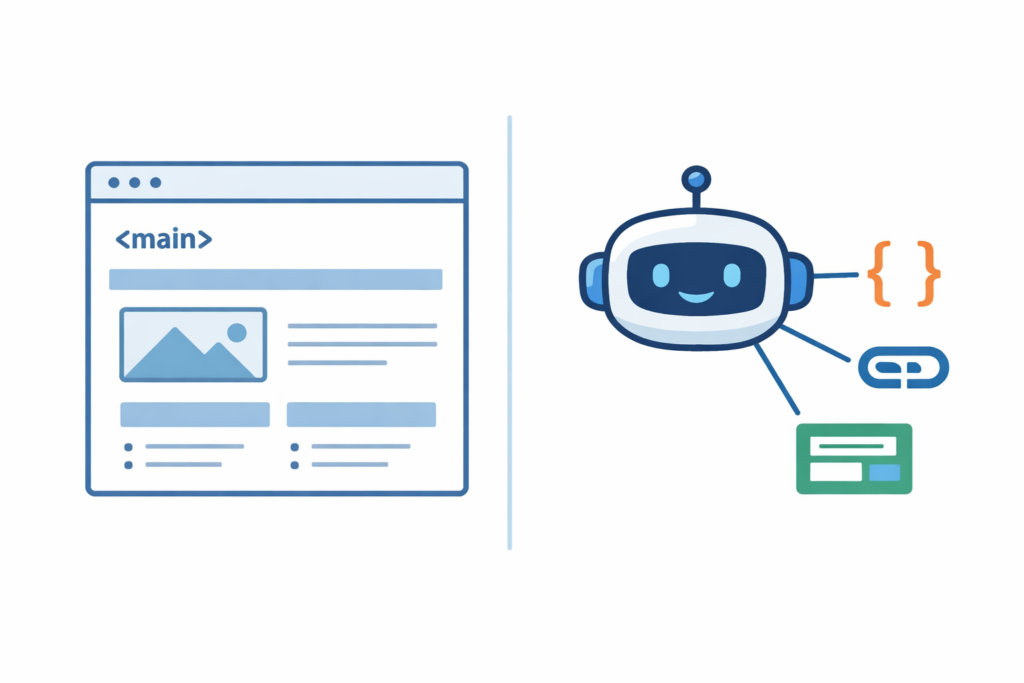
To prepare your website for AI agents, you need to do four things: add structured data markup so AI can identify your content, ensure critical information is in server-rendered HTML rather than JavaScript, organize your pages with clear internal linking, and build transaction flows (forms, booking, checkout) that AI can interact with directly.
At TJ Digital, we help small and medium-sized businesses with AI optimization, and this is the foundation we start with for every client. Website visits from human users are already falling as AI handles more research on their behalf, and LLMs already convert users to customers at roughly 8 times the rate of traditional search engines. The businesses that structure their sites for AI now will have a real head start.
Table of Contents
ToggleWhy Fewer Humans Are Visiting Your Website (And Who’s Replacing Them)
@tjrobertson52 Most software won’t be made for humans in 2 years. Your website included. If AI can’t do business with you, it’ll use your competitor instead 😬 #AIWebsite #WebStrategy #FutureOfBusiness #WebDesign
♬ original sound – TJ Robertson – TJ Robertson
The history of computing is a story of abstraction. Machine code gave way to human-readable code. The command line gave way to modern operating systems. Most people today use a computer without any awareness of what is happening underneath.
The same shift is underway with software. AI is starting to abstract away the software layer entirely.
Think about research. A few years ago, if you wanted to look something up, you would run several Google searches and click through a dozen pages. Now, most people just ask an AI. Studies show over 60% of Google queries are now answered directly by AI summaries or panels, without the user visiting any website.
The same thing is happening with tools like Photoshop and PowerPoint. AI handles that work for most people now, and the trend only goes in one direction.
My prediction: within one to two years, most software will be built for AI to use, not humans. Websites will not disappear, but fewer and fewer humans will be the ones actually visiting them. AI agents will be the primary users of your site.
What AI Agents Need From Your Website
Think of your website as a database. The question is whether yours is organized well enough for AI to use it.
Here is how to think about it practically:
Is all the information about your business actually on your website?
As someone who reviews business websites daily, I can say with confidence that the answer is almost always no. Most business websites are built for the average human visitor, who will look at two pages and read maybe 400 words total. That has been fine until now.
AI will read everything. Every page, every service description, every FAQ. If the information is not there, or if it is buried and disorganized, the AI either misses it or cannot use it.
Can AI complete a transaction on your website?
This is the bigger issue. Web MCP (Model Context Protocol) is emerging as the standard for AI-to-website interaction. Instead of an AI visually interpreting your site like a human would, WebMCP lets AI agents interact with your forms and functions directly, treating them like callable tools rather than pixels.
If an AI agent cannot easily book an appointment, request a quote, or make a purchase through your site, it will move on. In many cases, that means it goes to a competitor who made things easier.
Practical Steps to Make Your Website AI-Ready
Add Structured Data Markup
Schema.org and JSON-LD markup tell AI exactly what each piece of content is. A product page with proper schema labeling the product name, price, features, and reviews is far more useful to an AI agent than a page with the same information written in unformatted paragraphs.
At minimum, you should have markup for:
- Your organization (name, contact info, service area)
- Your services or products
- Reviews and FAQs
- Any location-specific information
Use Semantic HTML Throughout
AI crawlers do not render JavaScript the way a browser does. If critical information (pricing, contact details, service descriptions) is only loaded via client-side scripts, many AI systems will never see it. That content needs to be in the initial server-rendered HTML.
Beyond that, use proper heading structure (H1, H2, H3), semantic tags like <article>, <nav>, <main>, and descriptive alt text on all images. These cues help AI parsers understand your page structure and what each section is about.
Keep Your Content Organized and Linked
A small, well-organized website will outperform a large, disorganized one in AI results. AI systems build a map of what your site is about based on how topics connect to each other. Clear internal linking between related pages signals those relationships.
This is something we cover in detail in our guide to AI SEO for small businesses and it is also something we do as part of our AI SEO service at TJ Digital because it compounds quickly. Every well-linked page makes the surrounding pages more visible.
Consider an llms.txt File
This is relatively new, but worth doing now. An llms.txt file is a plain-text summary of your most important pages, formatted in Markdown and placed at your site root. It acts as a shortcut for AI models with limited context windows, pointing them directly to your best content rather than making them crawl through menus and navigation.
Think of it as a sitemap, but designed for language models instead of search crawlers.
Prepare Your Transaction Flows for AI
OpenAI’s Instant Checkout and the Agentic Commerce Protocol already allow AI to complete purchases inside ChatGPT, with Stripe handling the payment. Google’s WebMCP is building toward the same thing for any website.
If your booking forms, contact forms, or checkout flows are not structured in a way that AI can parse and interact with, you are creating friction at the exact moment a customer is ready to act.
Human Visits vs. AI Agent Interactions: What Changes
| Factor | Human Visitors (Today) | AI Agent Interactions (Emerging) |
| Pages viewed per session | 2-3 | All relevant pages |
| Content consumed | Skims headlines, reads selectively | Reads everything |
| Form completion | Manual, requires motivation | Automated, if forms are AI-accessible |
| Decision to contact | Based on design and copy | Based on structured data and completeness |
| What hurts you | Slow load times, bad UX | Missing info, unstructured data, JS-only content |
| Standard to support | SEO best practices | Schema markup, WebMCP, semantic HTML |
What This Means for Your SEO Strategy
Gartner predicts that by 2027 there will be more AI agents than people accessing digital services. That is not far away.
The businesses that are going to do well in that environment are the ones whose websites are already functioning as well-organized information systems. Not just pretty interfaces for human visitors.
This does not mean ignoring traditional SEO. Most of what helps you rank in Google today still helps. It means layering on top of that foundation: structured data, complete information, clean HTML, and eventually MCP-compatible transaction flows.
Your website still matters. Its job is just shifting from a destination for human visitors to a data source for AI agents.
Frequently Asked Questions
Do I need to rebuild my website to make it AI-ready?
Not necessarily. In many cases, adding structured data markup, improving internal linking, and ensuring content is in server-rendered HTML is enough to make a meaningful difference. A full rebuild is only warranted if your site has serious structural problems.
What is WebMCP and do I need it now?
WebMCP is Google’s emerging standard for letting AI agents interact directly with website functions, like forms and booking systems. It is still rolling out. You do not need to implement it today, but you should be aware of it and start building forms that are clean and structured so the transition is easy when the time comes.
What is an llms.txt file?
It is a plain-text file placed at the root of your website that summarizes your most important pages in a format designed for language models. It helps AI assistants quickly find your best content when answering questions about your business or industry.
Is AI optimization different from traditional SEO?
They are closely connected. Clean HTML, good content structure, and comprehensive information help both search engines and AI agents. Structured data markup is the main addition specifically for AI. Think of AI optimization as SEO with a few extra layers.
Get a Free Audit of Your Website
If you want to know specifically where your website stands from an AI optimization perspective, I do free audits for businesses with a marketing budget of $750 or more per month. No obligation. I will review your site and put together a video and document showing exactly what I would prioritize. Request your free audit here.