Recommendation building is the process of getting your brand mentioned in the articles that AI search engines already trust and cite. It is the closest thing to a direct replacement for traditional link building, and for most businesses, it is more effective.
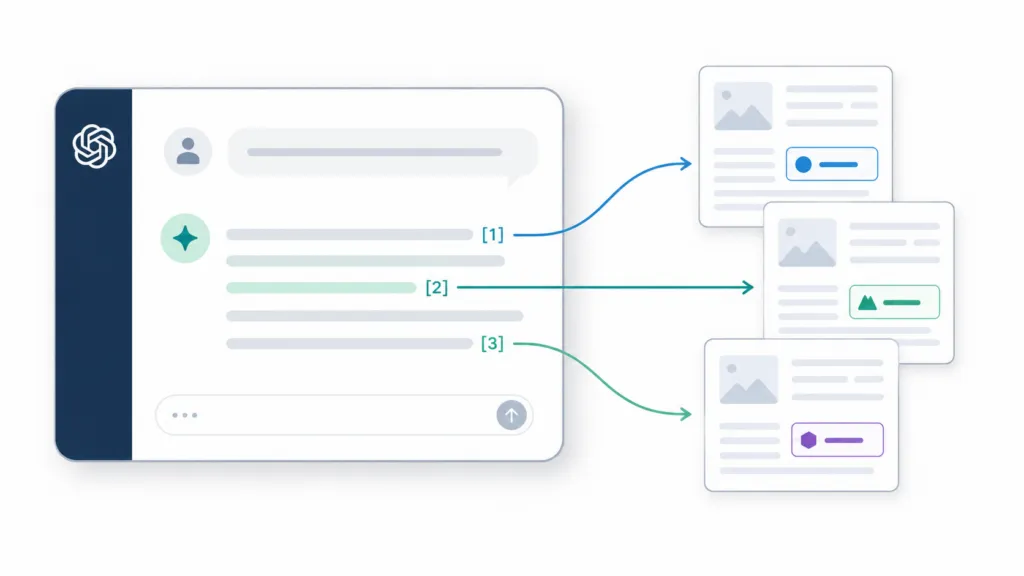
Here’s how it works. When someone types a query into ChatGPT or Google’s AI Mode, the model runs a series of searches in a traditional search engine, sorts through hundreds of pages, and cites a handful of them.
Whichever brands are recommended most often in those cited pages will almost always be the brands recommended in the final output. The entire game is making sure your brand shows up in those pages.
At TJ Digital, about half the work we do for clients is writing the kinds of articles that get cited by AI search. But the other half is identifying the articles AI already trusts and getting our clients mentioned in them.
We track over 1,500 prompts across 30 industries specifically to understand what drives AI citations. The pattern is consistent. Brands that show up in trusted third-party content get recommended more.
Table of Contents
ToggleHow AI Search Decides Which Brands to Recommend
The recommendation process in AI search is surprisingly straightforward. A user asks a question. The AI model breaks that question into multiple sub-searches, pulls results from traditional search engines, and then synthesizes an answer from the pages it finds most relevant.
The pages AI cites most often are blogs, articles, and listicles. These are the “source layer” that AI relies on before forming its response. If your brand is mentioned and recommended in several of those source pages, the AI is very likely to recommend you in its final answer.
In traditional search, a user clicks one of the top results and lands on your site. In AI search, the user may never visit any of the cited pages.
But the AI still uses those pages to decide who to recommend. A cited source might never get a click, yet it still shapes which brands the AI trusts.
That is why being cited by a trusted page gives you two things at once. You get traditional backlink value and direct influence on AI recommendations.
@tjrobertson52 AI search recommends whatever the articles it cites recommend. Are you in those articles? 👀 #AISEO #SEO2025 #SearchMarketing #ChatGPT
♬ original sound – TJ Robertson – TJ Robertson
How to Find the Articles AI Search Cites Most
First, you need a way to identify the articles that are most often cited when people ask about the types of products or services your business offers.
You can do this manually. Go to Google’s AI Mode and ChatGPT, type in the kinds of questions your potential customers would ask, and look at which sources the model cites. But manual tracking gets tedious fast, and you really want software.
The software we use is called Peec.ai. It tracks which pages and domains AI models cite most frequently across ChatGPT, Google AI, Gemini, and Perplexity. You can see how often your brand (and your competitors) get mentioned, and more importantly, you can see the specific articles that are driving those mentions.
Once you gather the top 100 to 1,000 articles being cited for your industry, you have a target list to work with.
How to Filter Your Outreach Target List
Not every cited article is worth reaching out to. Some will belong to direct competitors. Some will be from massive publications that won’t respond to a small business pitch.
You need a way to separate the high-potential targets from the noise.
We built a Claude skill that handles this automatically. It filters out direct competitors, removes brands that are too large to reach out to directly, and organizes the remaining articles by priority. You could also use ChatGPT or another AI tool to scan a spreadsheet of URLs and flag the ones that clearly belong to competitors or enterprise sites.
The goal is a manageable shortlist of publishers where your outreach has a realistic chance of earning a mention.
| Filter Criteria | What Gets Removed | What Stays |
| Direct competitors | Articles published by businesses selling the same thing you do | Articles from neutral publishers, bloggers, and industry sites |
| Enterprise sites | Pages from major corporations unlikely to respond | Niche publishers, smaller media, independent blogs |
| Topical relevance | Articles unrelated to your products or services | Articles closely aligned with what your customers search for |
| Citation frequency | One-off citations with low AI trust signals | Articles cited repeatedly across multiple AI models |
How to Find Contact Information for Article Publishers
Once you have your filtered list, you need to find the right person to email at each publication.
We have a Claude skill for this as well, although to be honest, I think ChatGPT’s Codex would probably do a slightly better job at this particular step. AI tools can scan a publisher’s website for author pages, staff directories, and contact forms, then compile email addresses into your outreach spreadsheet.
Services like Hunter.io and Snov.io can also surface email addresses for a given domain. The key is to find the actual author or editor of the article you want to be placed in, not a generic info@ address.
What to Say in Your Outreach Emails
Each email needs to accomplish three things:
- Reference the specific article you want to be mentioned in
- Explain why your brand would be a valuable addition for their readers
- Offer something in return
The “something in return” is typically one of two options. You can pay for placement, or you can offer a reciprocal mention in an article on your own website. We have a Claude skill that drafts these emails, and because Claude is connected to each client’s Brand Ambassador (our knowledge base system), it can even recommend specific articles on the client’s site where the reciprocal mention could go.
The reciprocal mention approach works well because it provides real value to both sides. You mention their brand in a relevant article on your site, and they mention yours. When done with genuine topical relevance, these placements strengthen authority for both parties.
Why You Should Never Send Outreach From Your Main Email
You do not want to send outreach emails from your primary business email. Cold emails risk spam complaints, and if your main domain gets flagged, all your regular business emails could start landing in spam.
Use a separate sending domain (something like yourbrand-outreach.com) with proper SPF, DKIM, and DMARC authentication. Platforms like Mailforge handle the setup, including DNS records and mailbox creation. You also need to warm up the new mailboxes gradually over several weeks before sending at volume.
This is a step a lot of people skip, and it kills their response rates before they even get started.
What Kind of Response Rate Should You Expect?
When you do this the right way, you can expect a response rate of about 5%.
That sounds terrible. But here’s the thing. For the average business, each of these placements is easily worth $1,000 or more.
In most cases, you can get both a link and a recommendation in the same placement. So you get the traditional SEO value of a backlink from a trusted domain, plus you’re getting placed on a page that AI has already told you it trusts. That is a combination traditional link building almost never delivers.
Unlike traditional link building, you are only reaching out to pages that Google or ChatGPT has already confirmed it relies on. So the placements tend to be very high quality.
Why AI Search Citations Are Worth More Than Traditional Backlinks
Traditional backlinks help you rank higher in Google. AI search citations do that and more.
When ChatGPT or Google’s AI Mode cites a page that mentions your brand, you gain credibility in the model’s “source layer.” Even if nobody clicks through to your site from that page, the AI has already used it to form its recommendation. Your brand ends up in the answer itself.
| Traditional Backlinks | AI Search Citations | |
| SEO ranking benefit | Yes | Yes |
| Influences AI recommendations | Indirectly | Directly |
| Targets verified trusted pages | Sometimes | Always (you start with what AI cites) |
| Gets your brand into AI answers | Rarely | Often |
| Typical cost per placement | Varies widely | Often $0 if reciprocal, or paid placement |
Each high-quality page that cites your brand gives you link equity plus a stamp of AI approval. That is a 2-for-1 that traditional link building cannot match.
How This Compares to Writing Your Own Content
The easiest way to get your brand recommended in an article is to write the article yourself. That is why about 50% of the work we do at our agency is producing content designed to get cited by AI search.
But there is a ceiling to what your own content can do. You can only publish on your own site and a handful of platforms. The articles that AI trusts most are spread across hundreds of independent publishers, bloggers, and industry sites.
A Search Engine Land analysis found that brands appearing consistently across trusted third-party platforms are more likely to be cited. If you can get mentioned in even a fraction of those, the impact on your AI visibility compounds fast.
The smartest approach is both. Write your own content optimized for AI search and run recommendation building campaigns to get placed in the articles that are already being cited.
How to Get Started With Recommendation Building
If you want to try this yourself, here is the process in summary.
- Identify cited articles. Use Peec.ai or manually check which articles AI models cite when answering questions about your industry.
- Filter the list. Remove competitors, unreachable enterprise sites, and irrelevant pages. Prioritize by citation frequency and topical fit.
- Find contacts. Use AI tools or services like Hunter.io to find the author or editor of each target article.
- Draft personalized outreach. Reference the specific article. Offer to pay for placement or provide a reciprocal mention.
- Send from a separate domain. Set up a dedicated outreach domain with proper email authentication. Warm it up before sending at volume.
- Track responses and placements. Monitor your AI search visibility after placements go live. You should see results within days, not months.
That last point is one of the most exciting things about recommendation building. Unlike traditional SEO, where you might wait three to six months to see movement, getting your brand mentioned in these cited articles can move your AI visibility within a day.
Talk to TJ Digital About AI Search Visibility
We handle the entire recommendation building process for our clients, from identifying cited articles to drafting outreach to tracking the results. If you want help getting your brand recommended by AI search, reach out to us and we will walk you through how it works for your industry.