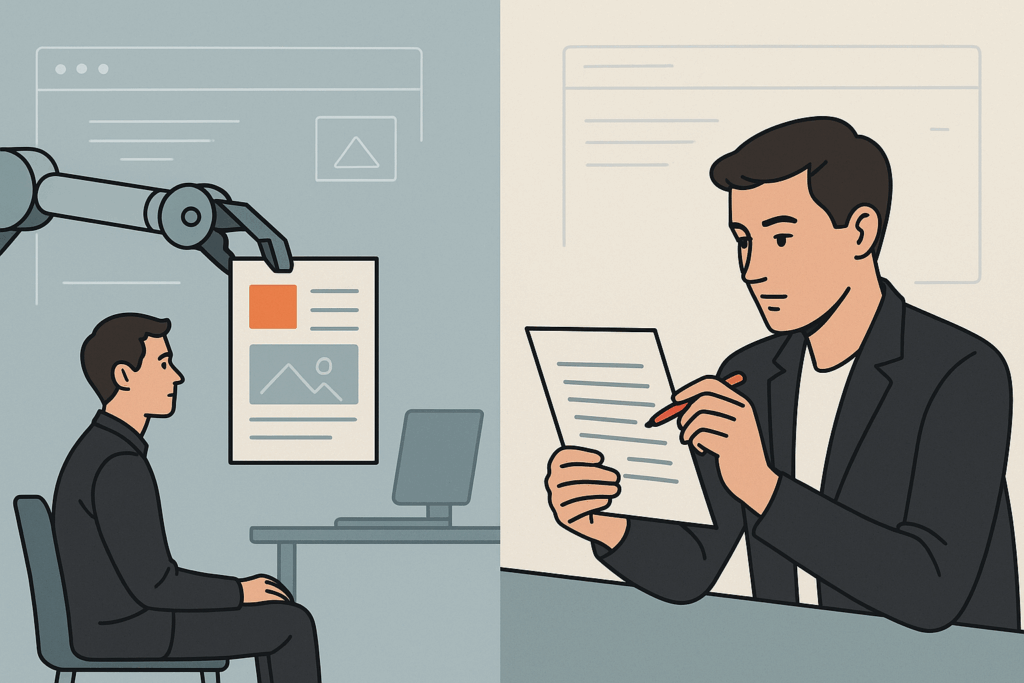
AI is transforming entry-level white-collar jobs, but it’s not simply eliminating them. AI can already match or exceed the average entry-level worker at tasks like graphic design, copywriting, software development, and marketing strategy. However, AI can’t yet handle the context awareness and autonomous decision-making required to fully replace human workers. Instead, the nature of these jobs is shifting. Entry-level employees are becoming quality controllers and curators of AI-generated work rather than sole creators. The value they provide has moved from execution skills to judgment and taste.
This is exactly what I’m seeing as I hire for my digital marketing agency right now.
Table of Contents
ToggleAI Already Matches Entry-Level Performance in Many Fields
There’s no shortage of examples where AI performs as well as or better than the average entry-level person at specific tasks. AI tools can generate polished visuals from simple prompts, speeding up prototypes and automating routine design work. For copywriting, AI can produce grammatically correct drafts and generate ideas at scale.
The same pattern holds across white-collar work. AI handles data gathering, basic coding tasks, and routine analysis. Junior analysts have shifted from gathering data to checking the data that AI gathers.
But here’s what’s important: AI isn’t as good as top performers in these fields yet. There’s still plenty of room for experts. And even more importantly, AI can’t actually take over these jobs entirely. You can’t just fire your graphic designer and replace them with an AI. There are still certain things you need a human to do that AI can’t yet handle.
@tjrobertson52 What Jobs Will AI Replace in Digital Marketing – here’s what I’m seeing as an agency owner actively hiring 👀 #AIjobs marketing #careeradvice #digitalmarketing #marketingagency #businesstips #aijobsecurity
♬ original sound – TJ Robertson – TJ Robertson
What AI Still Can’t Do
AI has critical limitations that prevent it from working autonomously. It can’t understand large amounts of context or work independently for extended periods. AI systems recognize patterns in data but don’t comprehend meaning. They can confidently produce plausible-sounding text or solutions that are completely wrong (hallucinations).
Large language models can invent facts. In one study of legal AI tools, popular platforms produced incorrect answers between 17-33% of the time. Even GPT-4 degrades after about 16,000 tokens of input, with important details getting lost in longer documents.
That’s why experts stress that AI without human oversight is a liability, not innovation.
How Hiring for Entry-Level Positions Has Changed
A few years ago, when I needed to hire an entry-level copywriter, I wanted someone with significant copywriting experience. If I needed someone for graphic design, they had to have a design portfolio. Now I’m talking about entry-level positions where all their work gets reviewed by me or another expert.
Today, when I hire for these positions, I create an SOP where the AI does the actual work. The person I’m hiring follows the SOP, gives the task to AI, and then reviews the AI’s output.
When I explain it like that, it sounds like I could slot any human into that role. That’s not the case. Good judgment, or in creative work, good taste, is incredibly important. What’s much less important now is the actual skills and knowledge to do the task.
I’m still hiring for entry-level positions. I’m just not hiring people who are trained for the specific task I’m giving them. And more importantly, they’re able to output far more work than they would have a few years ago because of AI.
Two Different Approaches to AI in Agencies
I’m not hiring any less than I would have a few years ago. We’re just doing a lot more work. We’ve at least tripled the amount of deliverables we give our clients for the same rate.
Other agencies are taking a different approach. The agency I left to start this one, for example, stopped hiring because they realized they could do the same amount of work with fewer people. A recent eMarketer report found 91% of senior agency executives expect AI to reduce headcount, and over half of agencies have already slowed or paused entry-level hiring.
The agencies focusing on cutting costs may shrink junior roles hoping for higher margins. But experts warn this can backfire by eroding the creativity, expertise, and human oversight that clients pay for. If you strip out too many people, you lose the fresh ideas and personal touch that clients value.
Meanwhile, agencies that maintain their teams and use AI to boost productivity can dramatically increase output. One firm reported serving 105 active clients nationwide with no compromise in service quality thanks to AI automation. Another achieved a 70% reduction in manual workload, freeing time for strategy and growth.
Can AI Fully Replace Graphic Designers and Copywriters?
Not entirely. In creative fields, AI can generate quality work faster than many beginners, but it lacks true creativity, context-awareness, and strategic vision.
For graphic design, human designers still provide essential value in storytelling, brand alignment, and emotional nuance. Experienced designers translate vague ideas into compelling visuals that align with user needs and brand identity. The creativity, empathy, and judgment required to make designs truly effective still belong to people.
Similarly, AI copywriters miss the subtlety of human insight. For high-stakes copy where you’re spending significant money on advertising, the copy needs to be exceptional, requiring strategic thinking, creative breakthrough, and audience understanding that human writers provide. AI-only content risks feeling generic, occasionally inaccurate, or missing emotional resonance.
The solution is a hybrid workflow. AI tools handle bulk generation (outlines, multiple drafts, or variants), then human experts edit and add context, brand voice, and creative flair. A team might use an AI writing tool to draft 20 blog posts, after which human editors review each draft, fact-check claims, add specific examples from their industry experience, inject brand personality, and refine the messaging.
Why “Taste” is Becoming More Important Than “Skills”
As AI makes technical execution easier, curation skills are rising in value. With polished content just a prompt away, the bottleneck shifts to knowing what’s actually good.
As it becomes easier to produce polished content, taste – the human eye for what is good, fresh, or interesting – becomes the key differentiator. The raw skill of generating work is no longer rare. AI handles that. What remains rare is the ability to recognize quality and elevate output beyond the AI baseline.
Only work that significantly exceeds what AI can produce, in both quality and originality, will stand out and justify a premium. Employers now prize candidates who can discern great ideas and refine AI’s suggestions into something exceptional.
When anyone can crank out competent work, the ability to judge and steer that work is what makes a candidate stand out. Hiring is shifting from “Can you make this?” to “Can you recognize and refine the best possible result?”
How Has AI Changed the Skills Required for Entry-Level Jobs?
AI has shifted hiring priorities from pure execution skills like coding or manual design to human qualities. Companies now emphasize AI fluency and soft skills over specialized technical chops.
Success in an AI-driven workplace requires “human-AI fluency” – the ability to work with smart systems, question their outputs, and keep learning rather than just raw coding ability. The biggest challenge isn’t writing code but having good judgment to spot AI’s mistakes.
In many fields, entry-level roles now demand more experience because AI handles the basic tasks. Hiring criteria now favor adaptability, communication, and critical thinking. The focus is on prompting and curating AI tools, understanding domain context, and spotting errors rather than solely on hands-on execution.
Key Skill Shifts
AI Literacy: Knowing how to operate and prompt AI tools effectively.
Critical Judgment: Evaluating AI output for accuracy and quality, since AI just recognizes patterns without true comprehension.
Creativity and Domain Knowledge: Offering insight, nuance, and context beyond AI’s reach.
Soft Skills: Communication, collaboration, and problem-solving, which underpin how people use new tools and learn in changing roles.
One survey found many firms are still hiring for yesterday’s résumés, while tomorrow’s work demands fluency in AI. Entry-level candidates need to show they can augment AI through taste, insight, and judgment more than they can execute tasks manually.
How to Stay Employable in an AI-First Job Market
Work with AI tools, not against them. Early-career workers report staying ahead by developing technical and non-technical skills and upskilling with professional qualifications to prepare for AI changes.
Staying employable means mastering AI-assisted workflows and maintaining a critical eye. Learn to craft effective prompts and then rigorously verify the results. Even as AI cuts down on routine drafting, workers still have to confirm whether the task is done properly or the information is correct. That extra step of checking and editing adds lasting value.
Invest in the human strengths AI can’t replicate: communication, creativity, leadership, and domain expertise.
Specific Actions
Learn AI tools: Practice using popular AI platforms for your field. Take courses or tutorials on prompt engineering.
Embrace quality control: Treat AI outputs as first drafts. Always fact-check, refine language or design, and ensure consistency with brand or project goals. Workers must build skills to effectively check AI outputs even when foundational tasks are automated.
Strengthen soft skills: Hone judgment, creativity, and interpersonal skills. Good judgment and other soft skills will determine who thrives in an AI world.
Stay flexible: Consider new roles or hybrid positions that arise (AI-prompt engineer, data curator). Many younger workers are exploring entrepreneurship or non-traditional careers as the market shifts.
Continuous learning: AI will keep improving, so commit to lifelong learning. Early-career employees are more open than senior colleagues to reskilling or starting new career paths to future-proof their skill set.
How to Integrate AI Into Standard Operating Procedures
Build AI into existing workflows as a semi-automated assistant and make oversight part of the SOP.
Step 1 (Data Prep): Have the junior gather all necessary inputs (data, briefs, client guidelines) as usual.
Step 2 (AI Drafting): Direct the employee to feed those inputs into an AI tool via a carefully crafted prompt. The AI acts as a guide and an experience accelerator, providing scripts, standard operating procedures, and correct answers to routine questions. The junior’s job is to compose that prompt (or follow a prompt template) so the AI produces the first draft.
Step 3 (Review & Edit): Instruct the junior to meticulously review the AI’s output. They check for accuracy, adherence to specifications, and quality. AI generates outlines, human writers develop them into full drafts, editors refine for voice and accuracy, then AI optimizes for SEO, followed by human final review before publishing.
Step 4 (Feedback Loop): Include a step to capture lessons learned. Update the prompt template if the output had issues. Over time, the junior’s feedback helps improve future AI prompts.
The core idea is to codify the handoff between AI and human. Let the AI do the heavy lifting within a script, then require a human check. This framework advises giving entry-level staff AI assistance for simple tasks while training them on technical oversight and higher-order decision-making alongside mentors.
What We Still Don’t Know About AI’s Impact on Jobs
It’s very hard to predict if AI is going to wipe out half of entry-level white-collar jobs. But what we can confidently predict is that the nature of entry-level white-collar jobs is going to change significantly.
Whatever basic skills or knowledge you’ve acquired is going to be much less important. Your ability to use AI tools and apply good judgment is going to become much more important.
The workforce of tomorrow will be dominated by those who can use AI to boost productivity and apply uniquely human insight.
Need Help Optimizing Your Business for AI?
At TJ Digital, we help small to medium businesses adapt to this AI-first world. Our AI optimization services focus on getting your business found in AI search results like ChatGPT and Google’s AI mode, where conversion rates are 8 times higher than traditional search.
We also offer content repurposing services that turn your expertise into high-quality content across multiple platforms. You create one video, and we handle everything else – turning it into blog posts, social media content, and more.
If you’re ready to stay ahead of the curve, schedule a consultation to discuss how we can help your business thrive in the age of AI.