
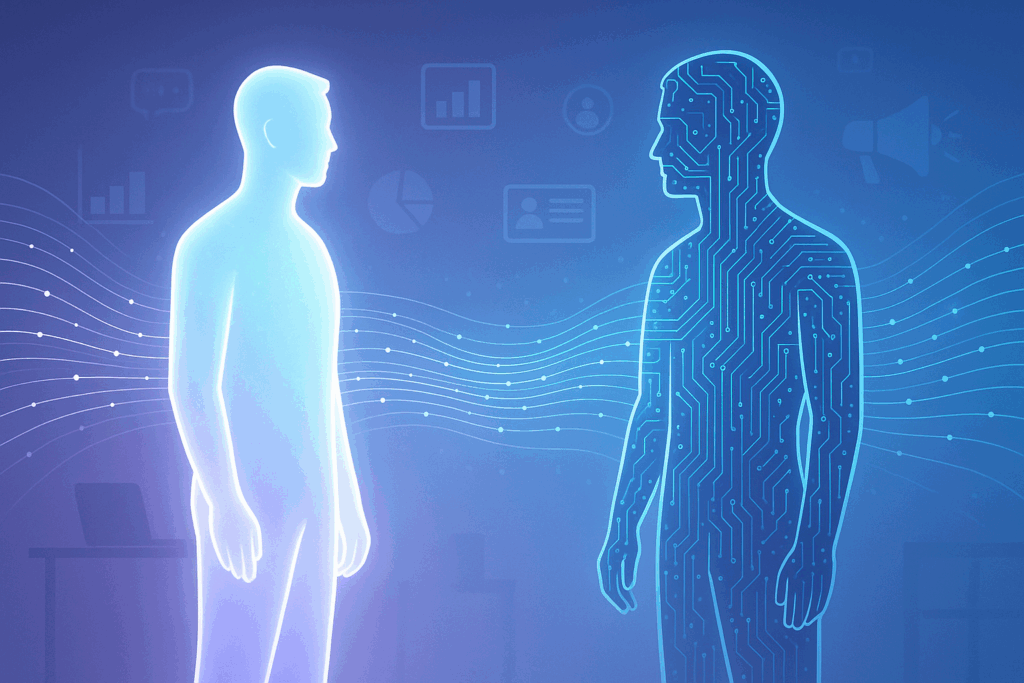
Digital marketing agencies as we know them will be obsolete by 2027. In their place, marketers will focus on building and maintaining “digital twins” – AI models trained on a brand’s complete knowledge, voice, and expertise. These twins, powered by context engineering, will generate all marketing content at scale while the business owner provides strategy and oversight.
Traditional agencies that charge for content creation will give way to teams of AI architects who design systems that produce marketing materials autonomously. The result: 10x to 100x more content output at a fraction of today’s cost.
Table of Contents
ToggleWhat is a Digital Twin for Your Business?
A digital twin is a large language model connected to everything about your business, brand, and leadership. It contains:
- All facts about your business
- Your opinions and perspectives
- Writing samples and brand voice
- Website structure and existing content
- Instructions for how to use this context for specific tasks
According to Ross Dawson, a digital twin is “a multimodal AI replica of knowledge, voice, likeness and decision logic” that can chat, write, and even appear on video.
In marketing, this means an AI avatar of your founder or brand that generates content in an authentic voice. It can create social media posts, blog articles, press releases, website copy, email newsletters, outreach messages, and responses to press inquiries.
The digital twin keeps your brand voice uniform while freeing humans for high-stakes judgment and strategy.
@tjrobertson52 Marketing agencies are about to be obsolete 😳 By 2027, we’ll have “digital twins” that know your business better than your team does #DigitalMarketing AIMarketing #MarketingTrends #ContextEngineering #BusinessTech
♬ original sound – TJ Robertson – TJ Robertson
Context Engineering: The New Core Skill
Context engineering is the discipline that makes digital twins work. It’s not about writing clever prompts – it’s about building the entire information ecosystem an AI needs to operate reliably.
A context engineer:
- Feeds the AI model everything it needs (data, tools, instructions)
- Builds long and short-term memory stores
- Maintains relevant documents and datasets
- Connects callable APIs and tools
- Ensures the right information arrives at the right time
As Cognizant defines it, context engineering brings “the right information in the right format at the right time” to language models.
This goes far beyond single prompts. Context engineers create AI workflows – giving the AI an “external brain” for multi-step tasks. Instead of asking “write a social post,” a context-engineered system supplies the AI with current performance data, brand guidelines, recent content, and scheduling tools. The result: on-brand, factual marketing materials generated autonomously.
Marketing Output Scaled 10x to 100x
Once a digital twin and its context framework exist, virtually all marketing content can be produced at scale:
- Social media posts across all platforms
- Blog articles on any relevant topic
- Press releases for company news
- Website copy for new pages or updates
- Email newsletters and sequences
- Outreach messages for partnerships
- Customer responses maintaining brand voice
According to industry analysis, AI agents excel at high-volume, repetitive content once properly trained. They can create personalized content based on user behavior, use real-time data to adjust offers, and automate routine tasks like follow-ups.
Outputs that once took teams hours per piece can be generated in minutes at massive volume, all with the owner’s authentic tone encoded.
The New Agency Model: AI Architects Over Content Creators
By 2027, marketing agencies will look fundamentally different. Instead of billing for creative services on a monthly retainer, agencies will charge for building and maintaining your AI system.
Traditional Agency Model:
- Charges per piece or per hour for posts and ads
- Employs large teams of writers and designers
- Creates content manually
- High marginal cost per piece
2027 Agency Model:
- Charges for system setup and maintenance
- Employs AI architects and strategists
- Designs systems that create content autonomously
- Near-zero marginal cost after setup
Smart agencies will automate tedious content production and redeploy staff toward higher-level tasks: creative direction, brand strategy, customer insight, and quality assurance of AI outputs.
New Marketing Roles Emerging
Successful agencies and marketing teams will need new specialists:
Context Engineer: Organizes all brand knowledge, data sources, tools, and workflows so the AI stays on message. Designs data schemas, sets up databases, and wires together APIs that the AI can call.
LLM Engineer/AI Integrator: Fine-tunes models and implements Retrieval-Augmented Generation (RAG) for accurate, up-to-date responses.
Data Curator: Cleans and prepares the owner’s content (press releases, emails, whitepapers) to teach the AI the brand’s style.
AI Conversation Designer: Crafts the personality and default responses of the twin.
Quality Manager: Guards against drift and ensures the twin doesn’t generate off-brand content.
Teams will resemble a cross between marketers and software developers – people comfortable with Python and APIs as well as copywriting and strategy.
The Business Owner’s Evolving Role
Business owners will shift from running the entire marketing machine to supervising their digital clone.
Old Role:
- Draft every post
- Approve every caption
- Manage all marketing activities day-to-day
New Role:
- Supply foundational content and vision
- Write cornerstone articles and materials
- Review summaries and high-level strategy
- Update knowledge base quarterly
- Focus on major decisions
As Ross Dawson notes, once a twin is built, the owner is freed “from writing every memo or Q&A; a single vetted corpus generates every output.”
The owner becomes more like a curator of the brand’s voice – collecting and polishing the inputs that train the twin, rather than hand-crafting every output.
Future Automation: AI Agents with Tools
Looking beyond 2027, AI agents will have internet and tool access. This will enable true end-to-end automation.
Future digital twins won’t just generate content – they’ll take actions:
- Pull live market data automatically
- Generate tailored content based on current trends
- Post to social media without human intervention
- Run ad campaigns and monitor results
- Answer incoming inquiries by searching the web
- Analyze performance and adjust strategy
The twin will operate like a junior marketing manager: observing, deciding, and executing multi-step campaigns. Business owners and consultants become overseers of the system, approving high-level strategy rather than managing daily tasks.
Cost Implications: Marketing at Scale Becomes Affordable
The economy will change dramatically.
Today: Full-service agencies typically cost $5,000-$10,000+ per month for content strategy and creation.
2027: After the one-time investment to build the digital twin (potentially tens of thousands upfront), the marginal cost of each additional post or email approaches zero.
According to Stanford’s AI Index, the cost of AI usage has fallen ~280x in 18 months (from about $20 to $0.07 per million tokens). Tasks that once required five-digit budgets can now be done for minimal cost.
Generating a week’s worth of social media copy takes minutes and costs pennies. After system setup and maintenance, ongoing expenses shrink dramatically.
If you can produce 10x the content at 1/10 the cost per piece, your marketing budget effectively buys 100x the engagement.
What This Means for Your Business
The shift to digital twins and context engineering will separate winners from losers:
Businesses that adapt:
- Invest in building their digital twin early
- Partner with agencies that understand AI architecture
- Provide rich foundational content to train the system
- Scale their marketing output exponentially
Businesses that don’t:
- Pay premium prices for manual content creation
- Fall behind competitors in content volume
- Miss the window to establish AI expertise
- Struggle to keep up with market changes
The question isn’t whether this transformation will happen. The question is whether you’ll be positioned to benefit from it.
Ready to build your digital twin? At TJ Digital, we’re already implementing these systems for our clients. We combine AI optimization expertise with transparent, results-focused service. Contact us for a free marketing audit and learn how we can scale your marketing output while reducing costs.