Traffic from ChatGPT converts at 23 times the rate of traffic from Google. That’s what Ahrefs found when they analyzed visitors to their own website. While conversion rates vary by industry, I’ve seen multiple studies on this, and the lowest I’ve encountered shows about eight times the conversion rate of traditional search.
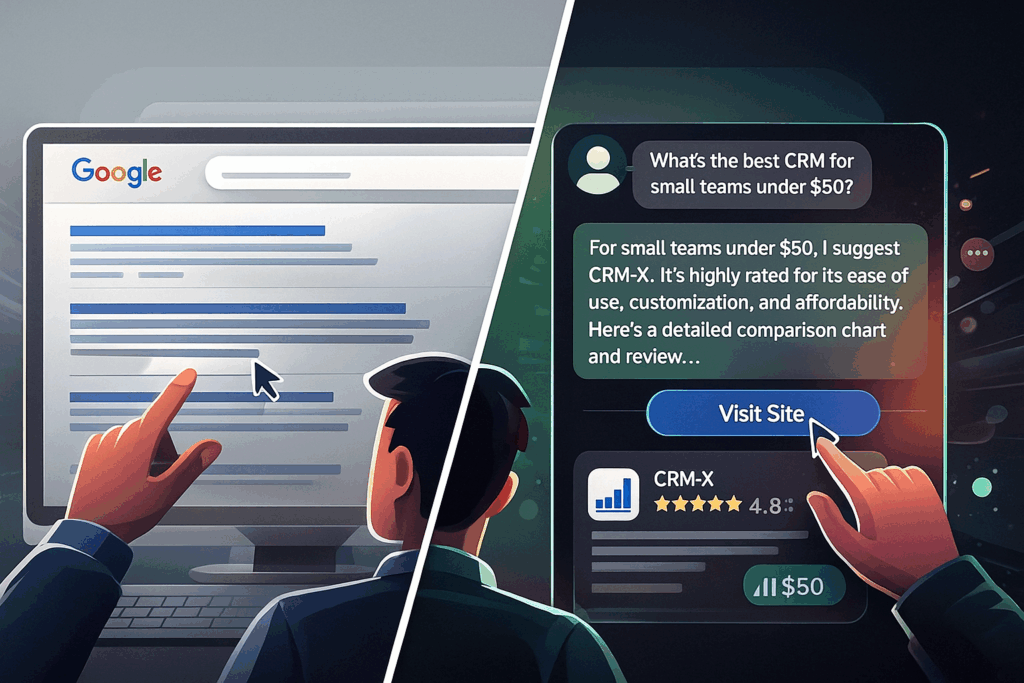
The reason is simple: when someone searches on Google, they only learn about your company after they click through to your website. But with ChatGPT and other large language models, users learn about your company and your competitors inside the conversation. They’re only clicking through once they’ve already decided they want to do business with you.
Table of Contents
ToggleThe Buyer’s Journey Has Changed
With traditional Google search, a user types in keywords, sees a list of results, and clicks one. Then they land on your website and start learning about your product or service from scratch. Many visitors bounce at this stage because they’re still figuring out if you’re the right fit.
ChatGPT works differently. Users ask questions conversationally, even complex ones like “What’s the best CRM for small teams under $50?” The AI provides detailed answers, side-by-side comparisons, and recommendations all inside the chat. By the time ChatGPT suggests a link, the user has already done their research and comparison shopping.
The entire buyer’s journey is happening inside the chat conversation. If someone still clicks through to your website after seeing a ChatGPT answer, it’s because they’re seriously interested and often ready to buy.
@tjrobertson52 ChatGPT traffic converts at 23X Google’s rate 📊 Why the buyer’s journey changed overnight #ChatGPT #MarketingTrends #BusinessTips
♬ original sound – TJ Robertson – TJ Robertson
The Data Behind High-Intent ChatGPT Traffic
Recent studies consistently show ChatGPT traffic converts at dramatically higher rates:
- Ahrefs: Only 0.5% of their traffic came from AI search, but that small amount produced 12.1% of their signups. That’s a 23x higher conversion rate than organic search visitors.
- Seer Interactive: In one case study, 15.9% of ChatGPT referral traffic converted, compared to 1.76% for Google Organic. About a 9x difference.
- TripleDart: ChatGPT referrals converted at 8.6% versus about 2.1% for Google. Over 4x higher.
What’s remarkable is that some companies now get only 2-3% of their traffic from ChatGPT but see 50% of their conversions coming from that small slice. Even though Google still drives more total traffic, ChatGPT visitors are far more likely to become customers.
Why AI-Referred Visitors Convert Better
ChatGPT traffic shows three key characteristics that explain the high conversion rates:
Pre-qualified clicks. Users have already read comprehensive answers before clicking. CustomGPT describes this as “the clicks that happen after the AI has already done some of the ‘qualifying’ for you.” If someone clicks your link after the AI has answered their question, they’re almost certainly motivated to act.
Deeper engagement. Once on your site, AI-referred visitors browse more deeply. One study found ChatGPT traffic viewed about 2.3 pages per session, nearly double the 1.2 pages for Google users. They also spend about 68% longer on site.
Purchase intent. The questions that lead to AI referrals tend to be specific, task-driven searches that signal buying intent. These aren’t top-of-funnel informational queries. These are people actively looking for solutions.
How to Get Your Business Recommended by ChatGPT
This trend is only going in one direction. More people will make purchasing decisions based on recommendations from large language models. As a business owner, you or someone on your team should be monitoring the sources ChatGPT uses when making recommendations in your industry.
Here’s what you need to do:
Identify the sources. Figure out which websites and pages ChatGPT references when people ask about products or services in your industry. You can do this by:
- Asking ChatGPT directly and noting which sources it cites
- Using tools like Qwairy that track which websites LLMs reference for specific queries
- Running the same query on Bing, since ChatGPT’s search often draws from Bing results
Get recommended on those sources. For each information source ChatGPT uses, make sure you’re either being recommended there or create your own content to replace that source. Focus on:
- Review sites and comparison pages in your industry
- Industry blogs and authoritative publications
- Reddit threads and forums where people discuss solutions
- Wikipedia and other knowledge bases
Create AI-friendly content. Structure your content so AI algorithms can easily understand and cite it:
- Write in clear, direct sentences that answer specific questions
- Use Q&A formatting with questions as headings
- Include comparison tables and structured data
- Build FAQ pages about your company and each service
- Write comparison articles (“Brand A vs Brand B” or “Top X Alternatives”)
Large language models cite comparison articles frequently, making them particularly valuable for AI visibility.
Strengthen your trust signals. AI platforms favor authoritative, high-quality content. Make sure your site demonstrates expertise through clear author credentials, case studies, and citations to reputable sources. Google and ChatGPT both reward demonstrated E-E-A-T (Experience, Expertise, Authority, Trust).
What This Means for Your Marketing Strategy
The rise of AI search doesn’t mean you should abandon traditional SEO. Google still drives significantly more volume, including people in early-stage research. But you need to recognize that AI referrals, though fewer, often deliver better conversion per visitor.
Some businesses are already clearly seeing this shift. While their organic search traffic stays flat or declines, AI referrals punch above their weight. Users only click through when the AI hasn’t fully resolved their need, meaning those visits often end in a sale.
Track AI-sourced conversions separately in your analytics. The usual volume-based metrics can hide the fact that these visitors are extremely valuable.
Right now, most of what helps you show up in large language models is the same as traditional SEO. But there are a few extra things we’re doing specifically for AI platforms, and we’ll continue to learn and adapt as these algorithms evolve.
The Opportunity Is Now
Most of your competition isn’t paying attention to this yet. There’s a huge opportunity right now to increase your visibility in AI platforms while competition is still low. The payoff might not be as immediate as some other marketing channels, but this is going to be the primary way people get recommendations.
If you’re a small to medium-sized business looking to stay ahead of this shift, we can help. Request a free digital marketing audit to see exactly what you could be doing to get more business from AI platforms like ChatGPT and Google’s AI mode.
The future of search is here. The question is whether you’ll be one of the businesses that gets recommended.