
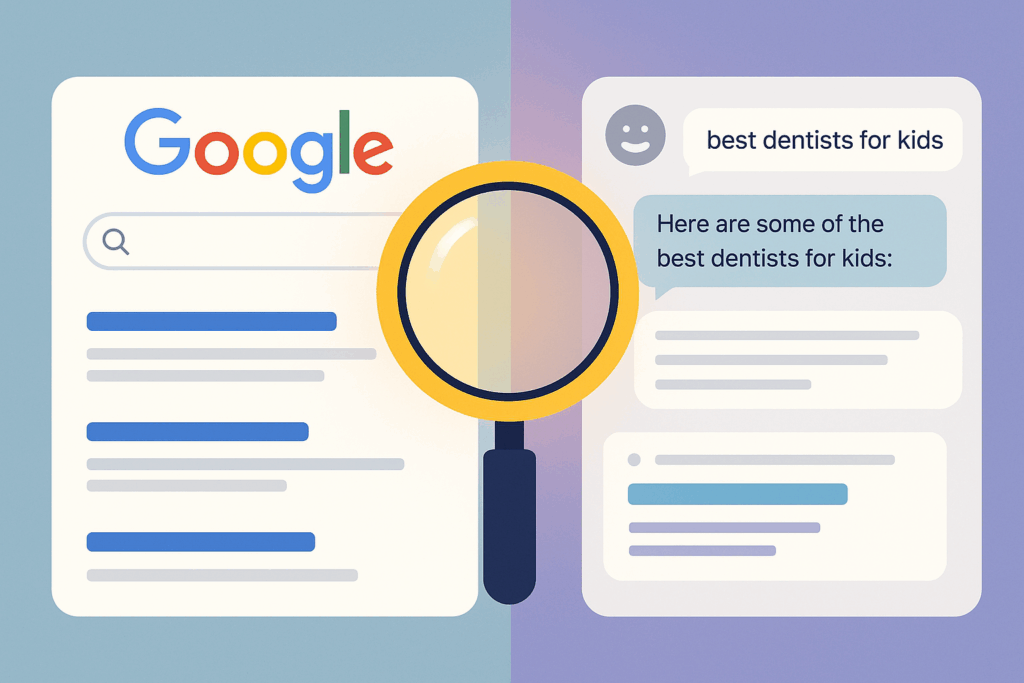
ChatGPT now accounts for 10% of search online, at least according to the head of ChatGPT. That number is promotional, not analytical. But there’s a real insight buried underneath the hype: the way people find businesses online is changing fundamentally. Business owners who understand this shift can position themselves to win.
Let me break down where that number comes from, what’s actually happening, and what you should be doing about it.
Table of Contents
ToggleWhere Does the “10% of Search” Number Come From?
The 10% figure appeared in a LinkedIn post promoting ChatGPT’s growth. Several people in the comments asked for the source. They didn’t get a response.
The number comes from OpenAI’s initiative to promote themselves as the market leader. And to be fair, they are the leading AI assistant right now. But independent data tells a different story. According to PageTraffic, Google holds about 81.6% of global search queries versus roughly 9% for ChatGPT platforms.
So yes, ChatGPT has captured meaningful market share. But treating every headline from a company as objective data will lead you astray.
@tjrobertson52 10% of search goes to ChatGPT – here’s what that actually means for your business and why the old SEO playbook is dead 📊 #SEO #ChatGPT #BusinessTips #AISearch
♬ original sound – TJ Robertson – TJ Robertson
Is ChatGPT Actually Beating Google?
No. But “beating” isn’t the right frame.
Google and ChatGPT serve different purposes. Data shows ChatGPT excels at creative and brainstorming queries (64% share) while Google still dominates straightforward fact-finding (71%).
As many people have pointed out, a lot of users don’t need the smartest model. They want the best product. ChatGPT has always focused on product experience, while Google has focused more on research. Google likely has the more capable AI model right now with Gemini 3 Pro. But ChatGPT has the integrations, the polish, and the early adopter base.
Both will be around for the foreseeable future. The question isn’t which one wins. The question is: how should this change your strategy?
What Actually Matters for Business Owners
Here’s the forest everyone keeps missing while watching the trees: regardless of how much market share each model has, discovery is moving into large language models.
More and more people are using ChatGPT, Gemini, and other AI tools to find businesses, products, and services. This is the trend that matters. And we now know enough about how this works to shift strategy.
How LLM Search Differs From Traditional Search
Traditional Google search created a winner-takes-all economy. If someone searched “dentist near me,” you needed to be in the top three positions. Otherwise, you get little to none of that traffic.
Large language models change this in two fundamental ways.
First, people don’t type simple keywords into ChatGPT. They have full conversations. They ask questions like “best dentists for kids,” or “dentists that take my insurance,” or “dentists with availability on the weekends.”
Second, the AI doesn’t just look at the top three Google results. It runs multiple searches and looks through several pages of results. In fact, one analysis found 89% of ChatGPT citations came from page two and beyond of Google results.
This means we’re moving from winner-takes-all to a world where there can be many winners.
Do You Still Need to Rank #1 on Google?
Not necessarily.
LLMs don’t simply grab the #1 Google result and show that answer. They perform their own search (often via Bing for ChatGPT) and dig deep. Backlinko’s analysis confirms that LLMs focus on identifying the most relevant content chunks, not the highest-ranking pages.
A page ranking #12 or #27 on Google can absolutely be pulled into a ChatGPT answer if it contains the precise information needed.
Strong SEO still helps. LLMs do ground their answers in search results. But you no longer need a top-three position to get found. You need content that matches what people are actually asking.
What’s the New Strategy?
The old strategy was to have one really strong page that ranked in the top three positions.
The new strategy is to create as much relevant content as possible. Get as many people talking about your brand online as possible. Be noisy.
This doesn’t mean quality stops mattering. You still need to protect your brand. But it no longer makes sense to put all your eggs in one basket.
Lightspeed Venture Partners describes this as search becoming “fragmented,” with many winners instead of one dominant page. Optimizing for AI means having credible content across a range of relevant pages.
How Should You Structure Content for LLM Search?
LLMs parse content differently from traditional search engines. Here’s what works:
Use Q&A format. Structure content around the questions users will actually ask. Include FAQs with direct questions as headings. WordLift notes that conversational search processes natural language queries and uses dialogue to refine responses.
Front-load answers. Put the direct answer to a question near the top of the section. LLMs tend to read the first few chunks and extract answers from them.
Write short, clear sentences. AI models parse shorter sentences more easily. Each sentence should make sense even when pulled out of context.
Match conversational tone. Write the way people actually talk. SavyAgency found users now type full questions like “What are the best hiking boots for wet trails this summer?” rather than keyword strings.
Should You Focus on Quantity or Quality?
Both.
The fundamentals still matter. LLMs reward content that is credible, well-structured, and authoritative. But instead of publishing one “perfect” page and moving on, you should build topical authority across multiple pages.
Produce a steady stream of useful, on-topic content while maintaining high standards on each piece. Search Engine Land confirms that credible, structured answers continue to win out. Google’s Gary Illyes has also said AI overviews still rely on Google search as a foundation.
Aim for both breadth and depth: a diverse set of relevant pages plus authoritative, clearly-answered content on each.
What Should You Actually Do Right Now?
Stop obsessing over which AI platform is winning the headlines. Start building a presence that serves you regardless of which platforms dominate.
- Create content that answers specific questions your customers ask
- Structure the content for easy AI parsing
- Build your brand’s voice across multiple platforms
- Focus on becoming the authority in your space
The noisiest brands are going to be the winners. Not the ones who waited to see which AI tool came out on top.
Work With TJ Digital
If you’re ready to adapt your digital marketing strategy for the AI era, TJ Digital can help. We specialize in AI SEO that optimizes your presence for both traditional search engines and large language models like ChatGPT.
Our approach focuses on building efficient systems to create high-quality content at scale, addressing the real questions your target customers are asking. Contact us to discuss how we can help your business get found in the age of AI search.