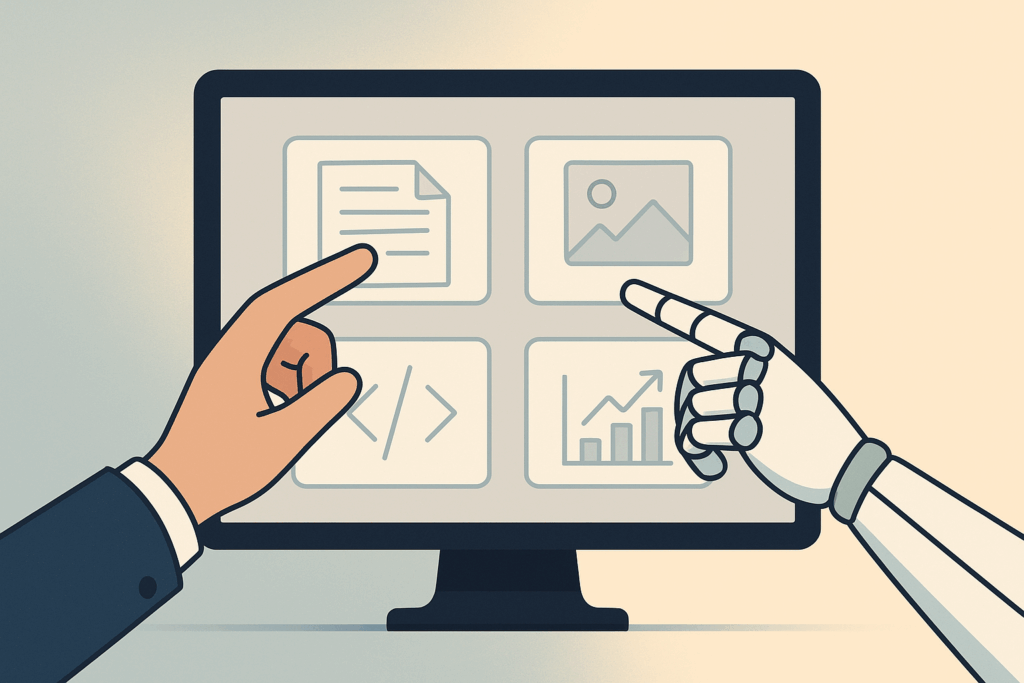
AI is already as good as or better than the average entry-level employee at many white-collar tasks. Graphic design, copywriting, software development, and marketing strategy. For routine work in these fields, AI performs at a level that matches or exceeds what you’d expect from a new hire.
But here’s what most people miss: AI isn’t replacing these jobs. It’s replacing specific tasks within these jobs. The nature of entry-level work is changing, not disappearing.
Table of Contents
ToggleWhich Industries Are Most Affected?
Digital marketing is probably the industry most disrupted by AI right now. I run an agency in this space and hire for these positions, so I see this firsthand.
The roles experiencing the biggest shift include:
Copywriting and content creation. AI can produce blog posts, ad copy, and marketing emails in seconds. Studies show GPT-4’s writing often matches or exceeds entry-level writers in clarity and structure. Some advertising executives report that AI performs at “the level of a mid-career professional” for routine copywriting.
Graphic design. Tools like Midjourney can generate dozens of design concepts in minutes. For standard tasks like social media graphics or blog images, AI output is comparable to what an average designer can produce at a fraction of the time and cost.
Software development. AI coding assistants write boilerplate code, generate functions, and detect bugs. Entry-level tech hiring dropped about 25% year-over-year in 2024.
Marketing strategy. AI can analyze data, generate campaign ideas, and create media plans. Tasks that used to take junior marketers days can be completed in hours.
@tjrobertson52 What Jobs Will AI Replace in Digital Marketing – here’s what I’m seeing as an agency owner actively hiring 👀 #AIjobs marketing #careeradvice #digitalmarketing #marketingagency #businesstips #aijobsecurity
♬ original sound – TJ Robertson – TJ Robertson
Is AI Actually Better Than Entry-Level Employees?
For many tasks, yes.
AI content is often grammatically correct, well-structured, and requires less editing than a junior employee’s first draft. In one comparison, teachers rated AI-written essays higher in quality than those written by human students.
AI-generated images can look polished and professional. AI code follows best practices and common patterns.
The gap is most noticeable in speed and volume. What takes a human days, AI does in minutes.
But AI still isn’t as good as experienced professionals. There’s plenty of room for experts. And more importantly, AI can’t actually hold these jobs in the way a person can.
What AI Still Can’t Do
You can’t fire your graphic designer and stick an AI in their chair. AI still struggles with:
Understanding large amounts of context. AI doesn’t know your company’s history, your client’s quirks, or why last quarter’s data looks unusual. A human brings that contextual awareness to every decision.
Working autonomously over time. AI can’t manage a project for days on end, adapting as situations change. It needs constant direction.
Handling unusual situations. AI excels at routine cases it was trained on. Throw it a curveball, and it struggles. Real jobs involve exceptions, novel problems, and incomplete information.
Making judgment calls. AI might flag a data pattern as a problem, but a human manager knows that pattern is expected given recent circumstances. That judgment is valuable.
Reliability. AI models confidently generate information that’s wrong. They might make up references, misstate facts, or produce inconsistent results. Human oversight isn’t optional.
How Entry-Level Hiring Has Changed
A few years ago, if I were hiring an entry-level person for copywriting, I wanted someone with copywriting experience. If I needed a junior designer, I wanted design experience.
That’s changed.
Now, when I hire for entry-level positions, I create an SOP where the actual work is done by AI. The person I’m hiring follows the SOP, gives tasks to AI, and reviews the AI’s output.
That might sound like I could slot anyone into the role. It’s really not the case.
Good judgment matters more than skills. Or in creative work, good taste. The ability to look at what AI produced and know whether it’s good, whether it fits the brand, and whether it will actually work. That’s incredibly important.
What’s less important is the actual technical skills to do the task from scratch. The value a human brings to entry-level positions is less about skills and knowledge and more about taste and judgment.
Industry research confirms this: agencies now favor junior hires who can co-create with AI because those hires contribute at a higher level from day one. Fresh graduates are expected to perform at a senior associate level with AI as their teammate.
Are Companies Hiring Fewer People?
It depends on the company.
Some agencies have stopped hiring because they realized they can do the same amount of work with fewer people. Over 90% of advertising agency leaders expect AI to reduce their headcount needs.
At my agency, we’re taking a different approach. I’m not hiring any less than I would have a few years ago. We’re just doing a lot more work. We’ve at least tripled the amount of deliverables we give our clients for the same rate.
So it’s not that entry-level jobs are disappearing. Some companies are reducing headcount. Others are massively increasing output with the same team.
What Entry-Level Jobs Will Look Like Going Forward
Whatever basic skills or knowledge you’ve acquired is going to be much less important. Your ability to use AI tools and apply good judgment is going to become much more important.
The roles aren’t disappearing. They’re elevating. Companies expect entry-level hires to arrive already augmented by AI, capable of producing output that would have taken a more experienced person without AI.
The employees who quickly become proficient with AI tools, combined with strong judgment and adaptability, aren’t just staying employed. They’re rising faster than they would have in the old model.
How to Stay Employable
Master the AI tools in your field. Learn prompt engineering. Get comfortable with whatever AI tools are standard in your industry. Being the person who knows the latest tools makes you valuable.
Use AI to produce more, not less. Don’t feel threatened. Use AI to generate more work than you could alone, then refine it to a high standard.
Develop excellent judgment. Work on critical thinking, attention to detail, and a sense for what’s high-quality. Practice editing AI-generated content to make it better. This is what separates useful work from “slop.”
Learn to define problems clearly. Much of working with AI is knowing how to ask the right questions. If you can take a vague goal and break it into clear steps that AI can execute, you’re providing huge value.
Stay curious. AI tools change fast. The person who stays current on new capabilities and integrates them into their workflow will always have an edge over someone stuck in old methods.
Don’t resist the change. People who resist AI are going to fall behind. The technology is here. The question is whether you’ll use it effectively or watch others pass you by.
The Bottom Line
We don’t yet know what effect AI will have on jobs long-term. But we can confidently predict that the nature of entry-level white-collar work is changing significantly.
The winners will be people who see AI as a tool that makes them more capable, not a threat to fight against. The skills that matter are shifting from technical execution to judgment, taste, and the ability to direct AI effectively.
If you’re building a business and need help with AI-powered digital marketing, we’d love to talk. Our entire approach is built around using AI to deliver more value at a lower cost.
Contact us for a free digital marketing audit of your website and current efforts.