
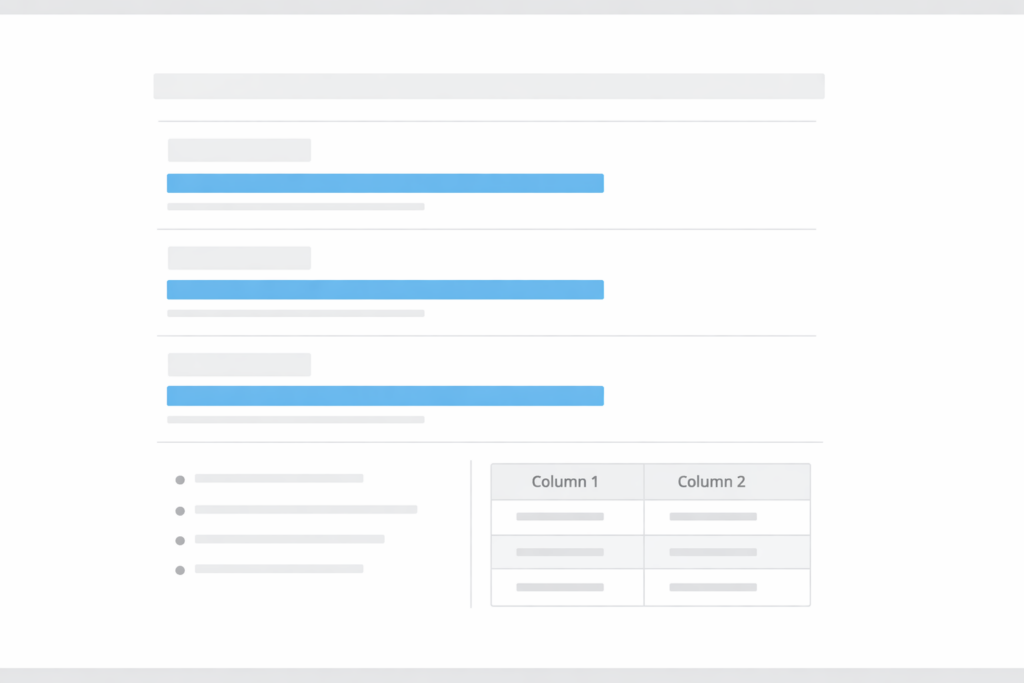
The most important things you can do to show up in AI search are: use a clear heading hierarchy (one H1, descriptive H2s framed as questions), lead every section with a direct answer, back up claims with 3 to 5 data points, mention your brand by name, and use bullet lists and tables wherever possible.
At TJ Digital, we’ve restructured hundreds of pages for AI optimization, and these formatting changes consistently make the biggest difference. Most of them overlap with traditional SEO best practices, but a few factors are either new or carry a lot more weight when you’re trying to get cited by a large language model.
This is the fifth AI search factor from Kevin Indig’s Growth Memo series, and I actually think the best single resource on this topic is Microsoft’s guide for AI search. A lot of what follows is based on that guide, combined with what we’re seeing work for our clients.
Table of Contents
ToggleHow Should You Use Heading Tags?
@tjrobertson52 Want ChatGPT to cite YOUR website? Structure matters more than you think. Headings as questions, first sentence = direct answer, then back it up with data. #AIsearch #SEO #ChatGPT #ContentTips
♬ original sound – TJ Robertson – TJ Robertson
Your heading structure is the single most important structural element for getting cited by AI. Large language models use headings to figure out what each section is about. They treat them like chapter titles.
Every page needs one H1 at the top. This is the title. Each major section below it gets an H2, and subsections get H3s and H4s.
Each heading should include the terms someone is likely to search when looking for that section’s content. If your page is about pool maintenance costs, your H2 might be “What Is the Cost of Pool Maintenance in Dallas, Texas?” rather than something vague like “Pricing Information.”
Three rules for heading tags:
- One H1 per page. It should clearly state the page’s topic and align with your page title and meta description. Microsoft’s guide calls out this alignment as a factor that improves AI confidence in your content.
- H2s for each section, H3s for subsections. This creates a hierarchy that both humans and AI models can follow. Each H2 signals where one idea ends and another begins.
- Be specific, not vague. “Learn More” tells the AI nothing. “What Makes Ceramic Window Tinting Different from Standard Tint?” tells it exactly what answer follows.
Why Should Headings Be Framed as Questions?
Large language models prefer headings framed as questions. This makes sense when you think about how people use ChatGPT or Google’s AI mode. They type questions. If your heading matches those questions, the AI can map your section directly to what the user asked.
If you can’t naturally frame every heading as a question, include an FAQ section on the page. FAQ-style Q&A pairs are highly effective for AI. The AI can lift those pairs almost word-for-word into its responses.
What Is the Answer-First Approach?
The first sentence of each section should directly answer the heading. Don’t build up to it. State the answer, then elaborate.
If your heading is “What Is the Cost of Pool Maintenance in Dallas, Texas?” the first sentence should be something like: “The average cost of pool maintenance in Dallas, Texas is $300 a month.” Then you follow with details.
This is probably the biggest shift from how most people write web content. We see it constantly with new clients. Their pages have great information, but the actual answer is buried in the second or third paragraph. AI models pull short snippets, typically 50 to 160 characters. If your answer isn’t up front, the AI might skip your section entirely.
Front-loading the answer makes your content “snippable.” The AI can grab one sentence and use it as a complete, standalone response.
Here’s the pattern:
- Heading states the question or topic.
- First sentence directly answers it.
- Following sentences provide supporting details, data, and context.
How Do Facts and Data Help AI Trust Your Content?
Once you’ve answered the heading, back up that claim with as many facts as you can. This is where AI search really differs from traditional SEO.
You can’t overdo it with data. The more numbers, statistics, quotes, and verifiable details you provide, the more likely a large language model is to trust and cite your content. Try to include 3 to 5 distinct data points per section.
This means replacing vague language with specifics:
| Vague Claim | Specific, Citable Version |
| “We’ve helped many businesses” | “[Brand] has served 150 clients since 2020” |
| “LLMs are growing fast” | “SEMrush predicts LLM traffic will surpass search traffic by mid-2026” |
| “This method works” | “After restructuring, pages earned 3x more AI citations in testing” |
| “We’re affordable” | “Plans start at $X/month with no long-term contracts” |
Words like “significant,” “recently,” and “innovative” mean nothing to an AI model. They can’t verify those claims. Specific numbers, dates, and percentages give the AI something concrete to cite.
When possible, link to the source of your data. A link to a credible study or report adds authority for both search engines and AI systems.
Why Should You Mention Your Brand by Name?
If you want AI to recommend your business, you need to actually say your brand’s name. Don’t just use “we” or “our.”
AI models often pull single sentences out of context. If that sentence says “we helped clients increase traffic by 40%,” the AI has no idea who “we” is. But if it says “TJ Digital helped clients increase organic traffic by 40% through AI-optimized content,” now the AI can attribute that claim to a specific brand.
This is something I recommend doing in your introduction. Find a natural way to position your brand as a solution to the problem the page addresses, backed by a data point or two. It can be a hard needle to thread. You want it to read like a substantive lead, not a sales pitch. Mention the brand, state a fact, move on.
Microsoft and AI optimization research both recommend using your brand name consistently across your site, profiles, and any external mentions. This helps AI build a clear “entity profile” for your business, making it easier to connect your brand with the topics you want to rank for.
How Do Lists and Tables Improve AI Visibility?
Anytime you’re presenting a list of something, put it in a bulleted format. Anytime you can justify a comparison, put it in a table. These formats are significantly more likely to be cited by AI.
Bulleted and numbered lists separate ideas into discrete, extractable points. If you have “5 Benefits of Ceramic Coating,” each bullet becomes its own potential snippet. The AI can grab one item without needing the rest.
Tables work the same way but for structured comparisons. A table comparing three products with columns for price, features, and ratings lets the AI scan a specific row or column to answer a query like “Which option is cheapest?” A Blue Compass case study found that converting a paragraph into a table caused an AI snippet to appear where the paragraph version did not.
Use lists for collections of related items: step-by-step instructions, key takeaways, pros and cons, or any set of short points that would be harder to scan as a paragraph.
Use tables for structured comparisons: product matchups, pricing breakdowns, feature evaluations, or any data where the reader needs to compare across multiple variables.
Keep tables simple. Avoid deeply nested or multi-level tables that might confuse the parser.
What’s Different from Traditional SEO?
A lot of the fundamentals are shared. You still need a technically sound website, good crawlability, and authoritative content. But don’t let that trick you into thinking nothing has changed. AI search adds several factors that didn’t apply to traditional SEO, and many of the shared factors carry more weight now.
| Factor | Traditional SEO | AI Search |
| What gets ranked | Whole pages | Individual passages and sections |
| Query matching | Keywords | Conversational questions and intent |
| Authority signals | Backlinks, domain authority | Content clarity, facts, entity recognition |
| Content format | Long-form pages can rank | Short, scannable sections with clear answers |
| Citation style | Links back to your page | AI quotes your content directly |
| Brand recognition | Domain reputation | Consistent entity naming across the web |
The biggest shift is that AI search operates at the passage level, not the page level. Even if your page ranks well in traditional search, a poorly structured section might never get quoted by an AI model. Each section needs to stand on its own as a complete, answer-first block.
We’ve seen this firsthand with client audits. A page can be the second most cited source by ChatGPT for a given topic and still not get recommended, because the AI is pulling information from that page but using it to recommend a competitor. The pages that actually earn recommendations are the ones with clear, structured, answer-first content that names the brand explicitly.
Quick Reference: Content Structure Checklist
- One H1 per page that matches your page title and meta description. All three should reinforce the same topic.
- H2s for each section, ideally framed as questions that match what someone would type into ChatGPT or Google.
- First sentence of each section directly answers the heading. No build-up, no preamble.
- 3 to 5 data points per section to support your claims. Numbers, dates, percentages, quotes, or citations.
- Brand name used explicitly in key sentences instead of “we” or “our,” so AI can attribute claims correctly.
- Bullet lists for any collection of items, steps, or takeaways. Each bullet should convey one clear point.
- Tables for any comparison or structured data. Keep them simple and clearly labeled.
- Short paragraphs of 2 to 4 sentences each. Large language models struggle to extract answers from dense blocks of text.
- Self-contained sentences that make sense if pulled out of context. This is what makes content “snippable.”
- No hidden content behind tabs, accordions, or PDFs. AI crawlers may skip anything that requires a click to reveal.
Get Your Content Structured for AI
The businesses that show up in AI results over the next year will be the ones that make it easy for these models to find, understand, and trust their content. The structural changes aren’t complicated, but they do require a deliberate approach to how you organize information on every page.
At TJ Digital, we build every page with AI optimization in mind. From heading structure and answer-first formatting to entity naming and data-backed claims. If you want help getting your content ready for AI search, reach out to us, and we’ll put together a plan for your business.