Yes, you probably should have a markdown version of your website, but not for the reason most people are talking about. The real value right now is internal. A structured markdown knowledge base lets AI do work on your behalf with full context about your business. At TJ Digital, we build a markdown-based AI Brand Ambassador for every client in the first two weeks of their campaign, and across roughly 40 to 50 active campaigns it has become the core of how we run an AI-powered agency.
Table of Contents
ToggleWhat Is a Markdown Version of a Website?
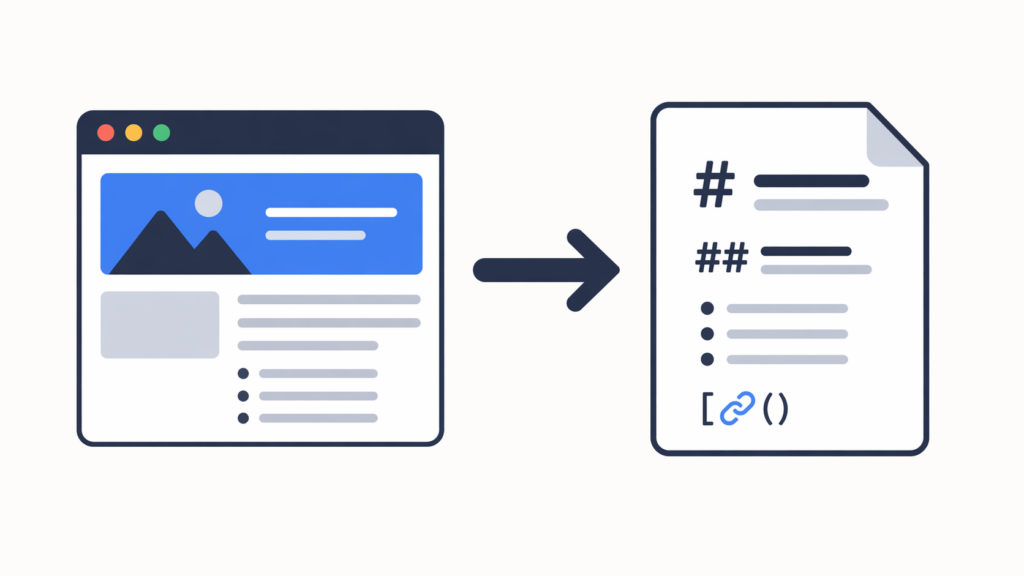
Markdown is a simple way to format a text file. Headings, bullet lists, links, and tables all get expressed with plain-text symbols instead of HTML tags.
The reason everyone’s suddenly talking about markdown is that large language models prefer it. Markdown is more efficient for AI to parse than HTML, which is full of scripts, styling, and nested tags that the model doesn’t care about. One analysis of a Cloudflare blog post found that converting it from HTML to markdown cut the token count from 16,180 to 3,150, about an 80% reduction (source).
For years there have been services that take the content of your website and generate a markdown equivalent of every HTML page. Humans see the HTML. AI sees the markdown. Cloudflare recently built this capability directly into their platform.
Will a Markdown Version of My Website Help Me Rank in AI Search?
Not yet, and probably not for a while. The issue is trust.
When someone asks ChatGPT or another AI model for a recommendation, the model runs a search through a traditional search engine in the background. That search engine is ranking pages based on the HTML version, not a bot-only markdown file. The AI has no way to verify that the markdown version contains the same content as the HTML version, and checking both would defeat the whole point of using the lighter format.
For the markdown version to actually get used, you’d need a separate index and ranking algorithm just for markdown files. Something like that is plausible in the next few years. It isn’t here today.
Google and Bing have both said publicly that they rank pages based on what users see. Serving different content to bots than to humans also flirts with cloaking, which has been against search guidelines for a long time. Right now, the safer play is to focus on clean, well-structured HTML and treat markdown as an internal format.
| Format | Best For | Current Status |
| HTML | Users, search engines, the canonical version of your content | What Google and Bing actually rank |
| Markdown | Internal knowledge bases, AI agents, LLM-friendly processing | Useful today for internal work, not yet trusted for public AI ranking |
| Hybrid (markdown via Accept headers) | Serving both formats from the same URL | Emerging, supported by Cloudflare and similar services |
Why Markdown Matters for Internal AI Use
The more immediate reason to have a markdown version of your content is internal. Putting your own business knowledge into a format AI can use changes what you can get out of AI.
Developers have been writing their docs in markdown for years. Google just rewrote their own developer docs in markdown, after telling everyone for years that they didn’t need to.
The reason is simple. If you’re using AI correctly, a human almost never reads internal documentation directly. You query the AI and the AI pulls the answer from the docs.
Your entire knowledge base should be written for AI. Anytime you need information, you get it through the AI. It’s faster, it’s more efficient, and it scales.
The bigger payoff is that with all that context, the AI can do work on your behalf. That’s where the real value shows up.
What Is an AI Brand Ambassador?
At TJ Digital, we call this system a Brand Ambassador. It’s a Claude project containing a structured set of markdown documents that describe a client’s business.
The documents cover who they are, who their customers are, how they talk, what they sell, what they’ve published, what competitors exist, and every piece of feedback they’ve ever given us. The Brand Ambassador is about 12 documents per client, and for some clients it now contains hundreds of pages of context.
Every process we run for that client passes through their Brand Ambassador. Blog posts, landing pages, Reddit comments, email outreach, technical audits, everything. When we get new information from a client, whether that’s feedback on a draft, a PDF of a product catalog, a meeting transcript, or a new testimonial, we give it to the Brand Ambassador and have it update itself.
This has been valuable enough for our agency, and for every other company I’ve heard doing it, that I think it’s going to become mandatory. Having a comprehensive knowledge base in structured markdown files is going to be at least as important as having a website.
You can read more about how AI search works and why a structured brand knowledge base is the foundation for preparing for agentic AI.
How Do You Build a Markdown Knowledge Base for Your Business?
- Gather every useful source. Product docs, customer FAQs, sales decks, case studies, meeting transcripts, blog posts, PDFs, testimonials, onboarding emails. Anything that describes your business.
- Convert it to markdown. Tools like Pandoc, AI-powered parsers, and custom scripts can do this at scale. The goal is to preserve structure. Headings stay as headings, lists stay as lists, tables stay as tables.
- Organize it into logical documents. We use about 12 documents per client, each covering a specific area like company overview, products and services, people and credentials, brand voice, and content guidelines.
- Load it into an AI platform. For us that’s a Claude project. You could also use custom GPTs, a vector database, or another setup.
- Keep updating it. Every piece of new information, every piece of client feedback, every revision gets absorbed into the relevant markdown file. The knowledge base gets more valuable every week.
This is work you would eventually have to do to replace repetitive tasks with AI. Starting now means you’re ahead when AI agents become a core part of how businesses operate.
When Will AI Search Start Using Markdown Directly?
My prediction is that once structured markdown knowledge bases become the norm for businesses, it will finally make sense for AI to have a dedicated search engine just for markdown files. At that point the two reasons for having a markdown version of your website collapse into one, and the sites that have been maintaining a clean, structured markdown knowledge base the whole time will be in a strong position.
Until then, the internal case is the case. Build the knowledge base because it makes your business run better with AI today, and you’ll already have the infrastructure when the public-facing side catches up.
Does Google Rank Markdown Files?
No. Google ranks HTML pages, and John Mueller has publicly said serving separate markdown files to crawlers is not something Google wants. If you want to rank in Google or in the AI models that pull from Google, focus on clean HTML with clear structure and semantic headings.
Is a Markdown Version of a Website the Same as Cloaking?
It can be. If your markdown version serves different content than your HTML version, search engines may treat that as cloaking, which violates their guidelines. The cleanest approach is to generate markdown automatically from the same source as your HTML so the two always match.
Do You Need a Developer to Build a Markdown Knowledge Base?
No. You need someone who understands your business deeply enough to decide what belongs in the knowledge base and how it should be organized. The technical setup is the easy part. Most of the work is extraction, organization, and ongoing maintenance.
How Often Should a Markdown Knowledge Base Be Updated?
Continuously. Every time a client gives us feedback, every time we publish new content, every time a business detail changes, the relevant document gets updated. A knowledge base that isn’t being updated is a knowledge base that’s getting less accurate every week.
Where Should You Start?
Building a structured markdown knowledge base is the foundation of every campaign we run at TJ Digital. If you want help setting one up for your business, contact TJ Digital for a free digital marketing audit and we’ll walk you through where to start.