
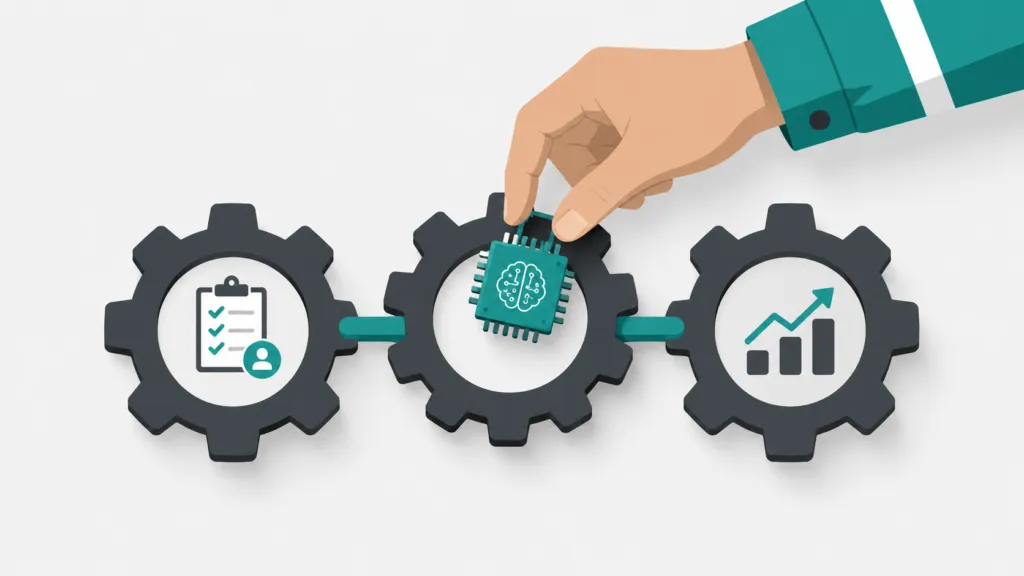
OpenAI and Anthropic just launched near-identical ventures to deploy AI directly into other companies. Both are sending their own engineers into client businesses to build AI into the workflows that run those companies. For businesses, this shift means AI deployment is now the main competitive battleground in enterprise software, and the gap between AI-integrated businesses and everyone else is going to widen quickly.
At TJ Digital, we manage AI-powered marketing systems for roughly 40 to 50 client websites, and that same gap already shows up clearly in our data. AI-referred visitors convert at about 8x the rate of traditional search visitors, and the spread keeps widening every quarter.
Here is what each announcement actually says, what they share in common, and what your business should do about it.
Table of Contents
ToggleWhat Is OpenAI’s Deployment Company?
The Deployment Company is a new joint venture between OpenAI and a group of private equity firms, valued at $10 billion. Reporting from Bloomberg and the Financial Times says the venture raised more than $4 billion from 19 investors including TPG, Brookfield, Advent, and Bain Capital. OpenAI itself plans to commit up to $1.5 billion of equity into the venture.
The structure matters more than the dollar figures. The investor group has access to more than 2,000 portfolio companies and clients, which gives OpenAI an instant distribution channel for enterprise AI rollouts. OpenAI’s model pairs long-term capital with privileged access to sponsor-backed companies, then staffs the deployments with its own engineers.
The pitch to private equity included a guaranteed 17.5% annual return floor over a five-year commitment. That tells you how confident OpenAI is in this model. They are willing to put real downside protection on the line to get into these businesses.
@tjrobertson52 Anthropic & OpenAI just announced they’re sending their own engineers inside companies to deploy AI. Finance is first, every industry is next. Who’s ready? 👀 #AI #OpenAI #Anthropic #AINews #Tech
♬ original sound – TJ Robertson – TJ Robertson
What Anthropic’s Financial Agent Cookbook Actually Does
Anthropic released ten ready-to-run agent templates for financial work on May 5, 2026. They are delivered in three forms at once. They work as plugins inside Claude Cowork and Claude Code, and as cookbooks for Claude Managed Agents that can run autonomously on a schedule.
The templates cover front-office and finance operations work. On the research and client-coverage side, they include a pitch builder, meeting preparer, earnings reviewer, model builder, and market researcher. On the finance and operations side, they cover valuation reviewing, general ledger reconciliation, month-end closing, statement auditing, and KYC screening.
Each template packages three things. There are skills with domain-specific instructions, connectors for governed access to financial data systems like FactSet and S&P Capital IQ, and subagents for specialized tasks like comparable selection. According to Anthropic’s announcement, teams can put Claude on real financial work in days rather than months.
What makes this different from a chatbot is the operational scaffolding. These agents have memory, permissions, credential vaults, audit logs, and approval flows. Anthropic is now packaging full financial workflows on top of the model itself, including connectors and governance.
How the Forward-Deployed Engineer Model Works
The forward-deployed engineer model comes from Palantir, which has used it for nearly two decades. Palantir describes its forward deployed engineers as the human equivalent of backpropagation. They embed with customers, configure platforms against the toughest real-world problems, and feed lessons back into the core product.
OpenAI’s version is almost identical in structure. Their job descriptions say the team operates at the intersection of customer delivery and core platform development. Engineers lead complex end-to-end deployments and measure success by production adoption and measurable workflow impact, not by hours billed or slides delivered.
Here is the thing. Frontier AI models are improving too quickly and enterprise workflows are too messy for self-serve adoption to do all the work.
The forward-deployed engineer model exists to solve last-mile problems like security boundaries, messy data, human approval steps, and unclear ROI. Those solutions feed back into the platform so the next deployment is faster.
Why Private Equity Is Backing These Ventures
There is a clear strategic reason private equity firms are backing these ventures. They get a faster path to selling AI into the businesses they already own. The PE firms behind both ventures control or influence networks that include thousands of operating companies.
The returns logic is explicit. According to BCG’s research on AI in private equity, PE-backed companies that systematically build AI capabilities across functions have nearly twice the return on invested capital compared to companies that do not. The same research found that 40% of investors have seen valuation haircuts of 5% or more when digital maturity lags.
For a private equity firm, AI works as both an operational lever and an exit-multiple lever. Sponsors want to accelerate adoption inside portfolio companies before exit so they can sell at a higher valuation.
OpenAI’s Deployment Company vs Anthropic’s Services Firm
Both ventures share the same fundamental thesis but differ in capital structure, partner networks, and current vertical focus. Here is how they compare.
| Aspect | OpenAI’s Deployment Company | Anthropic’s Services Firm |
| Announced | May 2026 (per external reporting) | May 2026 |
| Capital backing | TPG, Brookfield, Advent, Bain Capital | Blackstone, Hellman & Friedman, Goldman Sachs |
| Reported funding | $4B+ raised, $10B valuation | Not publicly disclosed |
| Distribution channel | 2,000+ PE portfolio companies | Hundreds of companies via consortium |
| Delivery model | Forward-deployed engineers and OpenAI secondees | Forward-deployed engineering plus Claude Partner Network |
| Vertical focus | Cross-industry | Cross-industry with finance templates available now |
| Standout product layer | Frontier platform | Claude Managed Agents and financial cookbooks |
| Public economics | Reported externally, not yet detailed by OpenAI | Detailed in Anthropic’s first-party announcement |
Both companies are betting that the bottleneck for enterprise AI has shifted from model capability to workflow design, integration, governance, and last-mile engineering.
Why the Gap Between AI Adopters and Laggards Is Widening
OpenAI’s enterprise data shows that frontier workers send 6x more messages than typical workers, and frontier firms now use 3.5x as much intelligence per worker as typical firms. That ratio was 2x just a year earlier. The gap is accelerating quarter over quarter.
Workers at frontier firms are using AI to run complex multi-step work. According to OpenAI, typical firms mostly use AI to answer individual questions, while frontier firms use it to complete entire workflows. Active enterprise users report saving 40 to 80 minutes per active day depending on role.
McKinsey’s 2026 work adds an important caveat. By the end of 2025, almost nine in ten companies had deployed AI somewhere in their business, but 94% said they had not seen significant value from those investments.
The real risk in 2026 is having an activity-heavy but transformation-light strategy while competitors redesign workflows around agents.
What Small and Medium Businesses Should Do About It
The truth is that no small business is getting an OpenAI or Anthropic engineer assigned to them. These ventures are aimed at PE-backed mid-market and enterprise companies. Your local roofer, dental practice, or 30-person SaaS company is not the target customer.
That actually creates an opportunity. The same playbook OpenAI and Anthropic are selling to large companies for hundreds of thousands of dollars is available to small businesses for a fraction of that cost if you do the work yourself or partner with someone who already does.
The first step is building an AI knowledge base for your business. This is a structured set of documents covering your services, voice, audience, competitors, and goals that any AI tool can read before doing work for you. Without this, AI tools produce generic content that sounds like every other business in your industry.
The second step is integrating AI into workflows that move your business forward. For most small businesses, marketing is the highest-leverage place to start because it is where AI tools have matured first.
How Can a Small Business Compete Without Forward-Deployed Engineers?
Most small businesses do not need a forward-deployed engineer. They need three things, in this order:
- A clean AI knowledge base
- A few well-chosen AI workflows that match where revenue actually comes from
- Someone who reviews the output before it goes out the door
The companies winning at AI adoption right now are the ones who took the time to write down everything important about their business in a way AI can use, then redesigned a few specific processes around what AI does well. The size of the tech stack matters less than the discipline of getting AI knowledge captured in writing.
Will OpenAI or Anthropic Offer These Services to Small Businesses?
Not directly, and not for a while. The unit economics of forward-deployed engineering only work for large clients. The minimum engagement size for these ventures is almost certainly in the hundreds of thousands of dollars per year.
What will trickle down to small businesses are the templates and cookbooks themselves. Anthropic’s financial agent cookbook is already available on every paid Claude Cowork and Claude Code plan. Other industry templates will follow over the next 12 to 18 months, which means a small accounting firm or law practice will eventually have access to the same starting point as a Goldman Sachs portfolio company.
What’s the Difference Between an AI Consultant and a Forward-Deployed Engineer?
A traditional AI consultant tells you what to do. A forward-deployed engineer builds it inside your company.
Consultants tend to focus on strategy, change management, training, and large-scale rollouts. Forward-deployed engineers focus on building working software inside your environment, often coding alongside your team and using your real data.
Both have a place. According to OpenAI’s own materials, the company is partnering with consulting firms like McKinsey, BCG, Accenture, and Capgemini specifically because the model and the rollout are two different problems.
For small businesses, the answer is usually neither. You need someone who understands AI tools well enough to build practical workflows in your business without the consulting overhead or enterprise pricing. That is the gap most small businesses are trying to fill right now.
Talk to TJ Digital About AI Optimization for Your Business
The gap between businesses that integrate AI and businesses that do not is widening every quarter. We help small and medium businesses get found and recommended in AI search, and we use AI in every part of our own operation so we can deliver more work at better quality for less money. Contact us for a free digital marketing audit and we will tell you exactly where AI can move the needle in your business.