
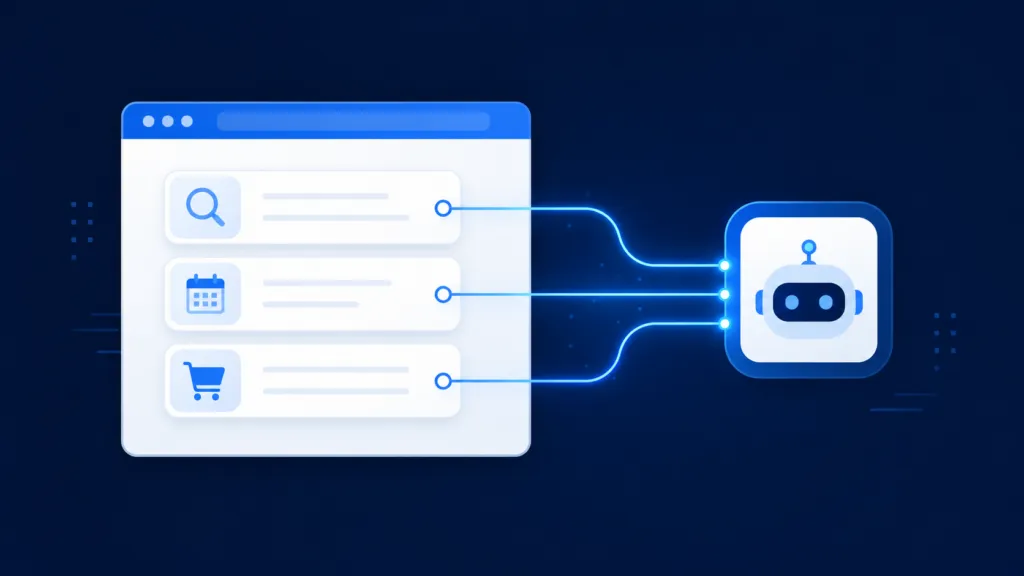
WebMCP is a browser standard, co-developed by Google and Microsoft, that lets AI agents interact with your website through structured tools. Agents can call specific functions like “search products,” “get a quote,” or “complete checkout” directly, without scraping pages or guessing where to click. At TJ Digital, we help over 40 small and medium-sized businesses show up in AI search, and WebMCP will let AI agents interact with their websites directly.
The standard is still experimental (available in Chrome 146+ behind a feature flag), but Cloudflare just made it dramatically easier to implement. Shopify has already started building the blueprint for how e-commerce sites will work with AI agents.
Table of Contents
ToggleWhat Is WebMCP and How Does It Work?
Right now, when an AI agent tries to do something on your website, it’s pretending to be a human. It takes a screenshot of the page, tries to figure out where the buttons are, and clicks them. It’s slow, unreliable, and breaks constantly.
WebMCP fixes this by letting your website declare its actions as callable tools. Your site registers functions (things like “searchProducts,” “filterResults,” or “bookAppointment”) with names, descriptions, and input/output schemas. When an AI agent visits your page, it discovers these tools and can call them directly.
No screenshots. No guessing. The agent knows exactly what your site can do and how to do it.
This matters because AI agents are becoming the way people interact with businesses online. Adobe Analytics reported that AI traffic to US retail sites rose 393% year-over-year in Q1 2026, and the trend is accelerating.
@tjrobertson52 How will AI agents use my website? Go to any Shopify site and add /agents.md to the URL. That’s the blueprint. #AISearch #SmallBusiness #MCP
♬ original sound – TJ Robertson – TJ Robertson
How Does Cloudflare’s New Agent Toggle Work?
Cloudflare announced a WebMCP toggle on August 6, 2026, that makes this whole process dramatically simpler. If your site is on Cloudflare, you can enable WebMCP from your dashboard with a single click, no code changes needed.
When you flip the switch, Cloudflare’s edge servers automatically inject a small bridge script into every HTML page your site serves. This script handles the WebMCP registration for you and comes with pre-built “tool packs” you can enable.
Right now, there are two tool packs in the developer preview. The first is Content Credentials (C2PA), which lets agents read embedded image metadata. The second is Site MCP Server, which proxies calls to your own MCP endpoint if you have one.
For most businesses, these two packs alone won’t transform anything. Unless you already have an MCP server set up, the toggle won’t do much by default.
The real significance is that Cloudflare is fully supporting WebMCP. This is the same standard Google introduced, and when a company Cloudflare’s size puts their weight behind it, we can be confident it’s here to stay. As more tool packs get released (and they will), enabling them will be as simple as toggling a switch.
What Can We Learn from Shopify’s agents.md?
To see what the future looks like for AI agent interactions, go to any Shopify website and type /agents.md at the end of the URL. You can also try /llms.txt and you’ll get redirected to the same page.
Shopify is integrating AI into their platform faster than any other website provider right now. In May 2026, they quietly rolled out /agents.md as the canonical AI discovery file across all storefronts, replacing /llms.txt as the primary agent-facing endpoint.
What you’ll find is a set of instructions for any AI agent that wants to interact with the website. It describes what the store sells, what product categories and price ranges are available, and what API endpoints or tools agents can use.
You don’t have to be an e-commerce business to learn from this. Shopify’s agents.md is a blueprint for how any business can structure its site for AI agents.
The takeaway is simple. Start thinking about all the actions an AI agent might be able to take on your website.
I recommend being really ambitious about that.
What Actions Should AI Agents Perform on Your Website?
Think about everything your website would ideally do for the user, even if it can’t do those things today.
For an e-commerce business, the obvious ones are searching products, filtering by price or feature, viewing details, and completing checkout. But for a service business, the possibilities are just as interesting.
| Business Type | Agent Actions to Consider |
| E-commerce | Search products, filter results, compare items, check inventory, complete checkout, track orders |
| Service Business | Request a custom quote, book an appointment, check availability, get pricing estimates |
| SaaS / Software | Look up pricing plans, start a free trial, submit a support ticket, access documentation |
| Local Business | Check hours, book a table or appointment, get directions, view menus or service lists |
| Professional Services | Schedule a consultation, download resources, submit intake forms, check qualifications |
The reason to think big is that AI is already very good at software development. Building these kinds of tools into your website gets easier every month.
Don’t limit your planning to what’s easy to build today. Plan for a future where you can let AI agents perform any action you can imagine.
If AI agents get more value from using your website than they do from your competitors, they’re going to choose you by default.
Do You Need an MCP Server Right Now?
No. Very few websites have set up a dedicated MCP server, and you’re not falling behind if you haven’t started.
An MCP server (the backend version, separate from WebMCP) is a service that runs on your server and exposes named tools that agents can call with structured parameters. WebMCP is the browser-side version of this concept, where your website becomes its own MCP server in the browser, with tools defined and executed right in the browser tab.
For most businesses, WebMCP is enough to get started. A dedicated backend MCP server becomes useful when you want agents to trigger complex actions that can’t run in the browser, like pulling real-time inventory from a database or processing a payment.
The practical advice right now is to focus on the fundamentals. Clean, semantic HTML, properly labeled forms, and structured data markup.
These things help both search engines and AI agents. They’ll give you a strong foundation when WebMCP goes mainstream.
I wrote a more detailed guide on preparing websites for AI agents that covers the full checklist.
How Do These Standards Work Together?
Is WebMCP the same thing as MCP?
They’re related but different. MCP (Model Context Protocol) is a broader standard for connecting AI agents to external systems through a backend server. WebMCP is the browser-native version, where your website itself becomes the MCP server.
Tools are defined and executed in the browser. You don’t need to deploy a separate server.
Which browsers support WebMCP right now?
WebMCP is currently experimental. It’s available in Chrome 146+ (Canary) behind a feature flag, with an origin trial planned for Chrome 149+.
Other browsers haven’t announced support yet, but with Google and Cloudflare both backing the standard, broader adoption is likely.
Does this replace traditional SEO on my website?
No. Everything that helps you rank in Google today still helps with AI agents. AI agent optimization adds a new layer on top of what you’re already doing.
I’ve written about how AI agents will eventually replace traditional websites as the primary way customers interact with businesses. We’re still early in that transition, but WebMCP is one of the standards making it possible.
Why Your Website Needs to Start Working Like an API
Your website has always been a place humans visit to read information and fill out forms. WebMCP changes that. It turns your site into something AI agents can call directly, like an API with a user interface attached.
That changes how you should think about every page, every form, and every action on your site. The businesses that plan for this now will have a real advantage as AI agents become more capable and more common.
Get a clear picture of where your website stands from an AI optimization perspective. Reach out to TJ Digital for a free digital marketing audit.