
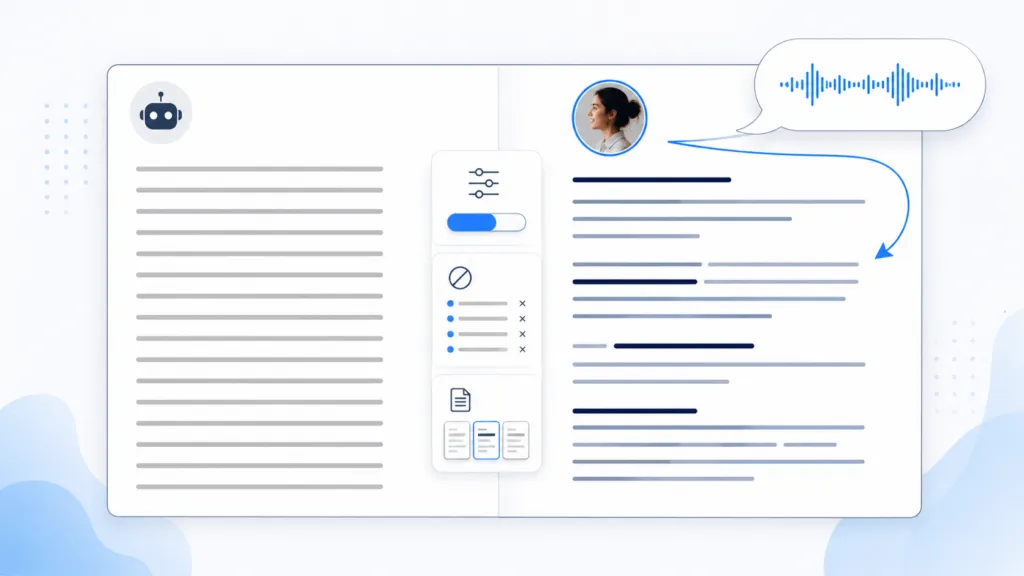
To make AI write like a human, you have to do three things. Ban the specific patterns that give AI away, describe the voice you want in measurable terms, and give the model a varied set of writing samples to copy.
At TJ Digital we’ve written thousands of pieces of content with AI for more than 40 client brands. No single one of those three layers is enough on its own.
Asking a model to “write more naturally” does almost nothing. The model doesn’t know it’s writing unnaturally, because the way it writes is natural to it.
Table of Contents
ToggleWhy Does AI Writing Sound So Obnoxious?
AI writing sounds obnoxious because the labs are now optimizing their models for software engineering above everything else. The models increasingly write sentences the way they’d write code.
That shows up in three habits:
- They speak in shorthand.
- They leave out important context.
- They overuse jargon.
A lot of us assumed that as AI got smarter, it would also start writing more naturally. It has gone the other way. This is especially true of Opus 5 and Fable 5.
@tjrobertson52 How to get AI to write like a human: 3 layers we use after thousands of AI-written drafts #AIWriting #PromptEngineering #ContentCreation
♬ original sound – TJ Robertson – TJ Robertson
What Are AI Tells and How Do You Ban Them?
AI tells are the patterns that most obviously mark a piece of writing as machine-generated. You turn them into deterministic rules, which is the fastest fix available to you.
The rules we start with:
- Never use em dashes.
- Never use contrastive framing like “It’s not X, it’s Y.”
- Never use the words and phrases the model overuses, like “delve” or “in today’s landscape.”
We do keep a banned words list at the agency. These words and phrases change often. They also differ from model to model, so a list built around one model will miss the tells of another.
Why Isn’t a Banned Words List Enough?
A banned words list only gets you so far. After the early wins, a lot of people keep adding rules and expect the writing to keep improving, and it stops improving.
Removing the tells makes writing less obviously machine-written. Sounding like you is a separate problem, and it needs separate instructions. At some point you have to tell the AI how to speak.
Should Every Type of Content Use the Same Writing Style?
No. The way you write a blog post is different from the way you’d write a sales page, and different again from a social post. Most brands need several writing styles that share a common core.
Before you organize any of this guidance, whether it lives in a skill or a knowledge base, sort it into two buckets:
- Guidance that applies to all writing, like banned words, punctuation rules, and overall register.
- Guidance that applies to one category only, like structure, length, and how promotional the piece should be.
How Do You Describe a Writing Style to AI?
Specificity is the whole game. Vague guidance like “add more personality” produces some truly cringe-worthy output.
How Do You Set Tone Scales for AI Writing?
We measure every client’s tone on four scales before we write anything for them. Here’s where our own brand lands.
| Tone scale | TJ Digital’s setting | What that produces |
| Warm vs authoritative | Both, leaning authoritative | Direct claims backed by experience, with warmth coming from actually caring about the reader |
| Formal vs conversational | Strongly conversational | First person, plain English, no corporate language |
| Straightforward vs polite | Strongly straightforward | Skips the niceties and assumes the reader wants the truth |
| Playful vs serious | Serious with natural humor | Blunt observations that land as funny because they’re true |
The right setting on each scale usually sits somewhere between the two ends. Landing in the middle still gives you a framework for specifying your style. Nielsen Norman Group’s research on four dimensions of tone works the same way, with each dimension treated as a scale that has a neutral midpoint.
Should You Give AI a Persona?
Yes. Define who is writing the content as specifically as you can. Give the model a role, a level of expertise, and a reason for writing.
If your writing style is close to that of a well-known public figure or creator, name that person. The model already carries a strong sense of how they write.
What Writing Standards and Reading Levels Should You Specify?
You can point the model at an existing writing standard. A popular one for counteracting Claude’s default style is Simplified Technical English, a controlled language built on 53 writing rules and a dictionary of roughly 900 approved words.
A reading comprehension level does similar work. “Explain it like I’m five” and “write for an eighth-grade reading level” produce noticeably different output from the same prompt.
How Many Writing Samples Does AI Need to Learn Your Voice?
More than most people expect. Samples, often called exemplars, are the last layer and the hardest one to get right.
The best sample is you talking or writing about the exact topic you want covered, and that doesn’t scale. So most brands need a general set of samples the model can pull from for any piece of writing. That means gathering a lot of them.
Be careful how you build that set. AI is very good at detecting patterns across a group of examples, including patterns you never meant to teach it.
- If all your examples are in paragraph form, the model assumes you only write in paragraphs.
- If two of five examples use the same phrase, the model assumes you love that phrase.
- If two of five examples cover the same topic, the model assumes you write about that topic 40% of the time.
The ideal set is as different as possible from example to example, keeping only the qualities you actually want copied. That means sifting through a lot of samples. The good news is that AI can help you do the sifting.
This is the same principle behind using a transcript as source material. The raw material is already in your voice, so the model has less room to invent one. One client of ours produces roughly 3,600 pieces of content a year this way, nearly all of it built from daily video.
How Do the Three Layers Compare?
Each layer fixes a different problem, and they stack.
| Layer | What it fixes | Main limitation | Effort |
| Banned AI tells | The obvious giveaways, like em dashes, contrastive framing, and overused words | Says nothing about your actual voice | Low. It’s a list of rules. |
| Tone scales and persona | Register, formality, humor, and reading level | Won’t capture your specific rhythm or word choice | Medium. A one-time setup per content category. |
| Writing samples | Cadence, sentence length, vocabulary, and structure | A badly built set teaches the model habits you never had | High. Gathering and curating takes real time. |
We build all three into every client’s content machine so the guidance loads with every piece of content we produce.
Does Telling AI to “Write More Naturally” Actually Work?
Rarely on its own. The model doesn’t recognize its own output as unnatural, so the instruction gives it nothing concrete to change. Replace it with specific banned patterns, a defined tone, and real samples.
Why Do AI Models Overuse Em Dashes?
Em dashes are heavily represented in the writing these models learned from, so they show up heavily in the output. There’s some irony in that. Microsoft’s own guidance on AI search tells writers to be cautious with em dashes, because overuse can confuse how machines read sentence structure.
Replace them with commas, periods, or parentheses. It’s the single fastest edit on this list.
Where Should You Store Your AI Writing Guidelines?
Put them wherever the model reads before it writes. Depending on the tool, that’s a project knowledge base, a custom instruction set, or a skill. The important part is that the guidance loads automatically, so nobody has to paste it in every time.
At TJ Digital we call this a Brand Ambassador. It’s an AI project that holds everything about a client’s business and writes the way that brand writes.
Who Should Build Your Brand’s AI Writing Guidelines?
Whoever knows your voice best should define it, and that’s usually you. The work is gathering the samples, setting the scales, and keeping the banned list current as models change.
That’s also the part most business owners never get around to. We build and maintain these guidelines for every client as part of the campaign, then use them across blog posts, pages, and social content. Get a free digital marketing audit and we’ll show you where your current content reads like everyone else’s.