
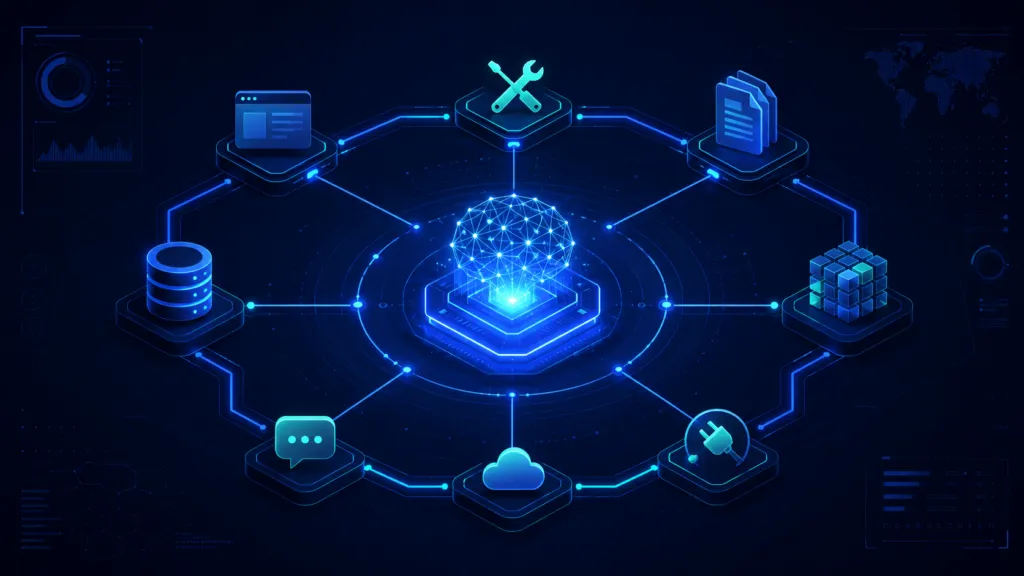
The AI harness matters more than the AI model you pick, and the gap is widening fast. A harness is the scaffolding around a model, meaning the instructions it follows, the way its documents are organized, and the tools it can reach. At TJ Digital we run AI-powered marketing systems across roughly 40 to 50 client campaigns, and most of our quality gains this year came from improving the harness rather than switching models.
NVIDIA just proved the point at a scale nobody expected. Its AVO harness took Claude Opus 5 from a 30.2% score on the ARC-AGI-3 benchmark to a perfect 100. Same model, different scaffolding.
Table of Contents
ToggleWhat Is an AI Harness?
An AI harness is a set of instructions, a structure for organizing documents, and a set of tools that wrap around an AI model. The scaffolding contains no AI of its own. The model does all the thinking inside it.
The shorthand people use is Agent = Model + Harness. The model supplies reasoning. The harness supplies memory, context management, tool access, and the loop that keeps work moving when a step fails.
Claude Code was the first harness that showed the world how much this matters. The Claude models have gotten better with every release, but Claude Code produced the biggest jump in what the tool could actually do.
@tjrobertson52 Does it matter which AI model you use? Less and less. The harness around it is doing the heavy lifting now. #AI #AITools #SmallBusiness #ClaudeCode
♬ original sound – TJ Robertson – TJ Robertson
What Did the Claude Code Leak Reveal?
The Claude Code source code leaked in March 2026, and it showed that harnesses are far simpler than most people assume. Anthropic accidentally shipped a source map file inside an npm package, exposing roughly 512,000 lines of TypeScript. Inside was a set of instructions, a document structure, and a tool list.
There’s no hidden second model running the scaffolding. If something this simple produces gains this large, then it’s something you can build and control yourself.
What Changed With NVIDIA and DeepSeek?
Two things happened in the last week that should change how you think about this.
DeepSeek released a fully modular open source harness on August 13. Every part of the runtime is a plugin, including the models, the tools, the sessions, the agent loop, and even the chat interface. Developers can take the parts they like, customize them, and leave the rest.
NVIDIA announced that its AVO harness paired with Claude Opus 5 scored 100.00 on ARC-AGI-3, clearing all 183 levels. That benchmark was invented to show that large language models would never handle certain types of tasks. Before Opus 5, the best scores on it were in the single digits.
ARC-AGI-1 got saturated, so they introduced ARC-AGI-2, and then ARC-AGI-3. Now it looks like we’ll need ARC-AGI-4. Or they’ll give up and admit that large language models were never limited the way they suspected.
One caveat is worth stating plainly. NVIDIA says in its own write-up that this wasn’t a controlled comparison, and the run covered the public problem set rather than the hidden competition split. It’s still the most dramatic harness result anyone has published.
How Much Does the Harness Change a Model’s Performance?
The same model scores wildly differently depending on what surrounds it. Here’s what the published ARC-AGI-3 results look like side by side.
| Setup | Model | ARC-AGI-3 Score |
| Model alone, high reasoning effort | Claude Opus 5 | 30.2% |
| Inside NVIDIA’s AVO harness | Claude Opus 5 | 100.00 |
| Default benchmark harness | GPT-5.6 Sol | 13.3% |
| Enhanced harness settings | GPT-5.6 Sol | 38.3% |
The OpenAI numbers make the mechanism obvious. In the default setup the model threw away its own reasoning after every action, so it couldn’t learn across steps. A harness that kept those thoughts around nearly tripled the score.
Why Does the Harness Matter More Than the Model?
Most businesses choose an AI tool by comparing models. The scaffolding around the model accounts for far more of the output quality than the model choice does. A strong harness makes an average model useful, and a weak harness wastes the best model available.
Expect this to keep moving fast. Harness design is early, it’s cheap to iterate on, and every lab is competing on it now. You need to stay flexible.
Where Should You Store Your Business Knowledge Base?
Store your knowledge base somewhere neutral. GitHub, Notion, and Google Drive all work well. Do not store it inside a project folder in Codex or Claude, and for God’s sake don’t rely on the internal memory of ChatGPT or Claude.
You need to retain full ownership of all your information. When you feed important facts into one tool’s memory, you lose them the moment you switch tools. Harnesses are changing monthly right now, and anything locked inside one of them is a liability.
Here’s what to look for in a storage platform.
- It has an MCP server, so any model and any harness can connect to it
- You control access and permissions
- Content lives in plain text or markdown rather than a proprietary format
- You can version it and see exactly what changed
Google’s open knowledge format is a vendor-neutral spec built for this exact problem. At TJ Digital we build a markdown knowledge base for every client and call it a Brand Ambassador. It sits outside any single AI tool, so we can point whatever model performs best this month at the same set of documents.
What Is MCP and Why Does It Matter for Your Knowledge Base?
MCP stands for Model Context Protocol. It’s an open standard that lets any AI application connect to any data source through the same interface.
Anthropic built it and handed it to a neutral foundation. OpenAI, Google, and Microsoft all support it now.
Storing your knowledge on a platform with an MCP server keeps your documents on your servers. The AI queries them when it needs them, and nothing gets permanently absorbed into a model. Switching AI models stops being a project once your documentation lives outside the tools.
Is an AI Harness the Same Thing as an AI Agent?
No. An agent is the model and the harness working together. A harness on its own has no reasoning ability, and a model on its own can’t hold state across steps.
Should You Build Your Own Harness or Use an Existing One?
Use an existing one. Most businesses should run Claude Code, Codex, or DeepSeek Harness and put their real effort into the knowledge base that feeds it. Building your own makes sense once you have an engineering team and a workflow that existing tools handle badly.
Which Harness Should You Use Right Now?
Claude Code and Codex work out of the box with almost no setup, and both stay locked to their own models. DeepSeek Harness takes more configuration, and in exchange every component is a plugin you can rewrite. Pick based on whether you value speed or control.
Should You Turn Off ChatGPT and Claude Memory?
Keeping it on is fine. Just don’t treat it as storage. Anything your business would miss if it vanished tomorrow belongs in a document you own.
How Should You Start Building Your AI Knowledge Base?
Your knowledge base, and the skills you build around it, are likely to become your business’s most valuable asset. Models will keep changing, and harnesses will keep changing faster. The documentation you own is the part that carries forward through all of it.
Start collecting and organizing your company’s knowledge today. Talk to TJ Digital and we’ll show you exactly where to start.