
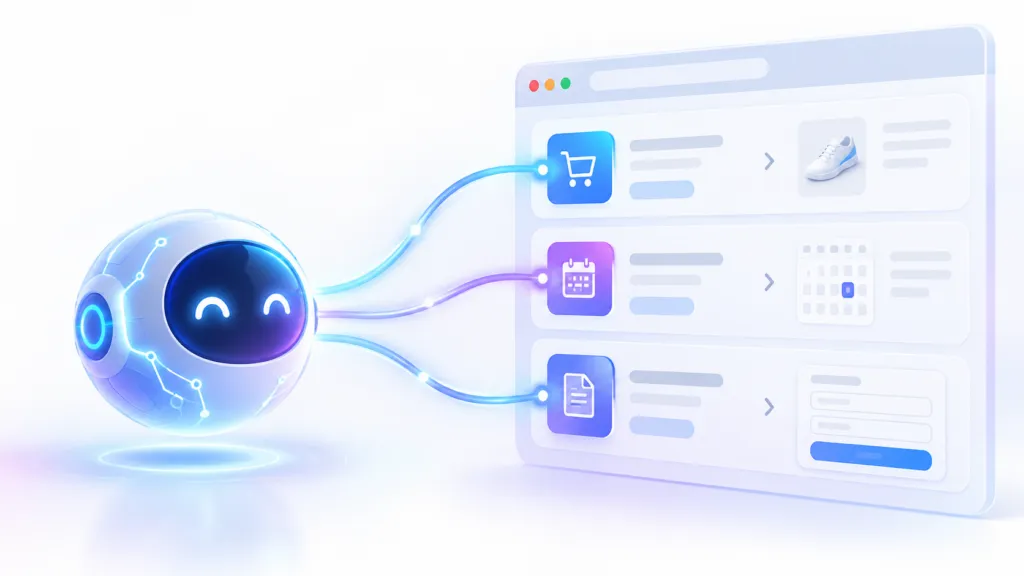
Most websites aren’t ready for personal AI agents like Meta Muse AI. An agent-friendly website lets agents use its product catalog, forms, and booking system directly, so they can finish a task without clicking through every page. At TJ Digital, our recommendation for AI agents is the Universal Commerce Protocol if you sell online, WebMCP if you don’t, and an llms.txt file that tells agents how to use the site.
I’ve been doing SEO for 17 years, and this is the moment I’ve been telling business owners to prepare for. With Muse, it seems we’ve officially entered the era of personal AI agents.
Table of Contents
ToggleWhat is Meta Muse AI?
Meta Muse is a personal AI agent that Meta launched on September 8, 2026. You give Muse a goal and it does the work. It can book flights, make appointments, fill out forms, and make purchases on your behalf.
Muse’s early adoption numbers are big. In its first 12 days, Muse had 38% more signups than ChatGPT did in its first 12 days, and it’s already close to a million active users. Sensor Tower data reported by CNN puts Muse above 2.5 million downloads, and it reached the top of the free iPhone app chart.
So far, the reception to Muse has been surprisingly positive. Muse does a lot on its free plan, from booking travel to checking out. To me, this feels like the start of AI agents going mainstream, with the general public using them for everyday errands.
@tjrobertson52 How to make your website AI agent friendly now that Muse is booking and buying for people #AIAgents #WebMCP #SEO #SmallBusiness
♬ original sound – TJ Robertson – TJ Robertson
Which other personal AI agents should business owners watch?
GrokBot, Instinct, and ChatGPT Desktop are the other personal AI agents worth watching right now:
- GrokBot has gotten a positive reception from early users.
- Instinct is apparently excellent, if you can get access.
- ChatGPT Desktop is OpenAI’s big push, and its built-in browser now supports WebMCP.
What do personal AI agents mean for your website?
Fewer and fewer humans are going to visit your website themselves. More often, they’ll send an agent to your site to research, book, or buy on their behalf.
I’ve been saying for a while that business owners need to start thinking about how AI agents interact with their websites. Now millions of consumers have a capable agent on their phone. Whichever site is easiest for that agent to use is the one that gets the booking or the sale.
How do AI agents use a website?
Most AI agents operate a website the way a human would. They open a page, take a screenshot, click something, wait, and take another screenshot. Browsing this way works, but it’s slow and clunky.
Agents are much more efficient when they can reach your product catalog, forms, booking system, and other tools directly. Here’s how the main approaches compare:
| Approach | How the agent interacts | Speed and reliability | Best for |
| Browsing like a human | Takes screenshots, clicks buttons, and types into fields | Slow and error-prone | Any site, as a fallback |
| Universal Commerce Protocol (UCP) | Calls standard endpoints for catalog search, cart, and checkout | Fast and structured | Online stores |
| WebMCP | Calls tools the page registers, like “book appointment” or “get a quote” | Fast and structured | Service businesses and lead generation sites |
| llms.txt or agents.md | Reads plain-text instructions about what the site offers and how to use it | Helps agents find the right path | Every website |
Are Shopify stores ready for AI agents?
Yes. Shopify stores already support the Universal Commerce Protocol, so agents like Muse can work from your catalog directly without loading your pages. If you’re on Shopify, congratulations, because this is all handled for you.
Shopify is also working directly with Meta. On September 21, 2026, the two companies announced agentic checkout with Shop Pay across Shopify stores.
Independent stores have another advantage right now. Amazon is currently blocking Meta’s Muse agent from shopping on Amazon.com. That pushes Muse users who want to buy something toward stores like yours.
How do you test whether AI agents can use your website?
The best way to test your website is to download Muse and ask it to make a purchase or fill out a form. Watch where the agent gets stuck. I’d urge anyone with a website to do this, even on Shopify.
Here’s what to look for:
- Whether the agent finds the right page or product on the first try
- Whether it can finish a form or checkout without your help
- How long the task takes compared to doing it yourself
- Whether it gives up and asks you to finish on the site
Shopify sites should pass easily. For every other website, the results have been mixed. More advanced tools like GrokBot and Instinct will work a bit harder than Muse does, but those are paid tools, and Muse’s free plan makes it the agent most consumers will start with.
How do non-Shopify stores add the Universal Commerce Protocol?
Non-Shopify stores add the Universal Commerce Protocol with a platform plugin or a custom integration that connects AI agents to their catalog and checkout. If you run an e-commerce business on any platform other than Shopify, I’d urge you to do this as quickly as possible.
UCP is an open standard co-developed by Google, Shopify, and others. It gives AI agents a common way to search your catalog, build a cart, and check out. The full spec lives on the official UCP site.
A UCP integration usually involves two pieces:
- A discovery profile at yourstore.com/.well-known/ucp that tells agents what your store supports
- UCP endpoints for catalog search, cart, and checkout that connect to your existing store
WooCommerce has separate plugins for this, and orders placed through UCP show up as standard WooCommerce orders. Whatever platform you’re on, Claude Code should be able to help you integrate UCP. Describe what you need in plain language, and Claude Code can generate the discovery file and wire up the endpoints.
What is WebMCP, and should your website use it?
WebMCP lets AI agents interact with your website directly, with no clicking around. Your site registers its key actions as tools with names, descriptions, and input schemas, and agents call those tools to fill out forms, get a quote, book an appointment, or take any other action you expose. If your business isn’t e-commerce, WebMCP is the integration I’d strongly urge you to add.
WebMCP support is growing fast:
- Meta AI supports WebMCP, although Muse doesn’t support it natively yet.
- Chrome now has WebMCP built in through an origin trial.
- ChatGPT Desktop started using WebMCP in its built-in browser on August 25, 2026.
There are two ways to add WebMCP to a website. The declarative approach adds annotations to the HTML forms you already have. The imperative approach uses JavaScript to register tools on the page.
We’re just starting to experiment with WebMCP for some of our clients. I’ve covered how WebMCP works in more detail separately.
How do you write an llms.txt file for AI agents?
The easiest way to write an llms.txt file is to copy Shopify’s approach. Every Shopify store serves a page at /llms.txt with instructions written for AI agents, covering how to search the store, which endpoints to use, and how checkout works. You can see one by adding /llms.txt to the end of any Shopify store’s domain.
Write the same kind of instructions for your own website. Update the file every time you add a tool like UCP or WebMCP, so agents know the tool exists.
A basic llms.txt file for a service business might look like this:
# Smith Plumbing
> Licensed plumbers serving Phoenix, AZ. Emergency service available 24/7.
## Instructions for AI agents
– Use the request-quote tool to get pricing for a specific job.
– Use the book-appointment tool to schedule a visit.
– Service areas and pricing are listed at /services/
I’ve also written about whether you need llms.txt for search visibility. The agents are coming, and you want your website to be easier for them to use than your competitor’s.
What do business owners ask about AI agents and their websites?
Does Muse work on websites without WebMCP?
Yes. Muse can still use most websites by browsing them like a human, but it’s slower and fails more often than it does with UCP or WebMCP.
Does Meta Muse identify itself as an AI agent?
According to Amazon, no. Amazon says Muse doesn’t identify itself as an AI agent while browsing, which is one of the reasons Amazon blocked it.
Do you need a developer to add WebMCP or UCP?
Not always. WooCommerce stores can add UCP with a plugin, and Claude Code can write most of the WebMCP or UCP code from a plain-language description, though someone should test it before it goes live.
Should you block AI agents from your website?
For most businesses, no. Amazon can afford to block agents because shoppers come to it anyway, while a smaller site that blocks agents is likely to hand those sales to a competitor.
How can TJ Digital help get your website ready for AI agents?
We’re already testing WebMCP and agent instructions on client sites, and we track how often AI recommends our clients. If you have questions about any of this, reach out through our contact page.