
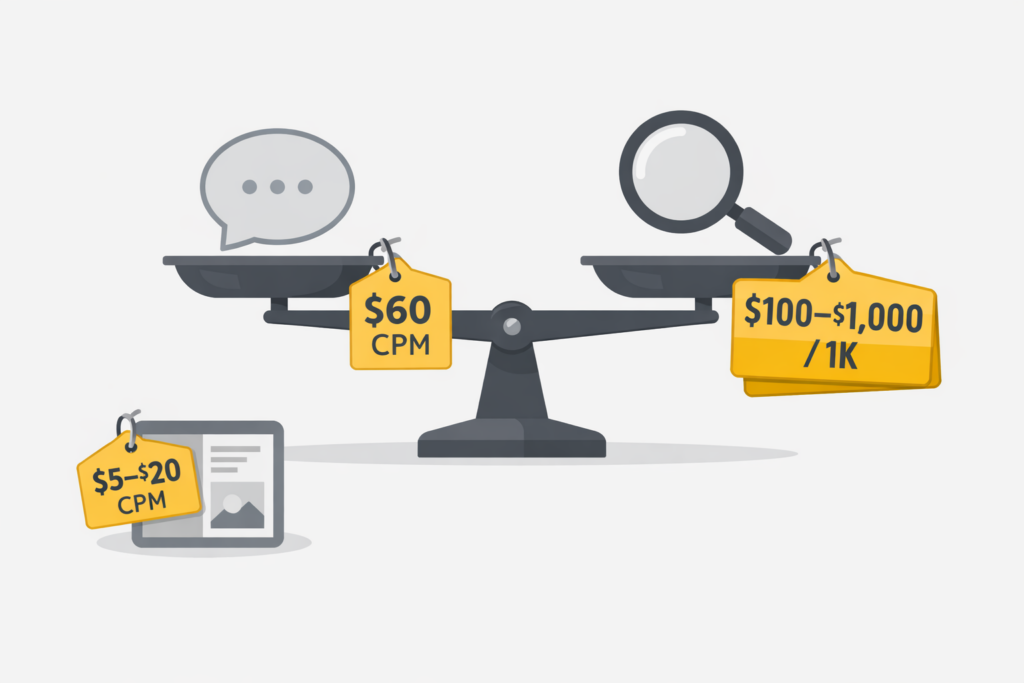
ChatGPT ads are not 3 times more expensive than Meta ads. They’re actually about half as expensive as Google Ads per impression. That reframing changes everything about whether they’re worth your money.
At TJ Digital, we manage Google Ads campaigns where clients routinely pay $5 to $50 per click. That works out to roughly $100 to $1,000 per thousand impressions. ChatGPT’s $60 CPM looks very different when you compare it to that.
The question isn’t whether ChatGPT costs more than Meta. It’s whether ChatGPT ads behave more like Meta ads or more like Google ads. If they behave like Google ads, the $60 CPM could be a bargain.
Table of Contents
ToggleWhy Is Everyone Comparing ChatGPT to Meta?
@tjrobertson52 Are ChatGPT Ads Worth The Cost? Everyone says 3x more than Meta, but that’s the wrong comparison. Here’s what actually matters 👇 #ChatGPT #DigitalMarketing #PaidAds #MarketingTips
♬ original sound – TJ Robertson – TJ Robertson
Because the comparison looks bad for ChatGPT.
| Platform | Average CPM |
| Meta (Facebook/Instagram) | $5 to $20 |
| ChatGPT | $60 |
That makes ChatGPT look 3 times more expensive. But CPM alone tells you almost nothing about whether an ad platform is worth your money.
How Does Google Ads Compare?
Google Ads uses a pay-per-click model. The average cost per click is $2 to $5, depending on the industry. Every time your ad is shown, it has about a 5% chance of being clicked.
Run the math. Per impression, Google Ads cost 4 to 10 times as much as Meta ads. Google is also about twice as expensive per impression as ChatGPT’s $60 CPM.
Why Would Anyone Pay More for Google?
Because targeting based on search intent converts at much higher rates than targeting based on demographics.
Meta ads show up in the feed of people who might be interested in your product. You have no idea if they actually need what you’re selling right now.
Google Ads show up specifically when someone searches for your product or service. That person has already decided they want to buy something. They’re just looking for who to buy it from.
The conversion rate difference is significant. Industry benchmarks show Google search ads converting 4% to 8% of clicks. Social ads often convert only 1% to 2%. That’s a 4x to 8x difference in how often clicks turn into customers.
Intent is rare. Intent converts. That’s why you pay more for it.
Does ChatGPT Behave More Like Meta or Google?
This is the only question that matters for determining if the $60 CPM is worth it.
If ChatGPT shows ads on every conversation regardless of intent, you’re paying $60 CPM for something that performs like Meta. You’re reaching people who might be drafting an email or debugging code. Not exactly buying mode.
But if ChatGPT only shows ads when someone is actively looking for product recommendations, those ads could perform as well as Google Ads. Maybe better. The conversational context gives ChatGPT even more information about what the user actually needs.
OpenAI has stated that ads will only appear when there’s a relevant product or service that fits the user’s query. They’re also excluding sensitive topics like mental health and politics from ads entirely.
If they stick to this approach, you won’t pay $60 CPM for someone asking ChatGPT to write a poem. You’ll pay for someone asking “What’s the best project management software for a team of 5?” That’s a very different value proposition.
What Kind of Conversion Rates Could ChatGPT Ads Achieve?
We don’t have concrete data yet. But we can make educated projections based on how the platform works.
If ChatGPT preserves high-intent placements, click-through rates should be higher than typical display ads. The user just asked a question. The ad directly answers it. That alignment should drive engagement.
The research suggests ChatGPT could achieve conversion rates approaching Google’s 4% to 8% range for the right queries. But this remains theoretical until advertisers start sharing real performance data.
One complication: ChatGPT currently offers no conversion tracking. You pay $60 CPM without clear data on what those impressions produce. That’s a significant risk.
When Are ChatGPT Ads Worth the $60 CPM?
The pricing makes sense in specific scenarios where timing and context justify a premium.
Product recommendation queries. Someone asking “What are the best noise-cancelling headphones under $200?” is in active buying mode. That’s exactly the kind of high-intent moment worth paying for.
B2B software. If a decision-maker asks “We need a better CRM for our sales team” and your ad appears, that single impression could be worth thousands in customer lifetime value. B2B SaaS companies typically have high enough margins to justify the CPM.
High-consideration purchases. People use ChatGPT for research before significant purchases. Reaching them during the comparison phase is valuable.
Travel planning. “What should I do on a weekend in Santa Fe?” sets up perfectly for hotel or tour company ads.
These use cases share one thing: the user has expressed clear purchase intent.
When Should You Avoid ChatGPT Ads?
If you’re a local small business with a modest ad budget, ChatGPT ads aren’t accessible yet.
OpenAI is reportedly requiring minimum commitments between $200,000 and $1 million for pilot campaigns. There’s no self-serve interface. No support for small budgets. No local targeting features.
For most small to medium businesses, the platforms that work right now are Google Ads and Meta. These offer proven ROI, mature tracking, and budgets you can actually control.
Will ChatGPT Ads Replace Google Ads?
No. Not for a long time.
Google has 10 to 20 times the distribution of ChatGPT. They’ve spent over 20 years developing their ad platform. Millions of businesses use Google Ads because it reliably delivers measurable results at scale.
ChatGPT is one product with a few hundred million users. It’s useful, but it doesn’t cover all the ways people find products and services. Many users still go to Google for local services, visual product browsing, and reading reviews.
That said, if ChatGPT ads aren’t immediately saturated with advertisers, early adopters in the right categories could see strong returns. The opportunity exists for businesses willing to pay the premium and accept the tracking limitations.
What Should You Do Right Now?
For most businesses, the answer is simple: stick with Google Ads and Meta for now.
The platforms are proven. The tracking is mature. The ROI is measurable. You can start with any budget and scale based on results.
But keep watching ChatGPT. If the early data shows strong conversion rates and prices come down as the platform matures, this could become a significant channel. Especially for businesses where catching someone at the exact moment of decision is worth paying a premium.
The $60 CPM only looks expensive when you compare it to the wrong thing.
Ready to Get More From Your Ad Budget?
At TJ Digital, we help businesses figure out which ad platforms actually make sense for their situation. We manage Google Ads and social media campaigns with complete transparency on what’s working and what isn’t.
If you’re spending money on ads and are not sure you’re getting the best return, let’s talk.