
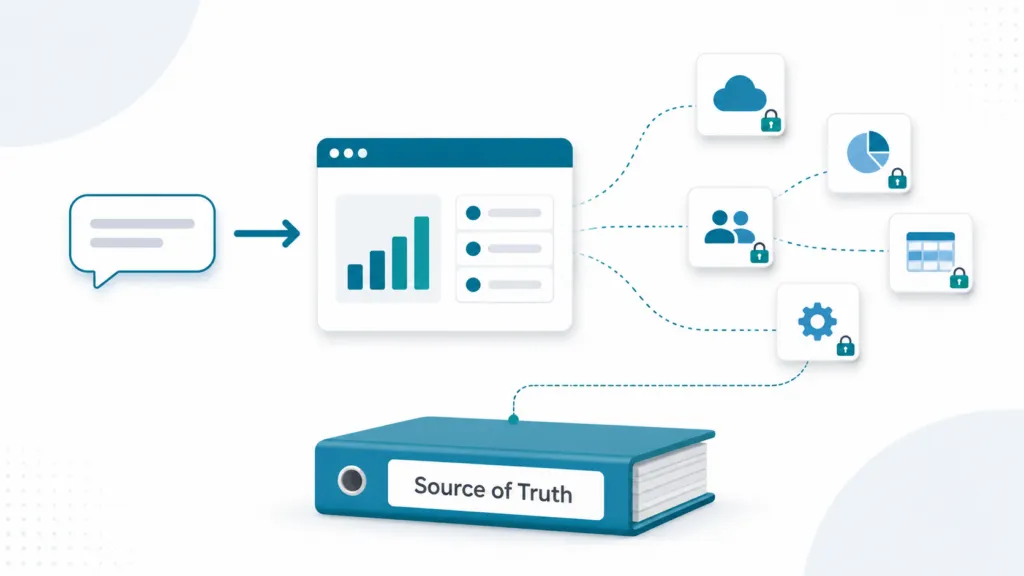
OpenAI just announced ChatGPT Sites, a new feature inside Codex that lets teams build fully hosted web applications from a plain-text prompt. It’s one of those products that solves a problem you didn’t know you had until you see it. At TJ Digital, where about 90% of our operations run inside AI platforms like Claude, we’ve been building these kinds of tools for months, and a custom interactive app beats a static document every time.
Every business should be looking at this technology right now. But I also think we’ll look back on this moment as an awkward transition phase, because these tools create a problem that most people haven’t thought about yet.
Table of Contents
ToggleWhat Are ChatGPT Sites in Codex?
ChatGPT Sites is a Codex feature that turns natural-language prompts into live web applications. You describe what you need, and Codex builds it, deploys it to a hosted URL, and adds authentication tied to your ChatGPT account. For example, you could ask Codex to build a prioritization dashboard that shows feature requests by owner and status, and your team would have a working app within minutes.
The feature launched on June 2, 2026 as a preview for ChatGPT Business and Enterprise plans. It includes persistent storage (a relational database and object storage), user authentication through ChatGPT credentials or enterprise SSO, and role-based access controls managed by workspace admins.
If you’re familiar with Claude Artifacts, Sites look like Artifacts and Dashboards combined with authentication on top. The main use case is when a team of people needs to make an important decision together.
@tjrobertson52 What is ChatGPT Sites in Codex? Useful now, but not the future of knowledge work IMO. #ChatGPT #AItools #AIforBusiness
♬ original sound – TJ Robertson – TJ Robertson
How Do ChatGPT Sites Compare to Claude Artifacts?
Both tools let you describe an application in natural language and get a working web app back. The differences come down to where and how they run.
| Feature | ChatGPT Sites | Claude Artifacts |
| Hosting | OpenAI-managed with a persistent URL | Runs inside the Claude interface |
| Authentication | ChatGPT credentials or enterprise SSO | Anthropic account login |
| Storage | Relational database (D1) and object storage (R2) | In-session state only |
| Access control | Workspace admin with role-based controls | Team-level sharing |
| Availability | Business and Enterprise plans only (preview) | Any team plan |
| Architecture | Full-stack JavaScript and TypeScript | Single-page HTML, JS, or React |
Sites are built for enterprise use. It’s designed around workspace authentication, admin oversight, and centralized permissions. Claude Artifacts are more general-purpose and available to anyone on a team plan.
I’ve been building these kinds of applications in Claude Artifacts for a while now. You only have to do it once to see it’s far superior to creating a document. It’s essentially bespoke software spun up for one specific purpose.
Should Every Business Be Using AI-Generated Web Apps?
Yes. The traditional workflow for team decisions usually starts with someone putting a document together, calling a meeting, and explaining that document to everyone in the room.
Then the team debates, someone takes notes, and someone else goes back to update the document afterward. That entire loop gets eliminated.
With Sites or Artifacts, you skip all of that. You give the information to the AI, it creates a web application, and everyone on the team interacts with the data directly. They can filter, sort, input new data, and see results update in real time.
The shift from static documents to interactive applications changes the entire decision-making process. OpenAI reported that Codex now has more than 5 million weekly active users. Roughly 20% of them are knowledge workers (not developers), and that segment is growing 3x faster than the developer segment.
Why Are AI-Built Web Apps Just a Transition Phase?
Even though every business should be using this technology right now, I think we’ll look back on this as a transition phase. It doesn’t fit within the model I think we’re heading towards.
Here’s the core problem. Each ChatGPT Site or Claude Artifact is completely isolated from the rest of your work. It only knows about the data you explicitly give it.
If two teams build separate tools about similar topics, they each have to re-enter or re-upload the information.
Over time, a company’s knowledge fragments across dozens of mini-applications. That duplication is a serious problem for any business trying to hand work over to AI.
For AI to effectively work in your business (and ultimately run parts of your business), there needs to be a single knowledge base. Each piece of information needs to live in a single canonical document written for AI. If important information is scattered, isolated, or duplicated across multiple sources, you’ll never truly be able to turn that data over to AI.
What Should Businesses Build Instead of Isolated AI Apps?
The answer is a unified knowledge base where every piece of company information has one canonical version. This is the foundation that AI tools need to actually work at scale.
At our agency, this is what we’ve been building. We call it a Brand Ambassador. For each client, it’s a curated set of documents that teaches AI everything about the business, its voice, its customers, its services, and its competitive positioning.
Instead of scattered files and chat logs, there’s one structured source of truth that any AI tool can pull from.
If you haven’t started this process yet, the most important step is to begin collecting three types of data right now. We wrote a full guide on how to prepare your business for AI that walks through exactly what to collect and how to organize it.
Are AI Operating Systems Coming for Businesses?
I believe that in the next two years, we’re going to see businesses starting to adopt AI operating systems that fully own and maintain all information about the company. These won’t be individual tools or plugins. They’ll be integrated platforms where AI agents, data, workflows, and identity management all connect.
ChatGPT Sites is a really useful tool right now. But this can’t be what knowledge work looks like two years from now.
The web applications it produces are great for collecting information, coordinating across your team, and making important decisions. But that information and those decisions still need to be reflected in your knowledge base.
I’m hoping the major platforms will stop making prototypes and toys and actually start building the operating system that’s going to run future businesses. In the meantime, we’ll continue building our own at TJ Digital. If you want to understand what preparing for agentic AI actually looks like in practice, we’ve written about what your business should be building right now.
How to Start Building Your AI Knowledge Base Today
No matter who builds the platform, the knowledge base will be mandatory. Start collecting and organizing three types of information right now.
- Call transcripts and meeting notes. Every client call, team meeting, and vendor conversation contains decisions and context that AI will eventually need.
- Standard operating procedures. Document how your team actually does things. AI needs the real workflow to automate it, not the idealized version.
- Expert guidance and institutional knowledge. The advice your senior people give to new hires. The judgment calls that aren’t written down anywhere. Get those into documents now.
The businesses that start this work today will have a significant head start when AI operating systems arrive. The ones that wait will be stuck trying to organize years of scattered information while their competitors are already running on AI.
Can AI-Generated Apps Replace Traditional Internal Tools?
Not yet. Sites is designed for quick prototypes and internal demos, not production-grade enterprise software. It works best for situations where a team needs to collaborate on a specific decision or dataset.
For tools that require complex integrations, high-volume data processing, or long-term reliability, traditional development is still the better option. OpenAI has said as much in their own documentation.
Do You Need a ChatGPT Business Plan to Use Sites?
Yes. As of June 2026, Sites is available only to ChatGPT Business and Enterprise plans. Solo users on Plus or Pro cannot access it yet.
OpenAI has indicated that availability will expand to more plans, but hasn’t provided a specific timeline.
Is This a Replacement for Website Builders Like Squarespace?
Sites is not competing with website builders. It’s designed for internal tools and team collaboration, not public-facing websites. It generates dashboards, trackers, decision-support tools, and lightweight workflow applications with workspace authentication and persistent data storage.
Website builders like Squarespace are designed for marketing sites, online stores, and public content. They solve entirely different problems.
Build the Foundation That AI Tools Actually Need
Whether you end up using ChatGPT Sites, Claude Artifacts, or whatever comes next, the bottleneck won’t be the tools themselves. It will be whether your business has the organized knowledge base that these tools require. Reach out to TJ Digital for a free audit of your current digital presence and a clear plan for what to build next.