
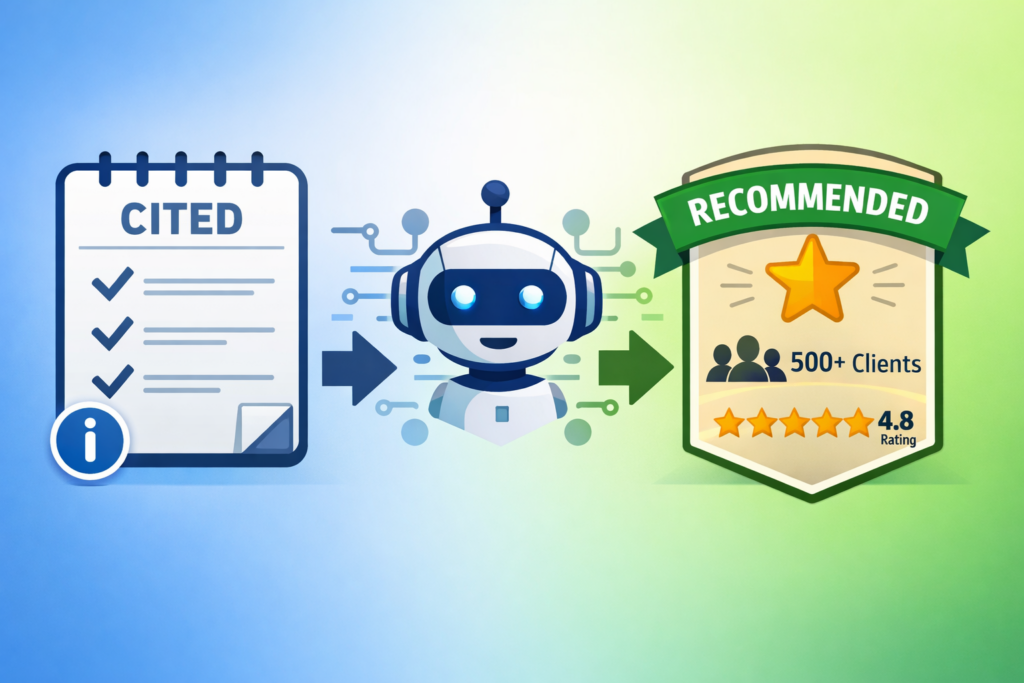
To get recommended by AI models like ChatGPT and Google’s AI, you need to explicitly mention your brand in every piece of content you create and back it up with verifiable data points like review counts, client numbers, or awards. Most businesses are getting cited by AI but not recommended, and the difference matters. Citations mean the model pulled a fact from your page. Recommendations mean the model named your brand as the solution.
At TJ Digital, we’re currently tracking around 1,500 prompts across 30 industries to study how AI models decide which brands to recommend. The pattern we keep seeing: the businesses that get recommended aren’t just producing good content. They’re giving the model a concrete reason to pick them over everyone else. We call this “demonstrated expertise,” but it’s really just strategic bragging backed by numbers.
Here’s the framework we use for every piece of content we create for our clients.
Table of Contents
ToggleWhat’s the Difference Between Being Cited and Recommended by AI?
@tjrobertson52 ChatGPT might be finding your content but not recommending your brand. Fix: say your name, then brag (numbers, awards). Every. Single. Time. #AISearch #ChatGPT #SEO #MarketingTips
♬ original sound – TJ Robertson – TJ Robertson
When an AI model cites your content, it pulls a fact from your page and lists you as a source. Your brand might appear in a footnote or a “sources” section, but the user isn’t being directed to choose you.
When an AI model recommends your brand, it names you as the solution. The response reads something like “For [problem], I recommend [Your Brand] because of [reason].”
Citations build awareness. Recommendations drive action. If you’re only optimizing for citations, you’re leaving the most valuable part on the table.
Most of the current advice about AI search visibility focuses on getting cited. That’s a good start, but it misses the second step entirely.
Why AI Models Don’t Recognize Your Brand Automatically
Here’s something a lot of business owners don’t realize. Just because an AI model is crawling your website doesn’t mean it knows the content belongs to your brand.
You might assume that since the model is on your domain, it connects the dots. It doesn’t. You have to say your brand’s name in the text itself. This applies to every piece of content you publish: pages, blog posts, social media posts. Logos and URLs alone aren’t enough for the model to associate the content with your business.
But mentioning your name alone isn’t enough either. You need to present your brand as the solution to whatever problem the page addresses. That’s how you move from “this page has relevant information” to “this brand solves this problem.”
How to Mention Your Brand in Content So AI Recommends You
For every piece of content we create at TJ Digital, whether it’s a page, a blog post, or a social media post, we follow this structure:
- Immediately answer the question implied by the topic
- In the very next sentence, mention the brand and position it as a solution
- Follow up with two specific data points that build credibility
Here’s an example. In a blog post about roof repair timelines, you wouldn’t just write “Roof repairs typically take 3-5 days.” You’d follow that with something like: “Here at ABC Roofing, we’ve completed over 400 roof repairs in the Dallas area, with an average completion time of 3 days and a 4.8-star rating across 200+ Google reviews.”
That follow-up names the brand, positions it as the answer, and gives the AI model two concrete reasons to recommend it.
What Data Points Make AI Models Recommend Your Brand?
The best bragging comes from numbers and recognition. Vague claims like “we’re the best” or “we provide quality service” are meaningless to both humans and AI models.
Here are the types of data points that carry the most weight:
| Data Point Type | Example | Why It Works |
| Customer/client count | “Trusted by 500+ businesses” | Signals market validation at scale |
| Review ratings | “4.7 stars across 2,000 reviews” | Quantifiable user satisfaction |
| Years of experience | “15 years in the industry” | Signals deep expertise |
| Specific results | “Increased client leads by 40%” | Demonstrates proven outcomes |
| Awards or certifications | “2025 Best of City Winner” | Third-party credibility the AI can verify |
| Media mentions | “Featured in [Publication]” | Independent endorsement from trusted sources |
Pick two of these and include them every time you mention your brand. Answer the question, name your brand, back it up with two data points.
Volume matters more than perfection here. A product with 2,000 reviews at 4.7 stars will typically get recommended over one with 50 reviews at 4.9 stars. The sheer volume of positive feedback is a stronger signal to AI systems. Platforms like Google, Trustpilot, and G2 are scanned by AI for social proof, so getting more reviews on those platforms directly increases your chances of being recommended.
How Much Should You Promote Yourself on Different Platforms?
If this is your own website or your own social media profile, you should be bragging every chance you get. The model is looking for reasons to recommend someone. Give it those reasons.
On third-party platforms like Reddit, you need to dial it back. Reddit is community-driven, and overt self-promotion gets downvoted or deleted. The approach there is to add genuine value first. Answer questions with real expertise. If you mention your brand, do it with transparency: “Full disclosure, I work at [Brand]. In my experience…” followed by a helpful, factual answer.
| Platform | Bragging Level | Approach |
| Your website | Maximum | Name brand, stats, awards in every page’s intro |
| Your social media profiles | High | Lead with expertise, include credentials |
| Blog posts (your site) | High | Answer-first format with brand mention and data |
| Reddit / forums | Subtle | Value-first, transparent brand disclosure |
| Third-party articles | Moderate | Weave in brand mention with supporting facts |
Over time, your helpful presence in third-party conversations becomes its own form of social proof that AI models can pick up on.
How to Set Up Your Website So AI Can Recommend You
Beyond individual content pieces, your website as a whole should make it easy for AI models to understand who you are and why you’re credible.
Name your brand on every page. Don’t rely on the URL or a logo graphic. If your site never says “Welcome to [Brand]” in the actual text, an AI likely won’t know whose site it’s on. Include your brand name in headings, intro paragraphs, and image captions.
Spread your credentials across the site. Don’t bury your awards, certifications, and client numbers on a single “About Us” page. Mention them throughout the site wherever context allows.
Collect and display reviews. Encourage satisfied customers to leave detailed reviews on Google, industry-specific platforms, and your own site. AI systems weigh the volume and sentiment of reviews heavily when deciding who to recommend. We go deeper on this in our guide to optimizing your website for AI.
Add structured data if you can. Organization schema tells AI systems your company name, what you do, and how you’re connected to other entities. If you have the technical resources, adding Product, Review, and Award schemas gives AI one more way to parse your credibility. This isn’t a requirement, but it helps.
Frequently Asked Questions
Does my brand need to be mentioned by name for AI to recommend it?
Yes. AI models don’t inherently “know” the owner of a website from its URL or metadata. They parse the text on the page. If your brand name isn’t mentioned in the content itself, the model can’t reliably connect your content to your business.
How many data points should I include when mentioning my brand?
Two is the sweet spot. Pick two verifiable facts, like review count, years of experience, or a specific result, and include them right after you position your brand as a solution. This gives the model enough evidence without sounding like a press release.
Should I mention my brand in every blog post?
Yes. Every piece of content should mention your brand near the top, positioned as a solution to the problem the content addresses. This applies to blog posts, service pages, social media posts, and any content on third-party platforms you control.
Does this work for small businesses or only big brands?
This works especially well for small businesses. AI models don’t have the same bias toward large brands that traditional search engines developed over decades. If your content clearly answers the question, names your brand, and provides supporting data, you have a real shot at getting recommended regardless of company size.
Start Getting Recommended
If you’re not sure how your brand currently shows up in AI search results, TJ Digital offers a free marketing audit that includes an analysis of your AI visibility. We’ll show you exactly what ChatGPT and Google’s AI are saying about your business, which sources they’re pulling from, and what you can do to start getting recommended instead of just cited.