
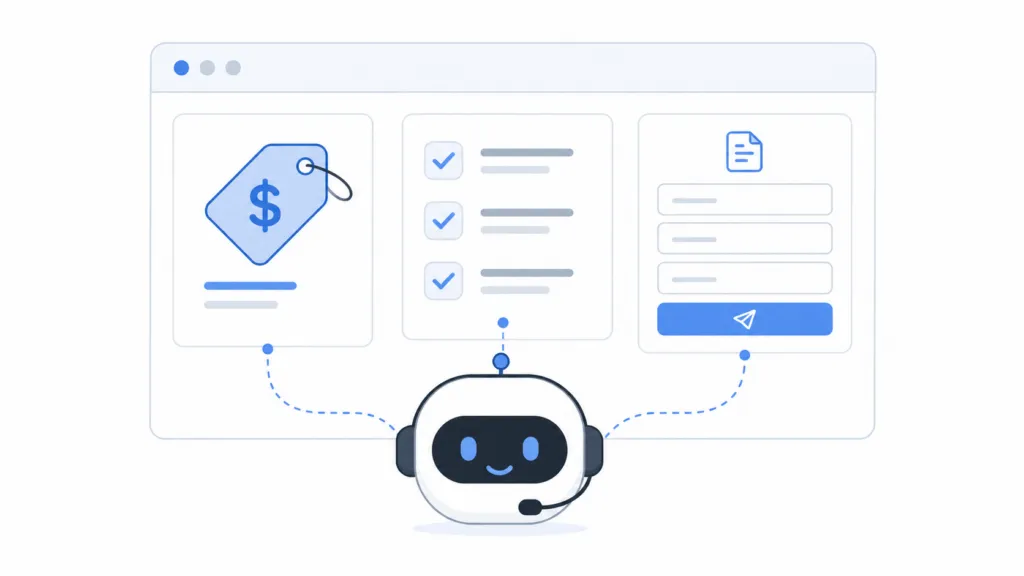
To prepare your website for AI agents, give them everything they need to recommend you. That means clear pricing, complete service information, a quote form they can fill out, and a phone line they can actually reach. At TJ Digital, we track around 4,000 AI prompts per day across ChatGPT, Google AI Mode, and Perplexity for our clients, and AI-referred visitors convert at about 8x the rate of traditional search visitors.
We’re heading into a world where AI agents make most buying decisions on behalf of people, and the businesses that feed those agents the right information win by default.
Here’s what’s coming. At Google I/O, Google confirmed that after someone searches for the products or services you offer, they’ll get the option to have an AI agent check pricing on you and your competitors. Those agents will read your website, check your Google Business Profile if you’re local, fill out your forms, and even call you to get information. So let’s go through what you need to do to get ready.
Table of Contents
ToggleWhat Are AI Agents and Why Do They Matter for Your Website?
An AI agent is software that acts on a person’s behalf. When a customer wants to evaluate you, the agent reads your website for them, compares you against competitors, and reports back with a recommendation. Within a year, I wouldn’t be surprised if most of the calls and form submissions hitting your business come from agents rather than people.
That changes the job of your website. An agent needs to find every fact required to recommend you, so your site has to make those facts easy to pull. If an agent can get what it needs from you and can’t get it from your competitor, you get the recommendation.
@tjrobertson52 AI agents are about to call your business and compare your pricing to competitors. Google just announced this. If they can get what they need from your competitor and not you, you lose by default. Here’s how to get ready 👇 #AIAgents #SmallBusiness #GoogleIO #DigitalMarketing
♬ original sound – TJ Robertson – TJ Robertson
How E-Commerce Businesses Should Prepare for AI Agents
If you run an e-commerce store, the main thing you need to do is implement Google’s Universal Commerce Protocol and make sure you’re eligible for the universal shopping cart. This is the open standard that lets a shopper’s AI agent add your products to a cart and check out directly.
If you’re on Shopify, this is largely happening automatically. On other platforms, you’ll need to look into it. The protocol works by hosting a discovery file on your server and supporting Google’s cart and checkout APIs, and you stay the merchant of record the whole time. You can read Google’s developer documentation for the technical setup.
For a deeper walkthrough on the product side of this, see our guide on setting up your product feed for ChatGPT and Google AI shopping.
How Local Businesses Should Prepare for AI Agents
If you’re a local business, your Google Business Profile is the first place many agents will look. Fill out every single field, including all of your services. Incomplete profiles get skipped because the agent can’t confirm the facts it needs.
A few things make the biggest difference for local profiles:
- Complete your name, address, phone, hours, categories, and a full service list
- Keep hours and pricing current, since agents compare your data across sources and distrust anything stale
- Connect your booking option if you use a third-party scheduling integration, so an agent can book without a phone call
- Add recent photos and posts, which signal freshness to Google’s local AI
Why Your Website Needs Pricing Information for AI Agents
For most businesses, the agent’s first stop is your website itself. Make sure it has all the information a person or an agent would want when deciding if you’re the right fit.
I highly recommend including pricing information on your website if you can justify it. An agent reads all of that content and uses it to compare you against everyone else. If you’re not one of the cheapest, spell out the argument for why someone should choose you anyway, which gives the agent something to repeat back to the user.
Here’s how the two approaches compare for an agent trying to recommend a business:
| What’s on your site | What the agent can do |
| No pricing listed | Skips you or marks pricing as unknown |
| Flat prices listed | Quotes your exact prices to the user |
| Price ranges plus reasoning | Quotes a range and explains your value |
| Custom quotes only, no form | Has nothing to work with unless it can request a quote |
How to Set Up a Quote Form AI Agents Can Use
If you offer custom quotes, build an interactive quote form on your website. Then you’ll need to integrate WebMCP so AI agents can fill it out and submit it the way a person would.
WebMCP is a protocol that lets your site tell an agent what its forms and tools can do. To get ready, use standard HTML form elements with clear, descriptive names on every input, and keep important content like pricing and forms in the raw page rather than buried inside heavy JavaScript that agents can’t read. Done right, your quote form becomes a tool the agent can operate directly, which turns an agent visit into a real lead.
What to Do When AI Agents Call Your Business
You’re going to start getting phone calls from AI agents. When a customer asks an assistant to check prices or book an appointment, the assistant may place an automated call to your business to confirm the details.
You need to answer these calls, and if a human can’t pick up quickly, have an AI answer. Most importantly, make sure your staff knows not to hang up on the agent. These calls represent real customer requests, so train your team to treat them like any other inquiry.
A simple scripted reply works well. Give your hours, quote a service or diagnostic fee, and note that an exact quote follows an assessment.
You can also reduce how often agents call by feeding the information into Google ahead of time. The more pricing and service details you publish on your website and profile, the less an agent needs to call to confirm it. For more on how Google is building agents into search, see our breakdown of Google AI agent SEO.
How Soon Do You Need to Prepare Your Website for AI Agents?
The shift is already underway, and the businesses preparing now will have a real advantage while their competitors wait. We estimate fewer than 2% of small and medium-sized businesses are doing any of this work yet, which means the window is wide open.
The core idea is simple. An AI agent is going to compare you against your competitors on behalf of a buyer. If you make every fact easy to find, your pricing, your services, your quote form, and a phone line that answers, you make it easy for the agent to recommend you. If your competitor makes the agent work for that information, you win by default.
If you want help getting your website and business ready for AI agents, reach out to TJ Digital and we’ll walk you through it.