
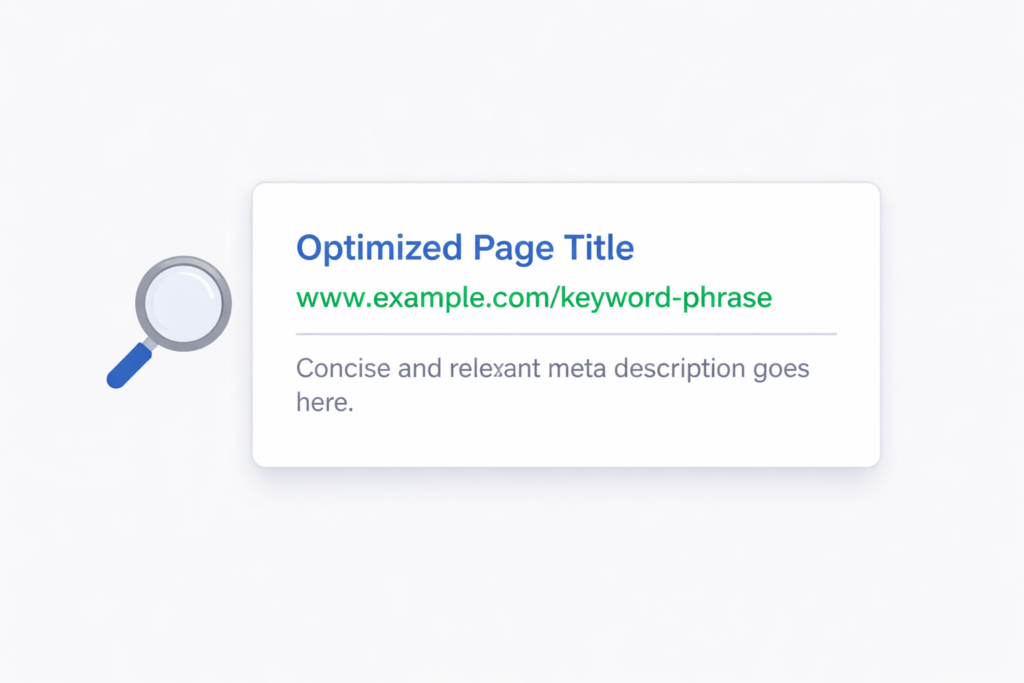
If you want your website content to get noticed by large language models, you need to understand metadata relevance. Your title tag, meta description, and URL structure determine whether an LLM even looks at your page.
If you know anything about SEO, you’re probably thinking you already know this. But it works differently with large language models.
At TJ Digital, we’ve run hundreds of prompts through ChatGPT and other LLMs to see which websites get cited. Profound’s research confirms what we’ve observed: pages with keyword-rich URL slugs received 11.4% more AI citations than those without. Small changes to metadata can make a measurable difference in AI visibility.
Table of Contents
ToggleHow LLMs Decide Whether to Retrieve Your Content
@tjrobertson52 Meta Tag Optimization for AI Search: LLMs only see your title, URL, and meta description before deciding to visit. Spoil the answer. #AIsearch #SEO #LLM #AIvisibility
♬ original sound – TJ Robertson – TJ Robertson
In traditional search engines, your title tag and URL help determine your rankings. Large language models use these signals too. But they add an extra step.
When you ask ChatGPT a question, it performs maybe a dozen different searches. Each search returns hundreds of results. The LLM doesn’t crawl every page. Instead, it reviews the title, URL, and meta description of each result to decide which pages are worth retrieving.
The LLM takes on the role a human would in a traditional Google search. You see titles, URLs, and descriptions. You decide which pages to visit. The difference: LLMs don’t respond to curiosity hooks or emotional language. They look for clear signals that a page will answer the question.
If your metadata doesn’t signal relevance, the LLM moves on. Your content never gets a chance.
The LLM Retrieval Process
According to research from LeadSpot, LLMs follow a specific sequence when deciding which content to retrieve.
First, the AI transforms the user prompt into search terms. It often adds context or related concepts. Then it retrieves top hits via a web API and reads each result’s title, URL, and snippet. Next, the LLM filters by checking if those elements contain clear, on-topic information. If a result passes the title and snippet test, the LLM fetches that page’s content. Finally, it identifies specific passages that best answer the question.
Your metadata determines whether you make it past step three. Everything else on your page is irrelevant if you get filtered out here.
How to Optimize Your Title Tag for AI Search
The best way to determine what the large language model is searching for is to use a tool like Profound or Peec. These tools simulate prompts and track the actual searches that the LLM performs.
If you don’t have that data, guess what a person might search if they were looking for the content on that page. But keep in mind that large language models search differently than humans.
LLMs typically perform much longer, more specific searches. They often append:
- The demographic or location of the user
- A specific use case
- The current year
Once you have a specific search term, include it in the title of the page. Front-load it. The primary keyword should appear as close to the beginning as possible.
An SEO-style title like “10X Your Sales Results!” becomes “Sales Automation Platform: Pipeline Management for B2B SaaS” for AI optimization. The second version tells the LLM exactly what the page is about.
How to Optimize Your Meta Description for AI Search
My recommendation: spoil the answer.
Think of the question the user was most likely asking. Then provide a concise answer to that question as your meta description. This makes the large language model confident that your page will answer the question.
This is different from traditional SEO. We’ve known for a long time that meta descriptions don’t impact Google ranking. But meta descriptions can have a huge impact on your visibility in large language models like ChatGPT.
Traditional SEO vs. AI Search: Meta Descriptions
| Traditional SEO Approach | AI Search Approach |
| Tease the reader to click | Spoil the answer upfront |
| Use emotional hooks | Use factual statements |
| “Discover the secret…” | “This platform tracks leads across 7 stages…” |
| Focus on curiosity | Focus on information density |
What Works for AI Meta Descriptions
Start with a concise answer or definition rather than a teaser. Avoid phrases like “In this article you will learn…” or “Click here to find out…” These waste characters.
Mirror the query format. For a “how to” query, begin “This guide explains how to…” This alignment makes the snippet more likely to be used.
Include specifics. Pack in concrete details: numbers, data, unique attributes. A sentence like “Framework includes 15 behavioral signals and 8 demographic factors” provides verifiable facts that AI systems can quote.
Write complete sentences that can be understood out of context. An AI may extract the description verbatim, so it must read as a self-contained summary.
Keep it within 150-160 characters. Prioritize clarity over style. The goal is giving the LLM enough of a snippet to trust and cite your content.
How to Optimize Your URL Structure for AI Search
Clear, descriptive URLs remain important for AI visibility. Google has largely downplayed URL keywords. But LLM-based search still treats slugs as a relevance signal.
Include the main keyword using hyphens. Use /best-crm-software-2025 rather than /page?id=1234. This gives an immediate cue to the AI about content focus.
Write the slug in plain words. Avoid jargon or over-stuffing. /marketing-automation-platform-guide is clearer than /auto-marketing.
If applicable, include categorical information. /products/sales/crm-platform tells an AI that this is a sales CRM product page. This helps disambiguate content when the LLM scans URL snippets.
Keep it concise but specific. LLMs scan URLs left-to-right. Put the most important words first.
Why Metadata Optimization Matters More for AI Than Traditional Search
AI-powered search behaves differently from classic Google queries. LLM systems synthesize direct answers rather than returning a ranked list of pages. They often break one user question into many “hidden” sub-queries and combine the results.
Asking “best CRM for real estate” might trigger dozens of internal searches: “CRM with MLS integration,” “best CRM for small real estate teams,” “real estate CRM pricing,” and more.
This creates a winner-takes-most dynamic:
- Research shows 80% of LLM-generated answers cited fewer than 10 URLs. Either your content gets selected and cited, or it gets ignored entirely.
- Only about 38% domain overlap exists between AI answer sources and traditional search results. Ranking well in Google doesn’t guarantee AI visibility.
- AI answers show strong bias for up-to-date and clearly-stated information. Recency and clarity matter more than backlinks.
Your metadata is your first impression with the LLM. If it doesn’t clearly signal that your page answers the query, you won’t get retrieved.
Tools for Tracking AI Visibility
Several tools can show you how AI assistants search for and cite your content:
- Profound tracks dozens of LLM channels and shows which pages and passages are cited. It’s enterprise-grade and the most comprehensive option.
- Peec AI offers prompt research and basic tracking of major LLMs at a more affordable price point.
- Otterly.AI turns target keywords into LLM prompts and tracks mentions. It’s the most budget-friendly option.
These platforms simulate user prompts and report how often your content appears in AI answers.
Next Steps
This was the number three AI visibility factor from Kevin Indig’s Growth Memo Newsletter. Your metadata is essentially an advertisement to the LLM. Get it right, and you’re in the conversation. Get it wrong, and your content never gets seen.
Metadata optimization is just one piece of AI search optimization. The bigger picture includes content structure, brand mention building, and showing up on the third-party sites that LLMs cite most often.
If you want help optimizing your website for AI search, contact TJ Digital for a free digital marketing audit. We’ll show you how your current metadata performs with AI platforms and what changes will have the biggest impact.