
Ranking well in traditional search does help you show up in AI results. But it’s not the whole story.
At TJ Digital, we’ve been tracking how ChatGPT, Google’s AI mode, and other large language models choose which businesses to recommend. After running thousands of prompts through these models across dozens of industries, what we’ve found is that LLMs don’t search the way humans do. They break your query into dozens of hyper-specific sub-searches. That changes the game for smaller businesses that could never compete for the big keywords.
Here’s how it actually works and why organic ranking is just one factor.
Table of Contents
ToggleHow Do Large Language Models Use Search Engines?
@tjrobertson52 ChatGPT doesn’t search the way you do. It runs hyper-specific queries with almost no competition. That’s your opportunity 👀 #AISearch #GEO #SEO #ChatGPT #MarketingTips
♬ original sound – TJ Robertson – TJ Robertson
When someone asks ChatGPT or Google’s AI mode for a recommendation, the first thing it does is run a series of searches in a traditional search engine. The response you get back is more or less a summary of the pages found in those searches.
So if you rank well in traditional search, you’ll show up in AI responses. That part is true.
But here’s what most people miss. These models don’t search for the same competitive terms that humans do.
What Is Query Fan-Out?
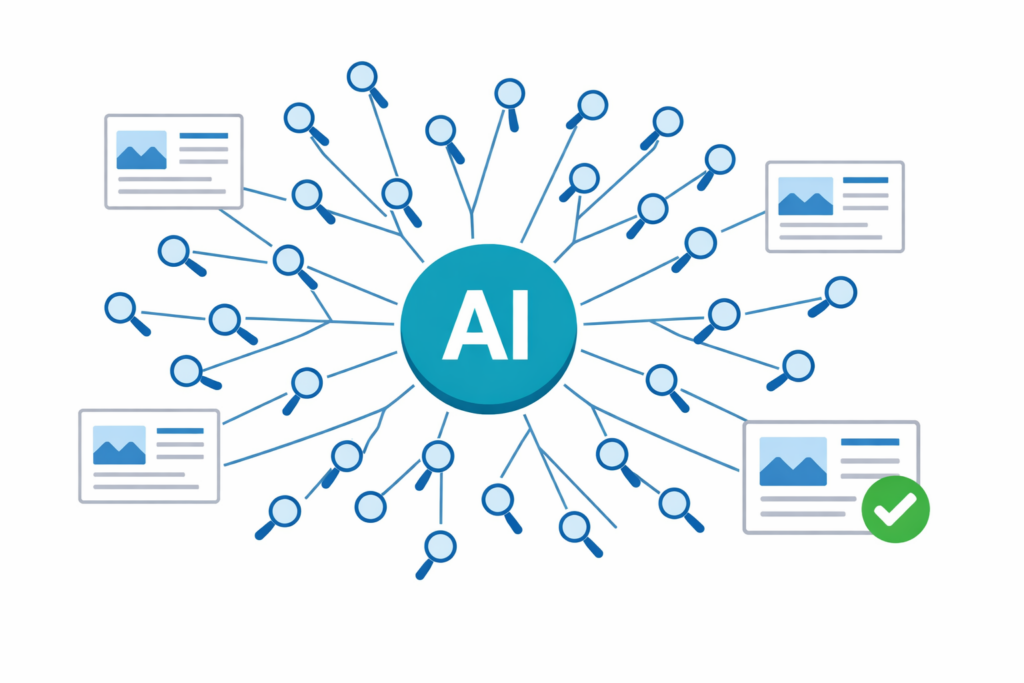
Large language models do something called query fan-out. They take your prompt and break it into a series of more specific searches. These are sometimes called long-tail searches.
Say someone asks “what’s the best laptop for video editing under $2,000.” The AI might fan that out into separate searches for GPU requirements, battery life, Adobe Premiere compatibility, and more. It pulls relevant information from each sub-search and combines everything into one answer.
This means ranking #1 for the main keyword doesn’t guarantee you’ll appear in the AI response. The AI is looking at who best answers each of the 10 to 20 sub-queries it generated. It doesn’t care who ranks #1 for the original term.
The Three Factors That Determine Your Search Ranking
Traditional search rankings come down to three categories of factors.
| Factor | What It Measures | Your Control Over It |
| Relevance | How well your content matches the search query | High. This is determined by your page content. |
| User behavior | Whether visitors are satisfied after clicking your page | High. This is determined by content quality and UX. |
| PageRank | Quality of backlinks pointing to your site | Low. This takes significant time and resources to build. |
Two of these three factors are almost entirely determined by what’s on your page. You have full control over that.
PageRank takes a lot of time and money to build. But PageRank only matters when you’re competing against pages that have more of it than you do.
For competitive head terms, you still need a high PageRank. That hasn’t changed.
Why PageRank Matters Less in AI Search
Because large language models use query fan-out, the actual searches they perform are far more specific than what humans type. There’s a lot less competition for these terms. In many cases, the searches are so specific that there’s not a single page on the internet targeting that exact term.
Research from Profound backs this up. Their analysis found a correlation of just 0.038 between backlink strength and AI citations. For over 97% of websites, there was no correlation at all between backlinks and being cited by AI.
LLMs care more about content quality, author expertise, and factual accuracy than they do about backlink profiles. Trust signals like brand mentions, credentials, and comprehensive answers are becoming the new authority metrics.
What This Means for Smaller Sites
If you don’t have massive domain authority, this is good news.
You can create hyper-relevant pages that perfectly match these specific search intents. Because you have no direct competition for most of these long-tail terms, PageRank becomes far less important.
These pages won’t get hundreds of visits a month. They might get 2-5 visits a month each. So for this to work, you need to create a lot of them. But the visits they do get convert at a much higher rate than traditional search traffic.
How Much Better Does AI Traffic Convert?
Visitors from large language models convert at about 8x the rate of traditional search engines. SEMrush’s data puts the conservative estimate at 4.4x. Other reports show early adopters getting 3-8x higher conversion rates from AI referrals.
This happens because AI does the filtering before users ever reach your site. By the time someone clicks through from an AI-generated answer, they’ve already completed most of their research. They’re not browsing. They’re ready to act.
So even though each hyper-specific page gets minimal individual traffic, the quality of that traffic makes the strategy worth it.
How to Create Hyper-Specific Pages Efficiently
The key is building pages that answer very specific queries where no good page exists yet. This means producing many niche pages. That requires a system.
Here’s what works:
- Identify query gaps. Use tools like LLMrefs’ Query Fan-Out Generator to see exactly what sub-queries an AI would generate from a given prompt. Then check which of those sub-queries have no strong answers on the internet.
- Use page templates. Create a template tailored to a specific query type, like a Q&A layout or data-driven comparison, and fill it for each target term. This lets you produce dozens of pages without starting from scratch every time.
- Answer the query immediately. Each page should directly address its target question in the first sentence or paragraph under the heading. Then add supporting detail below. This makes the page easy for both humans and AI to extract information from.
- Scale with data. Automate page creation using product, location, or industry data so you can target hundreds of unique queries efficiently. For example, a window tinting company could create separate pages for ceramic tinting, carbon tinting, and dyed tinting, each answering the specific questions people ask about that type.
This is a core part of how we approach AI optimization at TJ Digital. We identify the exact sub-queries that large language models search for in our clients’ industries, then create pages that are the best possible answer for each one. Because these terms have almost no competition, even newer or smaller websites can rank for them.
How to Track Your AI Visibility
Traditional analytics won’t show you which AI sub-queries are driving traffic. You need specialized tools.
| Tool | What It Does |
| LLMrefs Query Fan-Out Generator | Shows the sub-queries an AI would generate from a given prompt |
| Peec.ai | Tracks where your brand is being cited in AI results and which sources AI relies on |
| SEMrush AI Overview Tracker | Monitors how often your content appears in AI-generated answers |
| Google Search Console | Shows impressions and clicks from traditional search, useful for identifying long-tail opportunities |
We use Peec.ai for our clients. It shows the actual pages that large language models reference before making recommendations. That tells us exactly where a brand needs to be mentioned or what content needs to exist on their site to increase visibility.
So Does Organic Ranking Still Matter for AI?
Yes. A strong organic presence broadens the number of terms your site can rank for. That still feeds into AI visibility. If your site has zero presence in traditional search, AI systems are less likely to find you.
But organic ranking alone isn’t enough. AI search opens up real opportunity for lower-authority sites to get visibility on specific, low-competition terms that these models actually search for. This is where smaller businesses can compete with much larger brands without needing massive backlink profiles or years of domain authority.
As long as you have a process for creating these pages efficiently, it’s well worth it.
Get Your AI Visibility Assessed
Not sure where your business stands in AI search results? We offer a free digital marketing audit that includes an analysis of how large language models handle queries in your industry. We’ll show you exactly where the opportunities are. No obligation, no cost.
If you have a marketing budget of at least $750 a month, reach out and we’ll put together a full audit with a video walkthrough and a document outlining what we’d prioritize.