
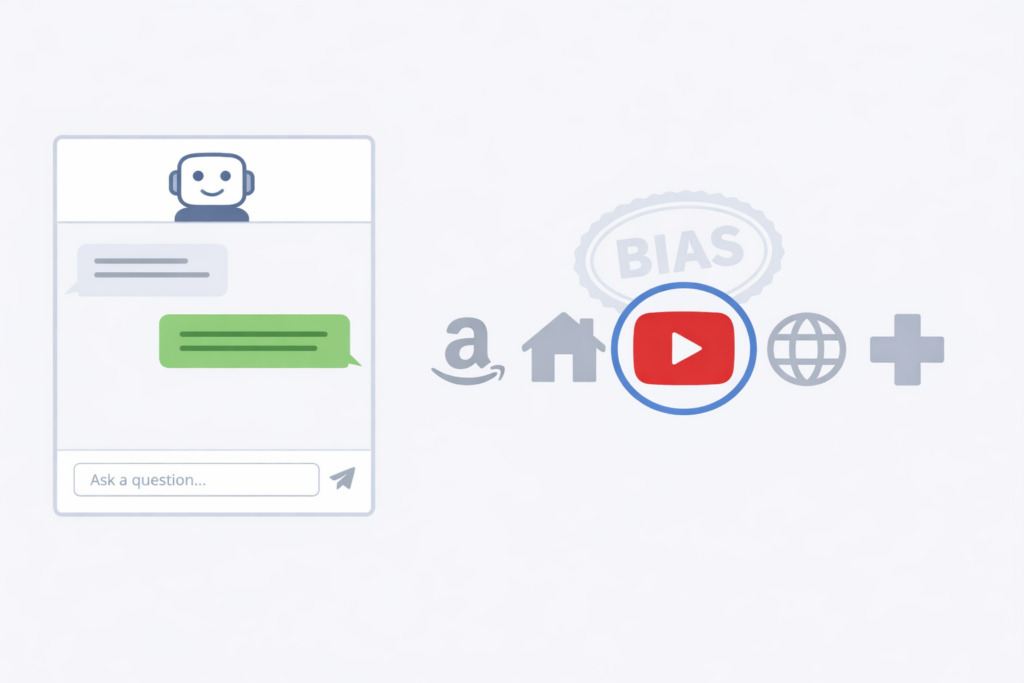
Before ChatGPT even runs a search, it already has opinions about which brands to trust. This “primary bias” is baked into the model from its training data. It heavily influences which websites get retrieved when you ask a question. For smaller brands trying to compete in AI search, understanding this bias is one of the most important factors in getting recommended.
At TJ Digital, we’ve analyzed how dozens of clients perform across ChatGPT, Perplexity, and Google’s AI mode. Through this work, we’ve found that primary bias often determines visibility before content quality even enters the equation.
Table of Contents
ToggleWhat Is Primary Bias?
@tjrobertson52 AI Search Factor 1_ Selection Rate & Primary BiasAI search already has opinions about your brand before it even searches. Here’s what that means for you. #AISearch #SEO #DigitalMarketing #ChatGPT #SmallBusiness
♬ original sound – TJ Robertson – TJ Robertson
Primary bias refers to the predisposition a large language model has toward certain brands before it performs any search. Think of it as the AI’s preformed worldview created during training.
LLMs like ChatGPT are pre-trained on massive amounts of internet data. If a significant amount of information exists about a specific brand, the model has already formed an opinion about that source. When you ask ChatGPT a question about real estate, there’s a good chance it immediately searches for Zillow. Not because Zillow necessarily has the best answer. The model has simply learned to associate Zillow with real estate authority.
This bias has huge implications for which webpages get retrieved in that initial search. Websites seen as trusted authorities are much more likely to be included. According to DEJAN’s research on AI search, a brand with weak or confused presence in training data struggles to get selected even when its content is relevant.
How Do LLMs Decide Which Sources to Trust?
When you ask a question, AI platforms use a process called retrieval-augmented generation (RAG). It happens in three steps:
| Step | What Happens |
| Retrieve | The model searches the web and pulls relevant pages |
| Augment | It combines this new information with its base knowledge |
| Generate | It creates an answer, citing only the sources it deems most trustworthy |
LLMs trust sources through pattern recognition, not traditional SEO ranking. They favor content from domains known to contain reliable information. Perplexity’s engine, for example, explicitly prioritizes pages that are relevant to the query, clearly structured, and hosted on high-authority domains.
In consumer categories, this means established platforms dominate. Amazon for products. Zillow for real estate. WebMD for health questions. The AI cites pages it judged most relevant and authoritative based on patterns learned during training.
Why Does Query Competitiveness Matter?
The more competitive a search term, the more primary bias dominates the results.
For popular queries with well-known players, the AI defaults to familiar answers. It keeps quoting the same big names because those are the brands it already trusts. This makes it extremely difficult for smaller brands to break through on competitive terms.
Niche queries work differently. When the model has fewer pre-trained assumptions about a topic, it relies more heavily on the actual content it finds at query time. You see more variety in long-tail question answers. This gives newer brands a fighting chance.
This is why I recommend smaller brands focus on hyper-specific terms. They’re much less competitive. The AI has to actually evaluate your content instead of defaulting to established players.
How Can Small Brands Compete with Established Authorities?
If you’re not Zillow or Amazon, you have two main strategies for improving your selection rate.
Strategy 1: Own a narrow niche.
Create content that answers very specific category-level questions with detailed, factual information. Instead of targeting “best digital cameras” where major retailers dominate, focus on something like “best mirrorless camera lenses for astrophotography.” On narrowly defined topics, the model relies more on content signals than preconceived fame.
Strategy 2: Piggyback on trusted platforms.
Publish your best content on high-authority domains that AI already indexes. Medium, LinkedIn, Reddit, industry blogs. When you host content on a platform the AI trusts, your content rides their authority.
One SEO practitioner reported that a Medium post was cited by Perplexity within 24 hours simply because the platform was trusted. This approach bypasses the slow climb of building your own domain’s reputation.
What Practical Steps Improve Your Brand’s AI Visibility?
Improving selection rate and managing primary bias is a long-term effort. You’re essentially reshaping how the model perceives your brand.
Use consistent branding everywhere.
AI systems rely on consistent signals to link content to a brand. Use the same brand name, product names, and key descriptions across your website, social profiles, directories, and industry forums. When a brand uses the same vocabulary and style everywhere, the AI can cluster that content as coming from one credible source. Jasper’s research on brand consistency confirms this is essential for AI discovery.
Get mentioned on multiple independent platforms.
Research from Evertune shows that brands mentioned across at least four non-affiliated sites are 2.8 times more likely to show up in ChatGPT answers. Aim for citations in respected sources like news articles, industry publications, and trusted communities.
Create content on hyper-specific topics.
These AI platforms search differently than humans. When I asked ChatGPT for game recommendations while standing in line at Disneyland, it ran a Bing search for “games for two players on mobile device while standing in line.” No human would search that way, but LLMs do this constantly. It’s suddenly worth creating content that addresses these hyper-specific queries.
Earn authoritative mentions.
Unlike traditional SEO, it’s much less important that mentions include a link to your website. A mention alone is enough. LLMs are way less picky than traditional search engines. I constantly see them citing obscure blogs and even press releases distributed by companies themselves.
How Long Does It Take to See Results?
Primary bias isn’t something you fix overnight. You’re essentially feeding new training signals to AI models. Your brand identity and expertise become part of the corpus these systems learn from.
The businesses that succeed treat AI visibility like building a knowledge graph:
- Consistent cross-platform presence
- Clear disambiguation of what your brand does
- Quality content on both owned and third-party sites
- Strategic focus on niches where you can compete
Once you’re “known” to the AI through repeated, consistent presence, the model becomes far more likely to include your brand in answers. That’s how you improve your visibility in AI-driven search.
This article is based on Kevin Indig’s comprehensive overview of AI search factors in his Growth Memo newsletter, which breaks down the 11 factors that determine which brands AI search recommends.
Ready to improve your brand’s AI visibility? At TJ Digital, we specialize in AI SEO strategies that help businesses get recommended by ChatGPT and Google’s AI mode. Contact us for a free digital marketing audit that includes AI optimization recommendations.