
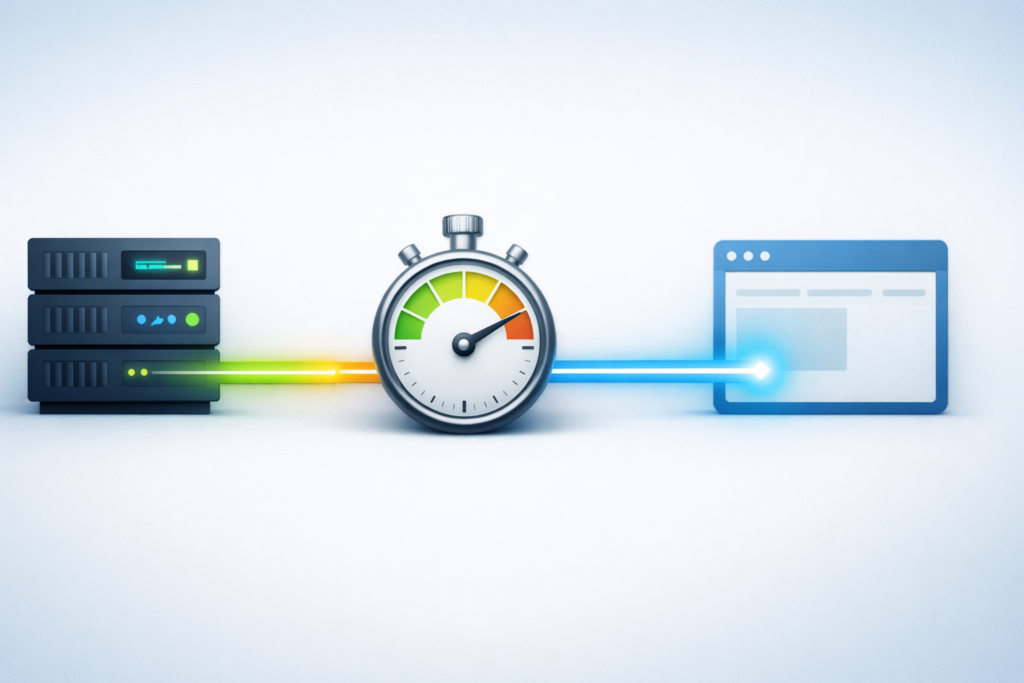
Server response time determines whether AI search engines like ChatGPT and Google’s AI mode will even consider your website. The metric that matters is TTFB, or “time to first byte.” This measures how long it takes from the moment a request hits your server until the first byte of data starts downloading. For AI search, you need a TTFB under 200ms to reliably get retrieved. Anything over 600ms and AI crawlers will likely skip your page entirely.
At TJ Digital, we help businesses optimize for AI algorithms across platforms. Through our AI SEO audits, we’ve seen the same pattern repeatedly: sites with slow server response times get ignored by AI crawlers even when their content is excellent. Traditional SEO is more forgiving. AI search is not.
Table of Contents
ToggleWhy Is TTFB More Important for AI Search Than Traditional SEO?
@tjrobertson52 ChatGPT literally gives up on slow websites. Here’s the 2-minute fix to stop getting skipped by AI search 👇 #AIsearch #SEO #ChatGPT #MarketingTips
♬ original sound – TJ Robertson – TJ Robertson
Traditional search engines like Google have patient crawlers. Googlebot can render JavaScript, retry pages, and revisit slow-loading content later. AI crawlers operate differently.
When you enter a prompt into ChatGPT or use Google’s AI mode, the system searches its index first. But then it goes one step further. Before generating a recommendation, it actually visits the web pages in its results. It performs multiple searches simultaneously and often does secondary searches based on what it finds in the first pass. All of this needs to happen fast enough to provide a good user experience.
AI systems typically impose hard timeouts between 1 and 5 seconds for each page. If your server doesn’t respond in time, the crawler abandons the request. Your page never gets considered.
Kevin Indig’s research on AI search factors describes this clearly: once TTFB exceeds the AI bot’s timeout, your page never enters their retrieval set. This is a silent failure. Your site looks fine to human visitors, but AI systems never see your content.
What Are the TTFB Benchmarks for AI Search?
For traditional SEO, a TTFB under 800ms has been the general best-practice target. AI search requires significantly faster response times.
| TTFB Range | AI Search Rating | What Happens |
| Under 200ms | Excellent | Reliably retrieved by AI crawlers |
| 200-500ms | Acceptable | Should work for most AI retrieval |
| 500-600ms | Risky | May cause issues with stricter crawlers |
| Over 600ms | Poor | High likelihood of being skipped |
The practical recommendation is to target 100-300ms TTFB. This gives you a buffer and ensures your pages load fast enough for any AI system.
How Can a CDN Improve Server Response Time?
A CDN (Content Delivery Network) like Cloudflare hosts your website on multiple servers around the world. This limits the physical distance between your website and whatever server is making the request.
When an AI crawler requests your page, it hits the nearest CDN node instead of your origin server. This can turn multi-second latencies into tens of milliseconds.
The key is enabling edge caching. With Cloudflare, you can use a “Cache Everything” page rule or enable Automatic Platform Optimization (APO) for WordPress sites. This ensures your HTML pages are cached at the edge, not just your images and scripts.
One important note: using Cloudflare without enabling edge caching can actually make things worse. The WAF (Web Application Firewall) overhead adds latency without the benefit of cached responses. Only use Cloudflare’s proxy when you have edge caching active.
How Does Server-Side Caching Help with AI Search Retrieval?
Server-side caching saves a pre-rendered copy of your pages. Instead of generating the page dynamically for every request, your server returns the cached version instantly.
The performance difference can be dramatic. One case study showed TTFB dropping from 288ms to 122ms after enabling caching. That’s a 58% reduction. For AI crawlers with tight timeouts, this difference can determine whether your page gets retrieved or skipped.
For WordPress sites, plugins like “Super Page Cache for Cloudflare” handle this automatically. For other platforms, look into your framework’s caching options or consider a caching layer like Varnish.
Will Cloudflare Block AI Crawlers by Default?
Yes. By default, Cloudflare may block or throttle unknown bots. This includes AI crawlers like GPTBot (OpenAI’s crawler) and ClaudeBot (Anthropic’s crawler).
If you have Cloudflare’s “Block AI Bots” rules enabled, it doesn’t matter how fast your server responds. The request gets blocked before TTFB even comes into play.
Check your Cloudflare AI Crawl Control settings and make sure you’re not blocking the AI crawlers you want indexing your content.
What Happens When AI Crawlers Skip Your Site?
AI crawlers typically don’t retry. If they skip your page because of slow response time, you won’t be reconsidered until another crawl cycle. Meanwhile, your competitors with faster infrastructure are supplying the answers.
This creates a compounding disadvantage. Faster sites get crawled deeper. Slow sites stay invisible to AI models. The gap widens over time.
Summary: How to Optimize TTFB for AI Search
Server response time has always mattered for SEO. For AI search, it’s not just an optimization. It’s a requirement for being in the candidate pool at all.
The fixes are straightforward. First, use a CDN with edge caching enabled. This alone can cut your TTFB dramatically by serving pages from servers near the requester. Second, implement server-side caching so pages don’t need to be generated dynamically for each request. Third, verify AI crawlers aren’t being blocked by your firewall or bot protection settings. Fourth, measure your current TTFB and target under 200ms for reliable AI retrieval.
This is factor number two from Kevin Indig’s State of AI Search Optimization 2026. If you missed factor one (brand mentions), I’d recommend going back to review it. We’ll be covering all the factors in this series.
Need help optimizing your site for AI search? At TJ Digital, we help small and medium businesses show up where their customers are searching. Whether that’s Google’s AI mode, ChatGPT, or traditional search results, we can audit your current setup and identify the highest-impact improvements. Get in touch for a free consultation.