
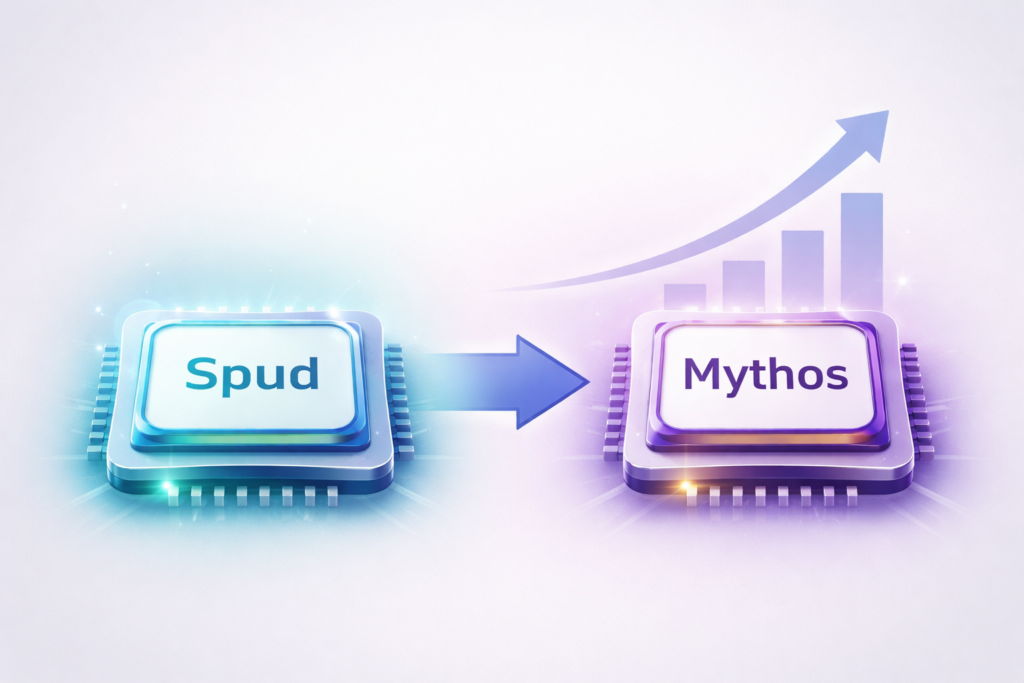
OpenAI and Anthropic are both preparing to release major new AI models in 2026. OpenAI’s model, codenamed Spud, is expected within weeks. Anthropic’s model, codenamed Mythos, sits in an entirely new tier above Opus and represents what the company calls a “step change” in capabilities. At TJ Digital, we’ve helped over 50 businesses build AI-powered marketing systems since 2023, and we do roughly 90% of our daily work with Claude. These new models will accelerate the already widening gap between companies that have rebuilt their workflows around AI and those that haven’t.
Table of Contents
ToggleWhat Is OpenAI’s New “Spud” Model?
@tjrobertson52 OpenAI killed Sora to build something bigger. Anthropic’s next model sits ABOVE Opus. Are you ready for what’s coming in 2026? #AIModels #ClaudeAI #OpenAI #KnowledgeWork
♬ original sound – TJ Robertson – TJ Robertson
OpenAI has finished pre-training a new model codenamed “Spud.” CEO Sam Altman told employees it will be a “very strong model” that can “really accelerate the economy,” according to a report from The Information. Whether Spud will launch publicly as GPT-5.5 or GPT-6 remains unclear, but it is expected within weeks.
To free up the computing power needed for Spud, OpenAI made some dramatic moves. They shut down Sora, their AI video tool, even though they had a $1 billion partnership with Disney. They also cancelled their short-lived erotic content model. All resources are now going toward this one core model.
The math behind the Sora shutdown is straightforward. Sora was reportedly costing around $15 million per day to run while generating almost no revenue. Its lifetime consumer revenue totaled just $1.4 million from 9.6 million downloads. That kind of loss is unsustainable when you need every GPU for your flagship model.
OpenAI also restructured internally. They renamed their product organization to “AGI Deployment,” which tells you exactly where their head is at. Sam Altman has been more focused than ever on getting to AGI, and the side projects are done.
Why Did OpenAI Kill Sora and the Disney Deal?
It comes down to compute trade-offs. Generating high-fidelity video is vastly more GPU-intensive than text generation. Every photorealistic frame and motion sequence requires enormous computation, and OpenAI couldn’t monetize it at anywhere close to the cost of running it.
Sora was devouring GPU resources at a time when OpenAI needed every chip for its core language models. The Disney deal, the consumer app, the whole video experiment got cut so those resources could go toward training Spud.
When Will AI Start Doing Its Own Research?
Altman has publicly stated that by September 2026, OpenAI wants models functioning as “AI research interns.” By March 2028, they want fully automated AI researchers.
That means within months, AI assistants won’t just answer questions. They’ll actively read papers, synthesize information, suggest ideas, write code, and design experiments. All under broad human oversight, but doing intern-level research work autonomously.
I think OpenAI sees how quickly Claude is shipping right now. They see how quickly knowledge work is being automated, and they don’t want to miss out. So they’re shutting down all the side quests and focusing on the main story.
What Is Anthropic’s Mythos Model?
This is the one I’m personally much more excited about. We now know that Anthropic is preparing to release their next big model, codenamed “Mythos.”
Leaked documents revealed that Mythos will sit in an entirely new tier called “Capybara,” which is above the current Opus line. Anthropic describes Capybara as “larger and more intelligent than our Opus models, which were, until now, our most powerful,” according to Fortune’s reporting.
So the model tiers now go: Haiku, Sonnet, Opus, Capybara. I’m guessing they’ll come up with a better name.
Anthropic confirmed that Mythos represents a “step change” in capabilities and is “the most capable we’ve built to date.” Early testing shows dramatically higher scores than Opus 4.6 on software coding, academic reasoning, and cybersecurity benchmarks.
The model they released earlier this year, Opus 4.6, already blew everyone away with how capable it is. It shipped with a 1 million token context window and the longest task completion time of any frontier model at 14.5 hours. If Mythos sits a full tier above that, we’re looking at a significant leap.
Claude vs. ChatGPT: Who Is Shipping Faster in 2026?
Anthropic has been on an absolute tear. They shipped 74 product releases in 52 days between February and March 2026. Fully fledged features across Claude Code, Cowork, desktop automation, and core infrastructure. Not minor bug fixes.
| Area | Releases (Feb-Mar 2026) |
| Developer tools (Claude Code) | 28 |
| API and infrastructure | 18 |
| Desktop automation (Cowork) | 15 |
| Models and core platform | 13 |
| Total | 74 |
Meanwhile, OpenAI has been largely holding fire on ChatGPT feature updates, pausing or scaling back things like shopping integrations while teams reorient to core model development. Claude users are seeing new features and improvements weekly. OpenAI’s visible progress is mostly in backend R&D, not surface-level product changes.
This is a pattern we’ve noticed working with both platforms daily. Claude’s rapid iteration cycle means the tool we’re using today is meaningfully better than the one we were using two weeks ago. That compounds quickly.
How Wide Is the AI Productivity Gap in 2026?
Here’s the part that should concern every business owner. The gap between companies that integrate AI deeply into their workflows and those that don’t is growing fast. And it’s about to accelerate.
According to Deloitte’s 2026 State of AI in the Enterprise report, two-thirds of organizations using AI report productivity and efficiency gains, but only 34% are truly reimagining their business processes around AI. Most companies are still in “productivity theater,” getting modest gains from isolated use cases while missing the order-of-magnitude improvements that come from holistic implementation.
Research from the St. Louis Federal Reserve found that industries with higher AI adoption are experiencing measurably faster productivity growth. A 10 percentage point increase in worker AI adoption correlates with nearly 3 additional percentage points of cumulative productivity growth.
Organizations with mature AI capabilities see labor productivity grow nearly five times faster than the global average. Companies still on the sidelines face a compounding disadvantage that gets harder to close every month.
Most of the productivity gains we’re seeing right now were made possible by features or models released just in the last few months. If you extrapolate out and consider all the model and feature releases we’re likely to see through the rest of 2026, the divide is going to be massive.
How to Actually Prepare for These New Models
Start by rebuilding your workflows from first principles.
Rather than inserting AI into your existing processes, ask: “If we designed this workflow from scratch knowing what AI can do, what would it look like?” That’s the question that separates companies getting real results from those just playing around.
Here’s the framework:
- Identify every repeatable process in your business. Content creation, reporting, client communication, data analysis, scheduling. All of it.
- For each process, determine what requires human judgment and what doesn’t. AI handles predictable, data-intensive tasks. Humans focus on strategy, creativity, and oversight.
- Rebuild each process with AI handling everything it can do well. Then double down on the areas where humans are still critical.
- Use the right tools. At our agency, that means Claude projects with brand context, custom workflows for each content type, and human review at key decision points.
The companies getting real results aren’t using AI for one-off tasks. They’re building systems where AI handles entire process chains, with humans setting goals, reviewing output, and making strategic decisions.
What Should Small Business Owners Do Right Now?
If you’ve been putting off AI integration, the window to catch up is closing. Here’s where to start:
Start creating content with AI-assisted workflows. Record a short video, take the transcript, and use it as input for AI-generated blog posts, social media content, and newsletters. The transcript provides the unique insights and voice that AI can’t fabricate on its own. We’ve built our entire content system around this.
Set up a brand ambassador. This is an AI project that knows everything about your company, your voice, your products, and your customers. Every piece of content, every ad, every email should run through this system. It’s the foundation that makes everything else work.
Stop treating AI like a search engine. The businesses falling behind are the ones who open ChatGPT, type a question, and copy-paste the response. The businesses pulling ahead are building persistent AI systems with deep context that produce reliable, brand-consistent output across every channel.
With new models like Spud and Mythos on the horizon, the capabilities available to small businesses are about to take another leap forward. The question is whether you’ll be ready to take advantage of them.
FAQ
When Will OpenAI Release the Spud Model?
OpenAI has finished pre-training Spud and expects to release it within weeks. Based on current timelines, a release around mid-to-late April 2026 is likely, though OpenAI has not confirmed a specific date. It may launch as GPT-5.5 or GPT-6.
When Will Anthropic Release Claude Mythos?
Anthropic has not announced a release date. The model is currently being tested with a small group of early-access customers. Given the company’s cautious approach, especially around the model’s cybersecurity capabilities, a limited rollout before a general release is expected.
Should I Use Claude or ChatGPT for My Business?
Both platforms have strengths. Claude has been shipping features at a faster pace in 2026 and tends to excel at knowledge work, content creation, and long-context tasks. ChatGPT has a larger ecosystem and broader consumer reach. The best choice depends on your specific use case, but we’ve found Claude to be the stronger tool for most marketing and business operations work.
How Much Does It Cost to Start Using AI in My Business?
Starting is essentially free. Both ChatGPT and Claude offer free tiers, and paid plans start at $20/month. The real investment is time spent building your brand context, creating prompt templates, and iterating on your processes. For businesses that want help building these systems, TJ Digital offers AI-powered marketing plans starting at $1,600/month.
The models are improving rapidly. Every model maker is focused almost exclusively on automating knowledge work. If you’re a business owner still on the sidelines, now is the time to start building AI into your operations. Contact TJ Digitalto set up a free digital marketing audit and see how AI-powered workflows can work for your business.