

I don’t think ChatGPT is going to replace Google as the default search engine any time soon. But the competition is heating up.
ChatGPT now has its own search index, meaning its own stored copy of the web to pull answers from. And Cloudflare, a company that handles the traffic for a large share of the world’s websites, is now sharing data with OpenAI to help it find more pages for that index.
Google relies heavily on links from other websites to find pages and decide which ones are worth showing. From what the two companies have said publicly so far, my read is that ChatGPT’s search will rely on those links less than Google does.
If that’s right, a useful page with few links pointing to it has a better chance of showing up in ChatGPT. But ChatGPT finds pages for its index by sending its own bot, called a search crawler, to visit them. If your site blocks that bot, ChatGPT won’t show your pages in its search answers.
I’ve been in digital marketing for 17 years. Today I run TJ Digital, where we do SEO and GEO for small and medium-sized businesses. SEO gets a business found in Google, and GEO gets it found when people search with AI tools like ChatGPT.
Does ChatGPT Have Its Own Search Index?
ChatGPT has its own search index now, but it still gets some of its results from other search providers. OpenAI’s help page says ChatGPT search “sometimes partners with other search providers,” and it names Microsoft, which runs Bing.
OpenAI started building its own index because it wasn’t happy with the results it got from those providers. OpenAI said so in 2025, as a competitor testifying in the US government’s antitrust case against Google. The judge wrote that quality problems with those providers “compelled OpenAI to build its own search index.”
Nick Turley, who runs ChatGPT at OpenAI, testified that the goal was to answer 80% of ChatGPT’s searches with its own index. He called building a high-quality index a multi-year project. OpenAI hasn’t said how big its index is today or how much of ChatGPT’s search runs on it.
How Is Cloudflare Helping OpenAI Build Its Search Index?
Cloudflare is sharing data with OpenAI that helps ChatGPT’s search crawler find more pages worth adding to its index. The same data helps the crawler decide when a page it already has is worth visiting again.
The two companies started this as a research trial in July 2026, with a group of websites making up about 1% of Cloudflare’s network. In an October post, they said the trial has already helped OpenAI “discover and index hundreds of millions of new web pages.”
Cloudflare’s data comes in three kinds:
- Filtering. This keeps the crawler away from addresses that don’t lead to a real, new page. Other bots keep requesting pages that don’t exist, and all that traffic can make a missing page look worth a crawler’s visit. Some sites also send almost any address to their homepage. A crawler that visits these addresses gets nothing new.
- Change signals. These tell the crawler when a page has changed and is worth another visit, and when it hasn’t. Downloading every page over and over just in case would be expensive for both the crawler and the website.
- Harmful pages. Cloudflare can flag a single hacked page, like a fake login form planted on a legitimate site, so it can be kept out of the index without blocking the whole site. This part is still being tested.
Cloudflare only supplies the data. OpenAI decides which pages make it into ChatGPT’s answers. In the post’s words, “OpenAI then independently evaluates and ranks how those pages appear based on how relevant and helpful they are.”
Both companies say the trial is still early. They haven’t yet reported what it means for traffic to the websites involved.
Does Google Index Every Page?
Google doesn’t index every page it finds. Its own guide to how search works says Googlebot, Google’s crawler, “doesn’t crawl all the pages it discovered,” and that “Indexing isn’t guaranteed.”
Google is also slow to go back to pages it already has. At a Google event in October 2026, a Google presenter’s slides said Google typically takes about 30 days to come back and check a page it already knows about, and in the slowest cases it never does. Google hasn’t published the slides, but Search Engine Roundtable reported on them.
Keeping up with every page on the internet is possibly the number one pain point for Google Search. New pages are added constantly, and it’s just not feasible to index them all anymore.
My sense is that Google has been indexing a smaller and smaller share of those pages. A lot of businesses are having a harder time getting their pages into Google’s index, for reasons I covered in Why Google Is Ignoring Your Content.
Cloudflare’s data could help ChatGPT keep up with new pages. If OpenAI’s crawler wastes less time on pages that don’t exist or haven’t changed, it has more time left to find and index new pages. I think that could give ChatGPT a real edge over Google.
Does ChatGPT Search Rely on Links the Way Google Does?
ChatGPT’s search may rely on links less than Google does. OpenAI hasn’t said so, but Cloudflare’s post drops a real hint in a line about pages that few other sites link to.
Google uses links from other websites in two ways: to find new pages, and to decide which pages to rank. It finds many new pages by following links from pages it already knows about.
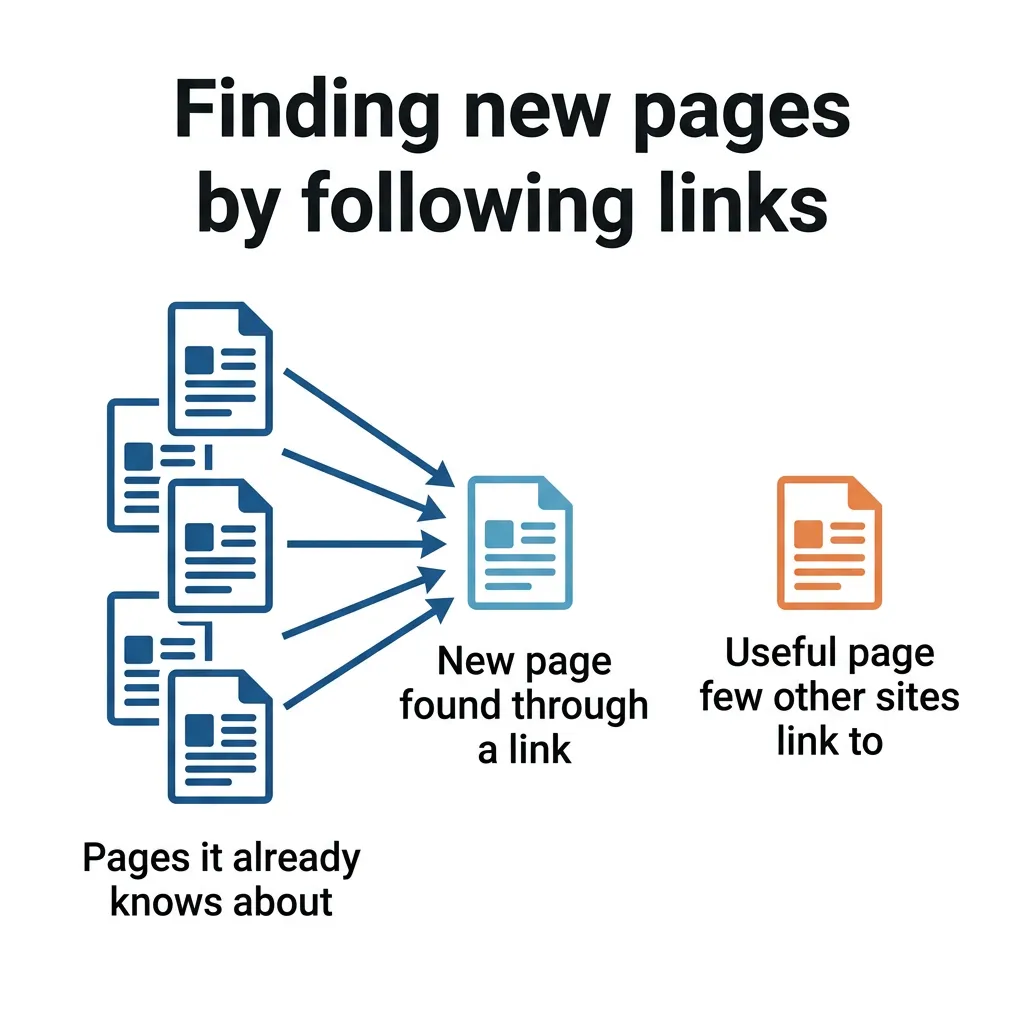
For ranking, Google has used a link-based system called PageRank since it launched. Google’s guide to its ranking systems says PageRank “continues to be part of our core ranking systems.”
Google looks at a lot of things to decide which pages are worth keeping in its index and showing in its results. In my view, links are probably still the most important of them.
That’s where Cloudflare’s post gets really interesting. It lists the kinds of pages people need, like the manual for one exact washing machine model, current passport requirements and fees, or a restaurant’s latest menu and hours. Then it says, “These pages can be valuable even if few other sites link to them.”
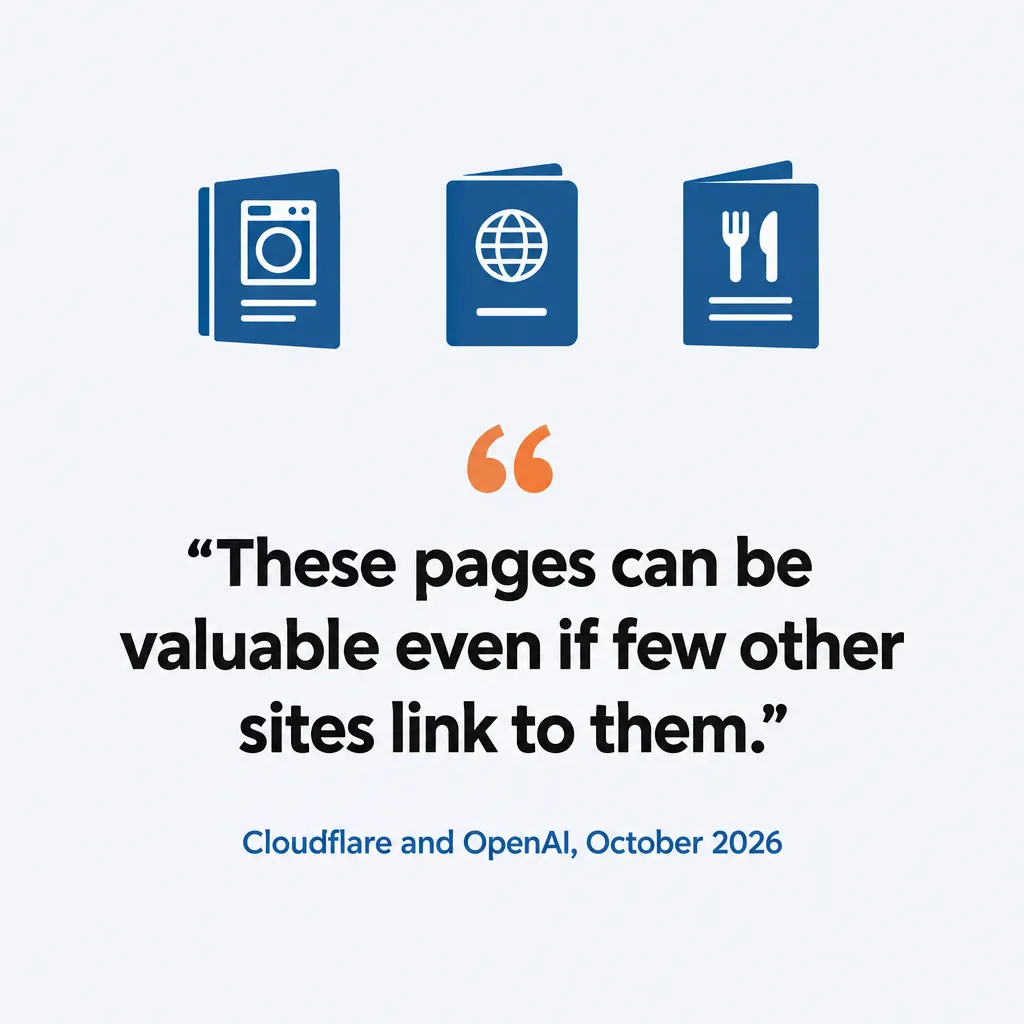
My reading is that the system Cloudflare and OpenAI are building won’t depend on links as much as Google’s does.
That few-links line is about finding pages like these. It doesn’t say how OpenAI ranks them once they’re in its index, and OpenAI hasn’t said either. So links could still affect where a page shows up in ChatGPT’s answers.
Now, in Google’s defense, it may not always lean on links this much. Its search advocate John Mueller guessed in 2022 that over time, links would become less of a factor than they were then. In 2024, he told website owners, “There are more important things for websites nowadays,” and warned that over-focusing on links often wastes their time. That same year, Google edited its spam policies so that links went from “an important factor” in judging relevance to just “a factor.”
As Google’s algorithm gets more sophisticated, it does seem to depend less and less on links. So while things are moving in the right direction for Google, I think its algorithm still depends on links more than Google would like to admit. I covered what that means for building backlinks in Do Backlinks Still Matter in 2026?
So the big open question is whether Cloudflare and OpenAI can build a search algorithm that competes with Google’s without depending heavily on links. I think maybe. Both sides have real advantages.
What Advantages Does Google Search Still Have?
Google’s biggest advantage is its head start. It has a ton of data and decades of experience, and that has let it build what is undoubtedly the most sophisticated search algorithm in the world.
And Google still sends far more people to websites. StatCounter tracks visits to more than 1 million websites. In September 2026, 99.61% of the visits those sites got from either Google or ChatGPT came from Google, and 0.39% came from ChatGPT.
StatCounter counts clicks to websites, so an answer someone reads in ChatGPT without clicking anything isn’t counted.
Even OpenAI’s CEO gives Google the edge. When Sen. Ted Cruz asked Sam Altman in May 2025 whether ChatGPT would replace Google as the primary search engine, Altman said “Probably not” and called Google a “ferocious competitor.”
Google has other advantages too, like how many people already use its products every day and how much money it makes. I wrote about those in Will Google Beat ChatGPT?
What Advantages Does ChatGPT Search Have?
ChatGPT’s search has two advantages Google can’t easily copy: Cloudflare’s view of the web, and a simpler job to do.
What Data Does Cloudflare Have That Google Doesn’t?
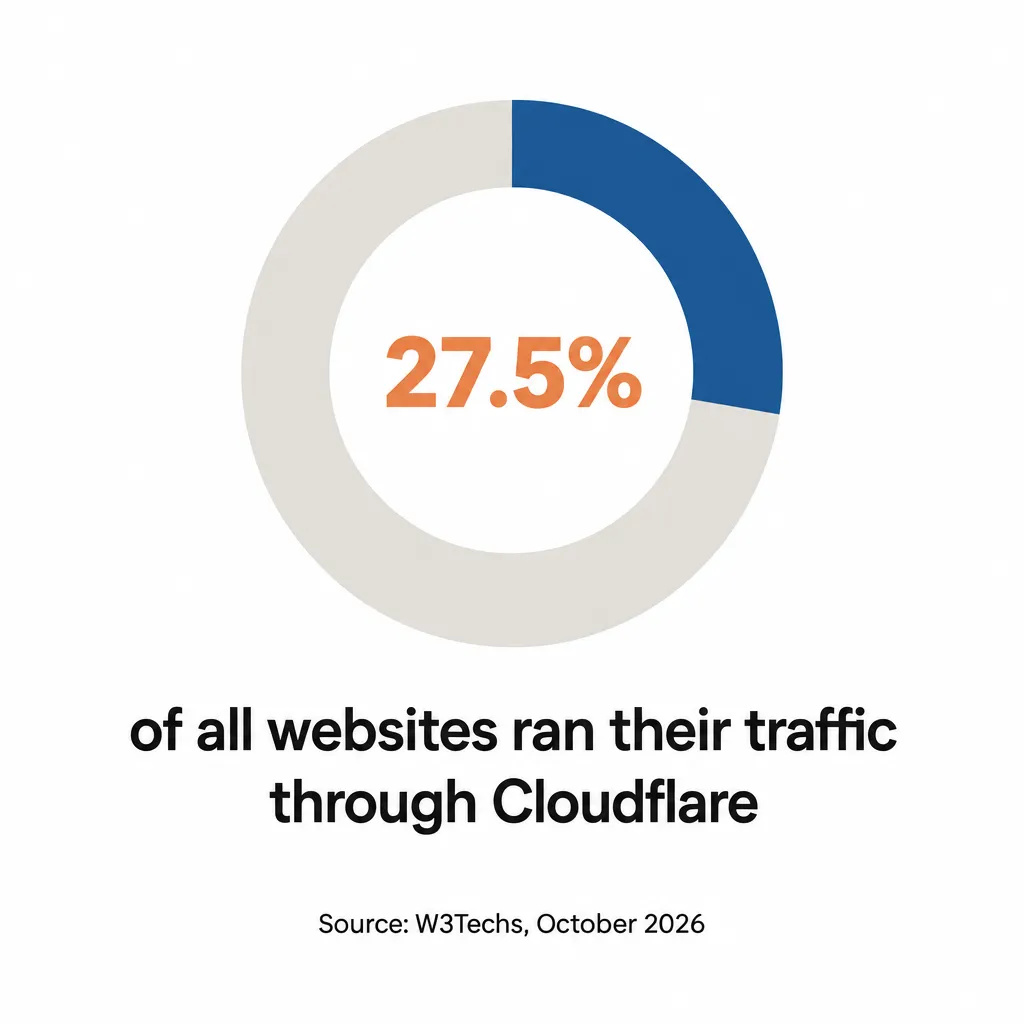
Cloudflare has data Google just doesn’t have access to: it sees the traffic going to every website that uses it. The filtering and change signals it shares with OpenAI come from that traffic. According to W3Techs, 27.5% of all websites ran their traffic through Cloudflare as of October 2026.
Google does get a ton of user data from Chrome and Google Analytics. But Google says it isn’t using that data for its search rankings. I think most SEO professionals believe Google does use it.
In 2022, John Mueller said, “I don’t think we use anything from Google Chrome for ranking,” apart from data on how quickly and smoothly pages load for Chrome users. Asked about Analytics, he said, “We don’t use that at all.”
Is a Search Engine for AI Easier to Build?
A search engine that only has to work for AI has an easier job than one that also has to work for people. Google has to do both: keep traditional search working for people while also feeding the AI answers in its results.
As I see it, people only look at the top one to three results, while an AI will happily read far more.
OpenAI says its deep research mode will “find, analyze, and synthesize hundreds of online sources” for one report. Google’s AI Mode splits a question into “a multitude of queries” and runs them all at once, which Google says takes it deeper into the web than a regular search. I explained how that works in How AI Search Works.
So if you’re making a search engine only for AI, you mainly have to find a big set of the best pages for a question. Traditional search has to go one step further and put those pages in order, and that’s arguably the hardest part.
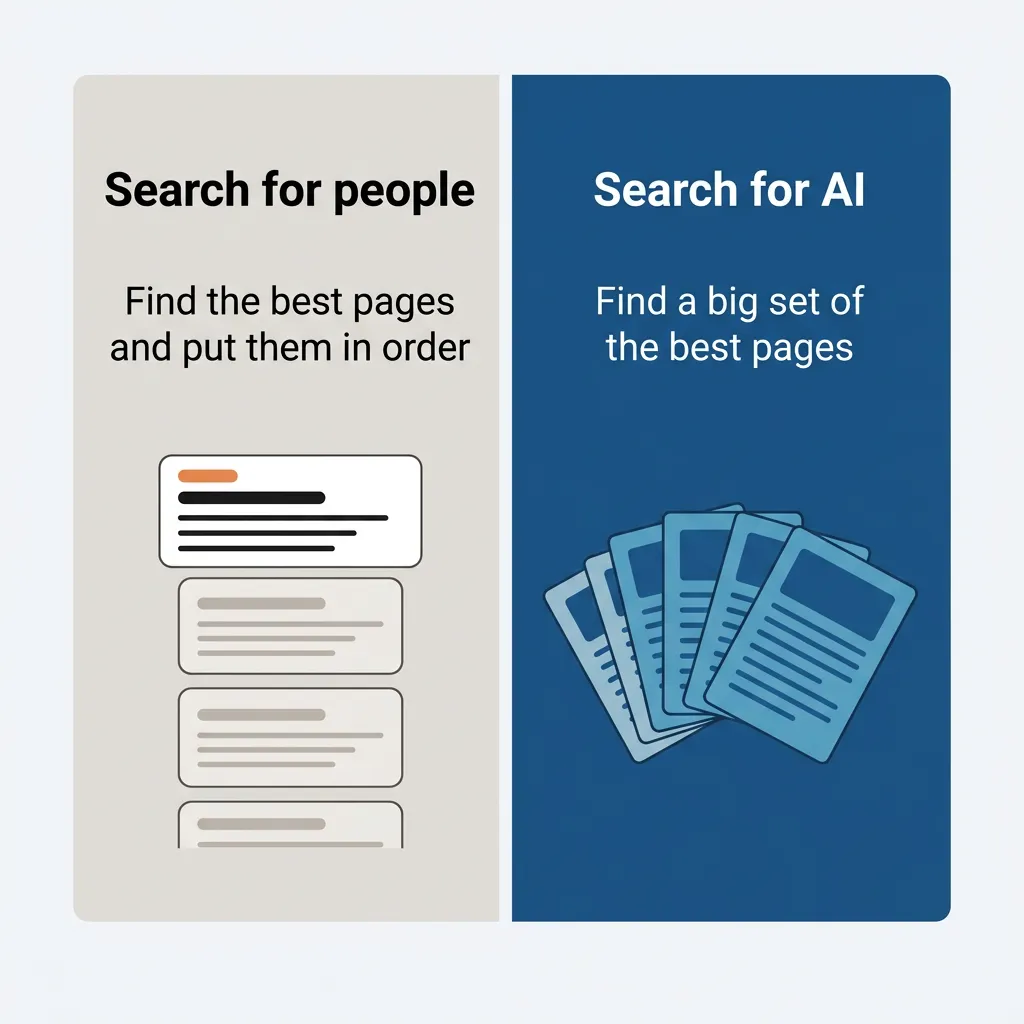
If you’re a person and the top result is actually the 100th best page on the internet, that’s a terrible experience. If you’re an AI, you just keep digging.
OpenAI says it isn’t trying to copy Google’s list of results. Nick Turley, who runs ChatGPT, told the court that OpenAI is “not trying to recreate the type of experience that [a consumer] would find on Google.com where you see ten blue links.”
How Does ChatGPT Search Compare to Google?
Side by side, Google still sends far more visitors to websites, but ChatGPT’s search is built differently in ways that could help pages with few links.
| Google Search | ChatGPT search | |
| Where results come from | Google’s own index | OpenAI’s own index, plus outside providers such as Microsoft |
| How it finds new pages | Googlebot follows links from pages it already knows and reads sitemaps (lists of pages that site owners submit) | OpenAI’s crawler, OAI-SearchBot, now helped by Cloudflare’s data on which pages exist and which have changed |
| Role of links | Used to find pages and to rank them (PageRank) | Not disclosed; Cloudflare says useful pages can have few links |
| Share of visits from either Google or ChatGPT, on sites StatCounter tracks (September 2026) | 99.61% | 0.39% |
What Does ChatGPT Search Mean for Your Website?
The most important thing you can do is make sure ChatGPT’s search crawler can reach your site. OpenAI says sites that block its crawler, OAI-SearchBot, won’t be shown in ChatGPT search answers.
That matters even more if your site doesn’t have many links from other websites, because ChatGPT’s search may give your useful pages a better chance of being found. Being found is only the first step, though. OpenAI still decides which pages appear in its answers.
OpenAI gives two steps for making a site eligible:
- Let OAI-SearchBot crawl your site. Your robots.txt file is a short text file on your website that tells crawlers which pages they may visit. Make sure it doesn’t block OAI-SearchBot.
- Make sure your web host or content delivery network lets OpenAI’s crawler through. A content delivery network (CDN) is a service like Cloudflare that your visitors’ traffic passes through. A CDN’s bot-blocking settings can turn OpenAI’s crawler away even when your robots.txt file allows it. OpenAI publishes the IP addresses its crawler visits from (the network addresses of its computers), and your host or CDN needs to allow traffic from them. If you’re on Cloudflare or another CDN, I walk through how to check in Is Your Website Blocking AI Bots?
OpenAI also has a help page for a ChatGPT feature called offline web search, which some company, school and government ChatGPT accounts can use. It answers from OpenAI’s own stored copy of the web instead of searching the live web each time someone asks.
Besides blocking the crawler, that page lists these common reasons a page may be missing from OpenAI’s index. OpenAI wrote the list for that feature, but I’d still check your site against it:
- The page requires a login or is personalized.
- The page depends heavily on scripts or dynamic loading (code in the browser that fills in content after the page first opens).
- The page is new or rarely accessed.
- The site’s structure makes deeper pages (ones that take several clicks to reach from the homepage) harder to discover.
None of this means you should stop caring about Google. It still sends most of the search traffic websites get, and links still matter there.
If you have questions about any of this, reach out through our contact page or email me at tj@tjrobertson.com.