
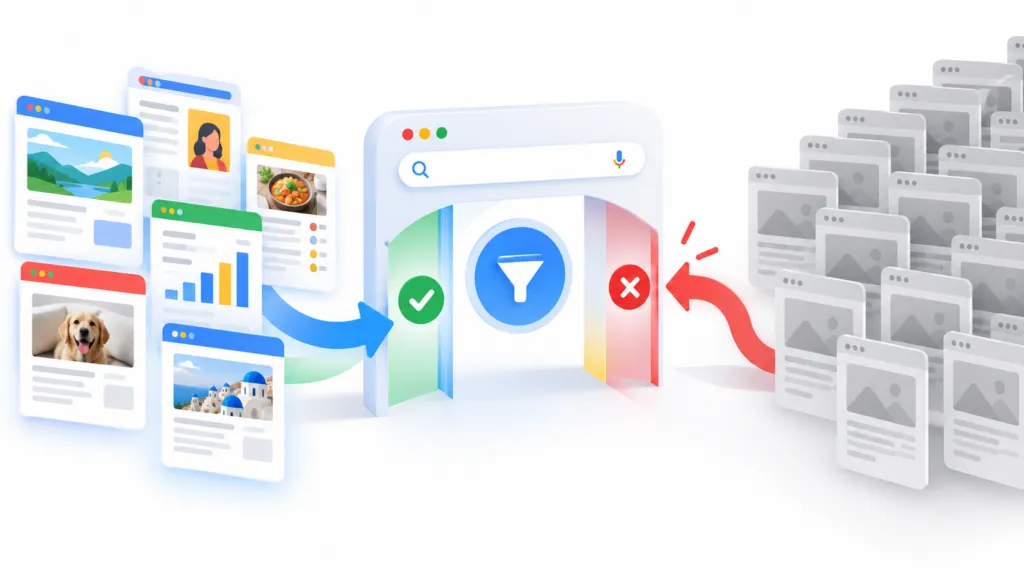
Google’s September 2026 spam update is unlikely to hurt sites that publish useful AI-generated content. The sites most at risk are the ones publishing large batches of near-identical pages built mainly to rank. The update rolled out from September 24 to October 8, 2026.
At TJ Digital, we create all of our content with AI and publish 1 to 10 pieces per week for each client. We’re keeping that pace. We have paused programmatic SEO, though, because nobody knows exactly where Google is drawing the line right now.
Table of Contents
ToggleWhat Is Google’s September 2026 Spam Update?
A spam update is a notable improvement to the automated systems Google uses to catch search spam, including its AI-based system called SpamBrain. Google announced the September 2026 spam update on September 24 and said it applies globally and to all languages.
Google hasn’t said what this update targets. The rollout window is the clear difference. Each of the three spam updates earlier in 2026 finished in three days or less, and this one took almost two weeks.
Here’s how this year’s spam updates compare:
| Spam update | Started | Rollout time |
| March 2026 | March 24 | Under one day |
| June 2026 | June 24 | About two days |
| August 2026 | August 18 | About three days |
| September 2026 | September 24 | About two weeks |
The two-week rollout had most people (me included) expecting a bigger, broader update. The rollout has since finished, and our data from about 100 client sites shows how it affected websites. The last three updates suggest Google is focused on sites mass-producing low-value pages.
@tjrobertson52 Does the September 2026 spam update penalize AI content? Probably not, but we’re changing a few things. #SEO #GoogleSpamUpdate #AIContent
♬ original sound – TJ Robertson – TJ Robertson
Why Is Google Releasing So Many Spam Updates in 2026?
Google used to release two or three spam updates in a typical year. In 2026 we’ve already had four, and the September update landed about five weeks after the August one.
Google has a spam problem. Publishing large amounts of optimized content has always worked for ranking in Google. Historically, the main risk was a person at Google noticing and manually penalizing the site for scaled content abuse.
AI makes it far easier to produce optimized content at scale, so manual review can’t keep up. More frequent spam updates are how Google is responding.
I think Google’s spam algorithms are improving faster now than they have in years. Google is falling behind in a lot of areas of AI, but spam detection protects the search business that makes it money.
Will This Update Hurt Sites That Use AI Content?
The September 2026 spam update is unlikely to hurt most businesses that use AI content. Google openly acknowledges that AI-generated content can be high quality. In Google’s guidance on AI content, the company says “Using AI doesn’t give content any special gains.”
Google says pages that are useful and original can do well in Search no matter how they were written. I personally think we’re very close to a world where most of the high-quality content online is AI-generated.
If you’ve held back on AI because of updates like this one, you’re probably publishing less than you should. Our breakdown of the August 2026 spam update covers what the previous update hit.
How Does Google Detect Scaled Content Abuse?
Google’s algorithm has to parse trillions of pages and rank billions of them. It can’t judge the quality of every individual page, because that would be far too slow and expensive. So it looks for patterns, and it has a good idea of what natural website growth looks like compared to scaled content abuse.
Google’s spam policies describe scaled content abuse as creating many pages “for the primary purpose of manipulating search rankings and not helping users.” The definition applies whether a person or an AI tool created the pages.
The patterns that tend to raise flags include:
- Hundreds of pages that are identical except for a swapped city, product, or keyword
- A sudden jump in publishing volume with little or no editorial review
- Pages stitched together from other sites’ content with nothing new added
- Pages that exist only to target a search term and give the reader no unique information
Is Programmatic SEO Still Safe After This Update?
Programmatic SEO uses templates and data to create many pages at once. A roofer might publish “roof repair in Henderson,” “roof repair in Summerlin,” and a matching page for every other city it serves. Google’s spam policies target pages made mainly to manipulate rankings, and many programmatic pages fit that description.
A useful test is to remove the variable from the page (the city name, product name, or keyword) and see what’s left. If the remaining content is the same boilerplate found on every other page, that page is a likely target. If each page holds real information the others don’t, like local pricing, project photos, or service details, it’s on much safer ground.
Here’s how we think about the risk:
| Lower risk | Higher risk |
| Blog posts that answer real audience questions | Hundreds of near-identical location pages |
| AI-drafted articles reviewed by a person | Bulk pages published with no human review |
| Location pages with unique local details | Pages that only swap the city name |
| A steady, consistent publishing pace | Thousands of pages published at once |
How Should Your SEO Strategy Change After This Update?
At TJ Digital, we’re still creating all of our content with AI, and I can’t imagine that ever stopping. We’re still publishing 1 to 10 pieces of content per week for each client.
We’ve paused all programmatic SEO work and become much more selective about which pages we create. A client who might have gotten 40 city or neighborhood pages before might get 12 now.
We don’t know exactly how much templated content Google will tolerate right now. If a penalty would seriously hurt your business, I’d play it safe until we learn more.
Should Most Businesses Slow Down on AI Content?
No. About 99% of business websites have nothing to worry about from this update, because they’re already playing it safe.
Most businesses should be creating more content right now and using AI even more. Our guide to finding a safe publishing pace covers how fast you can publish without creating a quality problem.
What Should You Do If Your Traffic Drops During the Rollout?
Hold off on reacting to day-one volatility. Rankings bounce around during any rollout, and the September update didn’t finish until October 8. Wait until it’s complete before you draw conclusions or rebuild anything.
Once the rollout finishes, here’s where to start:
- Compare clicks and impressions in Google Search Console for the weeks before and after September 24.
- Look for a sustained drop across many pages that lasts several days.
- Check your site against Google’s spam policies, especially the section on scaled content abuse.
- Audit large batches of templated pages, then add unique information to them or consolidate the weakest ones.
How Do Google Spam Updates Affect Your Website?
How long does the September 2026 spam update take to roll out?
Google said the rollout could take up to two weeks from its September 24 start. It finished on October 8, 2026.
Does Google notify you when a spam update affects your site?
No. Spam updates are algorithmic, so you won’t get a notice in Search Console the way you would with a manual action.
How many city pages are too many for local SEO?
Google hasn’t published a limit. Our current approach is to build fewer, stronger location pages, so a site that might have gotten 40 city pages might get 12.
Can you recover from a Google spam update?
Yes, once you fix the policy violations, though Google says its systems can take months to learn that a site now complies. Link spam is the exception, because any ranking boost from spammy links is gone for good once Google neutralizes them.
Who Can Help You Publish AI Content Safely?
We build content machines for small and medium-sized businesses, using AI in every workflow with a person reviewing everything that gets published. I personally build every client’s plan around what actually moves the needle in Google and AI search. Send me a message about your site, and I’ll tell you where I’d start.