

Google doesn’t penalize content just because AI wrote it. Its guidance on AI-generated content says so directly: “Appropriate use of AI or automation is not against our guidelines.”
Sites that use AI get penalized when they use it to publish lots of pages made mainly to rank in Google, with little or no value for the people who read them. Google calls that scaled content abuse.
Most of the business owners I talk to who worry about this are nowhere near that kind of volume. Adding a page a day that’s written for your customers, for example, is nothing to be nervous about.
At TJ Digital, Claude (Anthropic’s AI model) writes all of our content, for our clients and for our own site. An account manager on our team reviews every piece before it reaches the client. So I pay close attention to how Google treats AI content.
What Is Scaled Content Abuse?
Scaled content abuse is Google’s name for publishing lots of pages mainly to manipulate search rankings. Google’s spam policies list it as spam and define it this way:
> “Scaled content abuse is when many pages are generated for the primary purpose of manipulating search rankings and not helping users. This abusive practice is typically focused on creating large amounts of unoriginal content that provides little to no value to users, no matter how it’s created.”
AI makes it easy to publish a lot of pages quickly, so this is the rule sites using AI are most likely to break. Google gives these examples:
- “Using generative AI tools or other similar tools to generate many pages without adding value for users”
- Scraping (automatically copying) content from other sites, including rewording or translating it, to generate many pages
- Stitching together content from different web pages without adding value
- Creating several sites to hide how much content is being produced
- Creating many pages that make little or no sense to a reader but contain search keywords
When Google introduced the policy in March 2024, it said the policy applies “whether automation or humans are involved.”
Can Google Detect AI Content?
Google’s current guidance doesn’t say whether Google can detect AI-written content. Even if Google could tell, I don’t think it would change much for your rankings, because Google judges content on how well it helps the people who find it.
Google’s guidance says its systems “analyze patterns and signals to help us identify spam content, however it is produced.” That means Google looks for spam the same way whether a person or AI wrote it.
I’d expect Google’s systems to catch something like a site that suddenly adds thousands of pages that say nothing new. A single AI-written page doesn’t look like that.
An AI detector score doesn’t show you how Google sees your page. Google’s own guide to its AI search features says that “No third-party tool has access to our internal ranking or AI systems.”
If you’ve heard that Google reads hidden watermarks in AI text, I wrote about AI content watermarks separately.
How Do You Know If Google Penalized Your Site?
Google Search Console, Google’s free tool for site owners, is where you find out whether Google has penalized your site. People call four different things a Google penalty: a manual action, a drop in traffic during a spam update, pages Google won’t index, and pages that just don’t rank well.
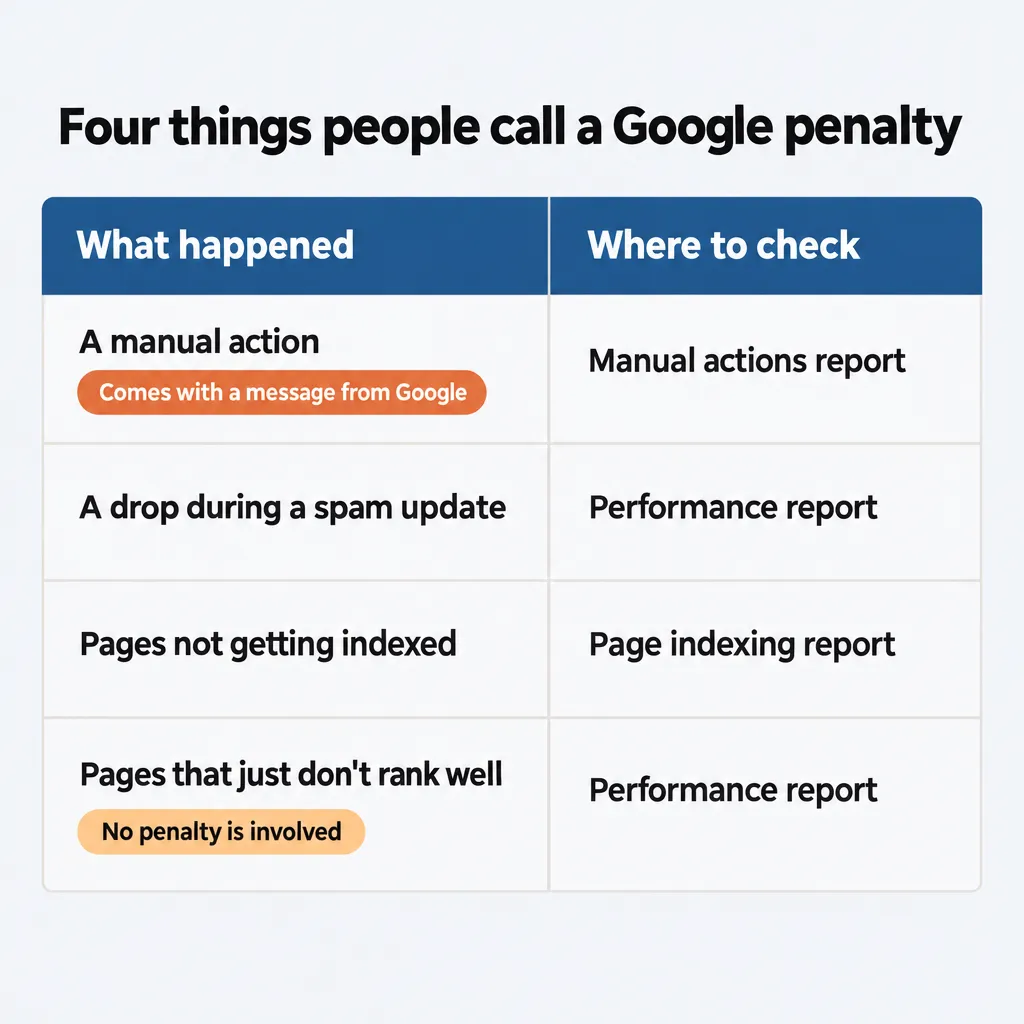
Only one of the four comes with a message from Google explaining the problem. That’s a manual action, which is a penalty a reviewer at Google applies after looking at your site.
A spam update is a change Google makes to the automated systems it uses to catch spam. Google posts the start and finish dates of each one on its Search Status Dashboard.
| What happened | What you’ll see | Where to check |
| A manual action | A message from Google naming the problem, such as “Major spam problems” or “Thin content with little or no added value” | Search Console’s Manual actions report (a green check mark means you have none) |
| A drop during a spam update | Your traffic from Google falls between a spam update’s start and finish dates, with no message from Google | Search Console’s Performance report, compared with the update’s dates |
| Pages not getting indexed | Pages listed as “Crawled – currently not indexed” or “Discovered – currently not indexed” | Search Console’s Page indexing report |
| Pages that just don’t rank well | Pages that are indexed but sit low in the results, with no sudden change. No penalty is involved: other pages are ranking above yours for those searches. | Search Console’s Performance report |
There’s no manual action called “scaled content abuse.” It falls under “Major spam problems,” which Google describes as “aggressive spam techniques such as scaled content abuse, cloaking, and/or other repeated or egregious violations.” A site full of low-value pages can also get a manual action called “Thin content with little or no added value.”
Google says its automated systems catch most spam. Those systems don’t send you a message. So your traffic can drop because of spam problems even when the Manual actions report shows nothing.
If Google won’t index a lot of your pages, that can be a sign it has doubts about your site’s quality, even without a penalty. Google’s John Mueller has said that when Google’s systems are “seriously worried about the quality of a website,” they “will reduce the number of pages that they index.” For what to do about pages Google won’t index, see my post Why Google Is Ignoring Your Content (And How to Fix It).
Did Google’s 2026 Spam Updates Target AI Content?
Google hasn’t said that any of its 2026 spam updates targeted AI content. It has released four so far in 2026:
- March 2026 spam update: March 24 to 25
- June 2026 spam update: June 24 to 26
- August 2026 spam update: August 18 to 21
- September 2026 spam update: September 24 to October 8
Each time, Google called it “a normal spam update” and named no new policy or target. I haven’t seen a reliable breakdown of what the September update hit yet.
After the August update, Search Engine Journal reported on posts online about which sites had lost rankings. One poster said sites that automatically published content with AI tools seemed to be losing rankings. He called his sample small and the trend “by no means definitive.”
He also said a journal that has people check its AI content before publishing wasn’t hit. So in his one example, a site whose AI content people checked before publishing kept its rankings.
Search Engine Journal wrote that these reports don’t mean “that Google’s August Spam Update was all about AI generated content.” It added that if the reports are correct, AI content published automatically and in bulk “may be the reason why many sites lost rankings.”
I went looking for the same thing in our clients’ data. AI writes all of the content we create, so if the August update had hit AI content, our clients would have felt it. I compared each client’s organic traffic from Google for the 10 days after the update finished with the 10 days before the update.
Most of our clients saw their Google traffic shift by at least 10%, and some by as much as 60%. Then I compared individual pages: the ones we’d written with AI and the human-written pages each client had from before we started working with them.
I couldn’t find any link between how a page was written and whether it gained or lost traffic. If anything, our pages tended to fare better, though I don’t think that’s because AI wrote them. I checked listicles and location pages too, and in both groups some pages went up while others went down.
Across our clients, pages targeting broad, competitive keywords tended to drop, and pages targeting keywords close to each client’s specialty tended to rise. That was the only pattern I found. So if your traffic moved after a spam update, don’t assume your AI content caused it.
I’ve seen broad keywords drop and specialty keywords rise in essentially every Google update for the past five to ten years. I think the reason is authority, by which I mean things like how many links point to your website, how many people search for your brand by name, and how much traffic your site already gets.
A spam site that just put up thousands of pages usually has very little of any of those. So one of the easiest ways Google can cut down on spam is by giving more weight to authority.
Bigger brands have more of all three, so that change also helps them win the broad, competitive searches. That makes it a little harder for smaller brands.
My advice is to focus on what you’re actually the best at. Don’t try to compete with companies 10 or 100 times your size on broad keywords. Go after specific searches that closely match what your ideal customer types when they’re close to buying.
How Much AI Content Is Too Much?
Google doesn’t give any percentage of AI content that’s too much. What I watch is how many pages a site publishes and how fast.
Most of the business owners I talk to who worry about this could publish 10 to 100 times as many pages as they do now before I’d expect Google’s spam systems to take notice. For the vast majority of websites, the bigger problem is that they aren’t publishing enough.
For most of our clients, we publish anywhere from one page a week to one page a day. Most of their sites have between 100 and 10,000 pages. We know better than to create hundreds or thousands of new pages all at once.
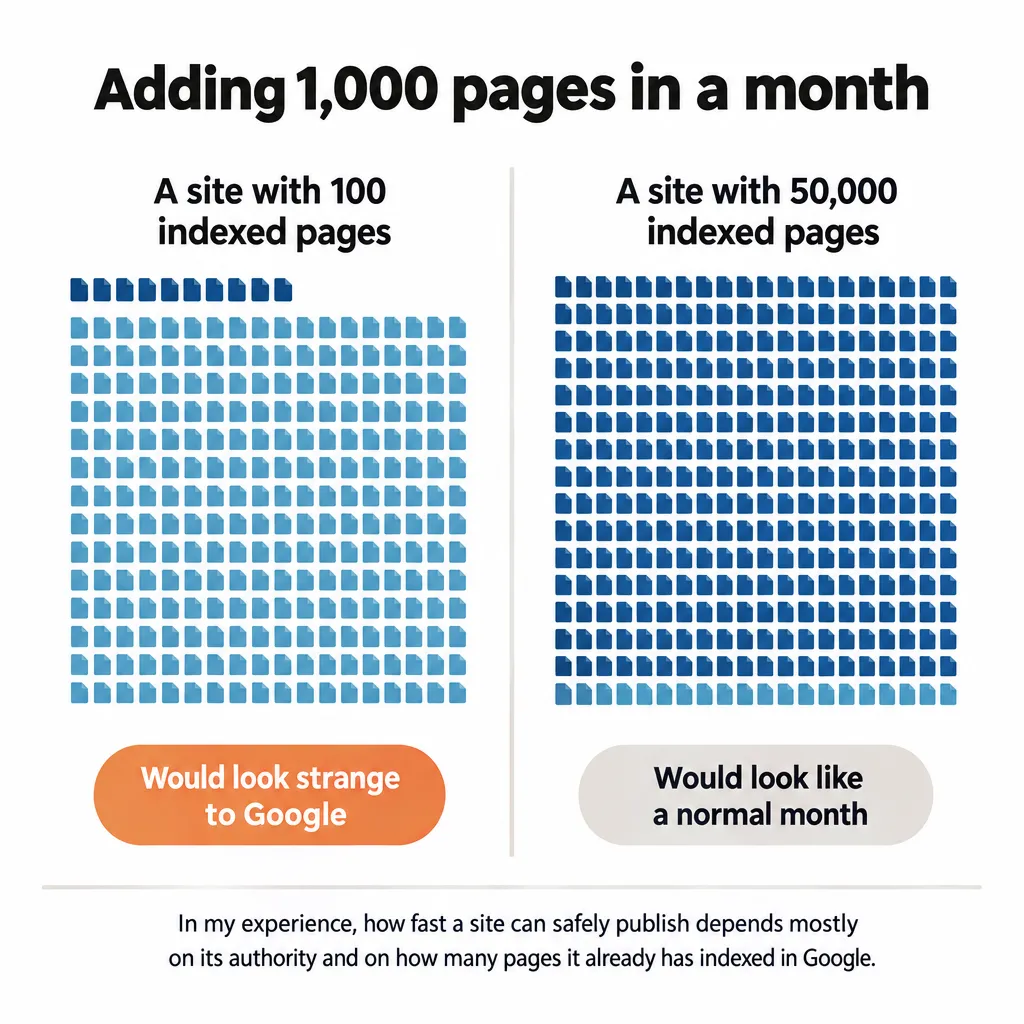
In my experience, how fast a site can safely publish depends mostly on its authority and on how many pages it already has indexed in Google. On a site with 100 indexed pages, I’d expect adding 1,000 pages in a month to look strange to Google. On a site with 50,000 indexed pages, the same 1,000 pages would look like a normal month.
I go through how to work out a safe pace for your own site in How Much Content Is Too Much? and in how much content to publish for SEO.
Does AI Content Still Rank on Google?
AI-written content does rank on Google, including in the top three results. Google’s 2023 guidance says: “Using AI doesn’t give content any special gains. It’s just content.”
Ahrefs, an SEO software company, checked pages from Google’s top 10 results for 100,000 searches in June 2026 with its AI detector. About 150,000 of those pages had enough text to score.
Of the pages in positions 1 to 3, 5.3% came back as fully AI-written and 82.2% as less than half AI. Ahrefs notes that AI detection isn’t perfect, so these figures are estimates.
Ahrefs saw no obvious cutoff: pages didn’t suddenly stop ranking well once AI wrote more than a certain share of them. Pages with more AI writing generally ranked a bit lower.
The biggest gap was in impressions, the number of times a page showed up in search results. Pages with low or moderate AI content got 2 to 3 times the impressions of pages with high or very high AI content. Ahrefs thinks that’s probably because heavily AI-written content tends to be lower quality.
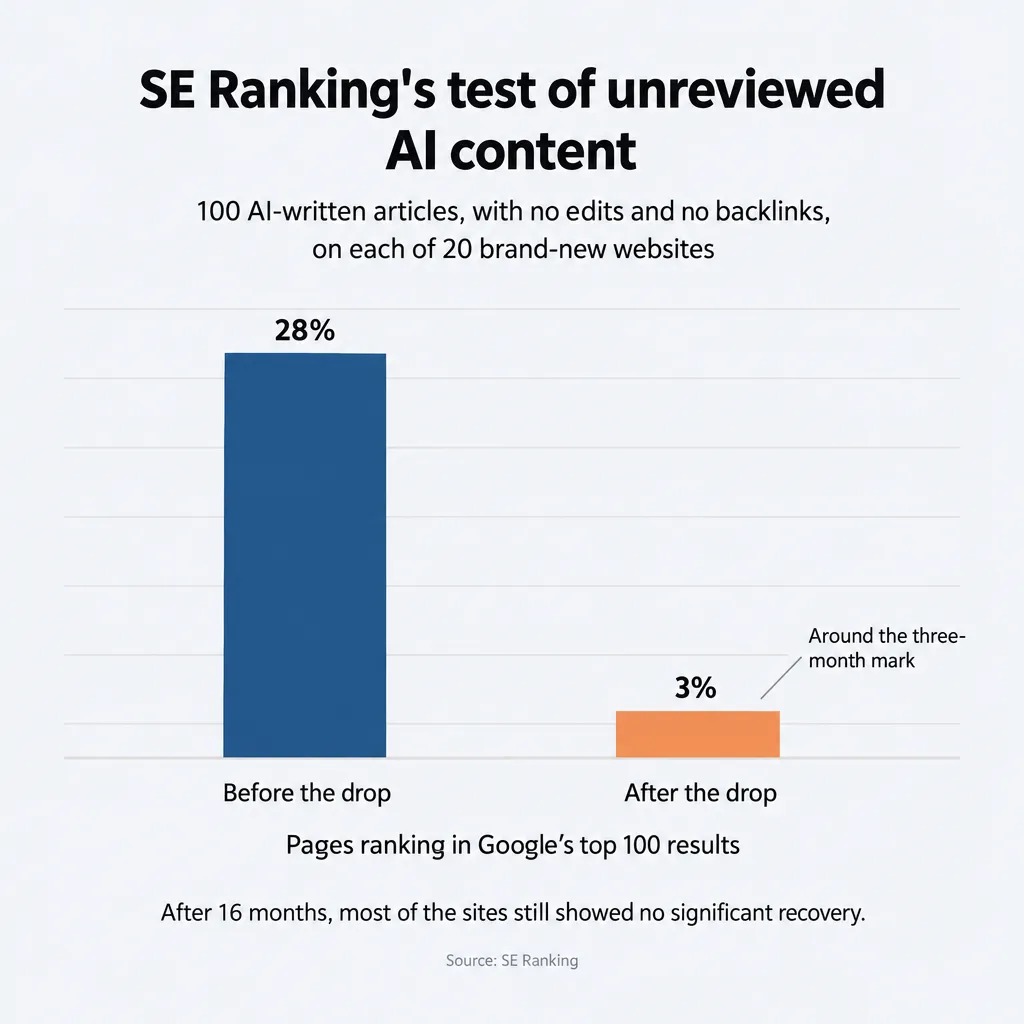
The clearest test of unreviewed AI content at volume comes from SE Ranking. It published 100 AI-written articles, with no edits and no backlinks, on each of 20 brand-new websites. Most of the pages got indexed, and for the first couple of months they showed up in search results more and more often.
Around the three-month mark, that reversed. Before the drop, 28% of the pages ranked somewhere in Google’s top 100 results. Afterward, only 3% did, even though most of the pages stayed indexed.
After 16 months, most of the sites still showed no significant recovery. Unreviewed AI content published in bulk can rank for a while, then lose those rankings for more than a year.
What Should You Do About AI Content You’ve Already Published?
If your traffic hasn’t dropped and Search Console shows no manual action, you don’t need to delete or rewrite the AI content you’ve already published. If some of it went out without a careful review, check it for mistakes when you can.
If you have a manual action, these are the steps to get it lifted:
- Open the Manual actions report and read which problem Google named and which pages it affects.
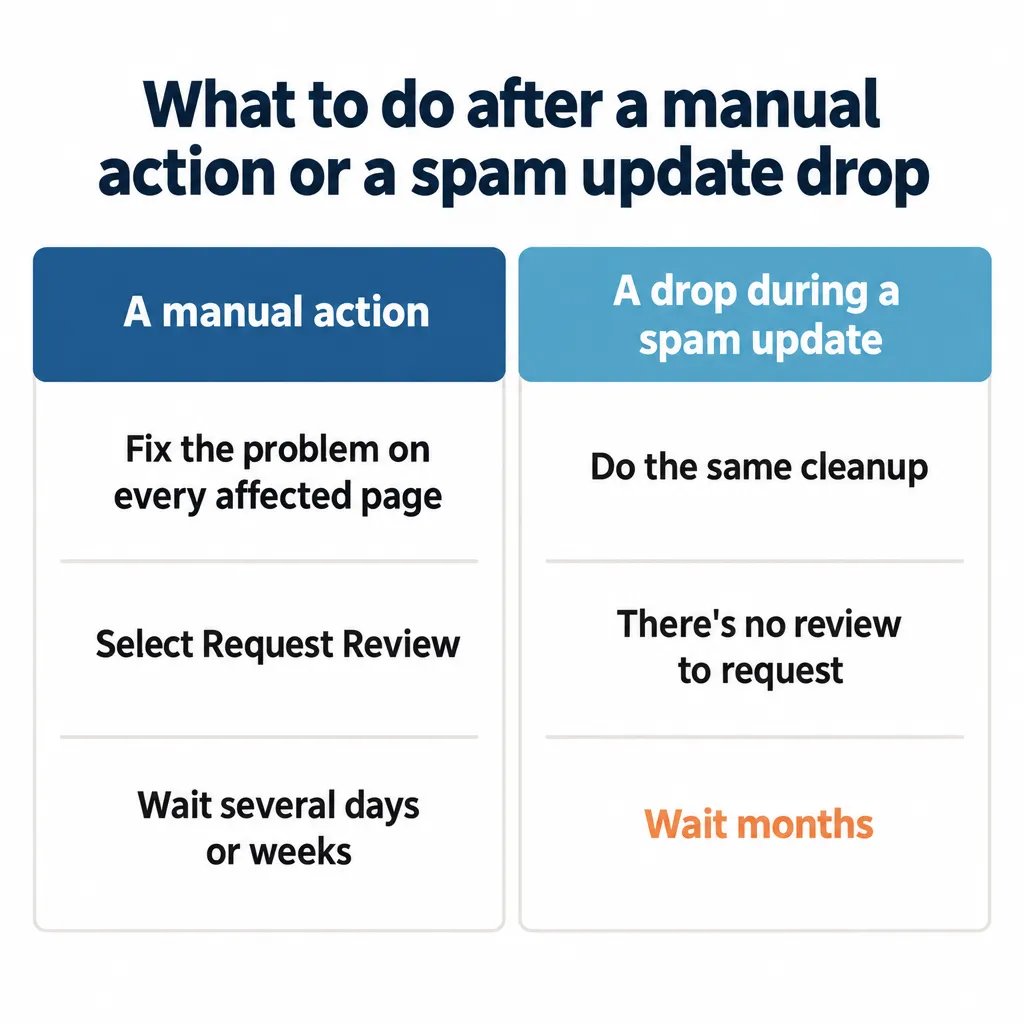
- Fix the problem on every affected page. Google says that “Fixing the issue on just some pages will not earn you a partial return to search results.” For scaled content abuse, that usually means removing the pages that add nothing, or adding a noindex tag to them so Google leaves them out of its results. That’s what the spam policy asks: “If you’re hosting such content on your site, exclude it from Search.”
- Select Request Review in the same report. Google asks you to “Provide examples of bad content that you removed and good content that you added.”
- Wait for Google’s answer. Google says most reviews “can take several days or weeks.”
If your traffic dropped in a spam update, there’s no review to request. You do the same cleanup, removing or noindexing the pages that add nothing, and then wait for Google’s automated systems to notice.
Google’s page on spam updates says a site may improve “if our automated systems learn over a period of months that the site complies with our spam policies.” So expect to wait months, compared with the several days or weeks a manual action review usually takes.
Rewriting AI pages by hand so they read as human won’t fix the problem on its own. Google’s John Mueller told the owner of an AI-written site that wasn’t getting indexed: “I wouldn’t think about it as AI or not, but about the value that the site adds to the web. Just rewriting AI content by a human won’t change that, it won’t make it authentic.”
So go page by page and ask what each one gives a reader that they can’t find somewhere else. Keep and improve the pages that have an answer, and remove the ones that don’t. I walk through those decisions in how to do a website content audit.
How Do You Use AI for Content Without Getting Penalized?
Use AI to make pages that help the people searching, publish them at a pace your site can support, and have a person review every one before it goes live. In practice, that means:
- Give the AI something it can’t find anywhere else. What you know from experience, your own data and your customers’ real questions are what make a page worth ranking. The best content we make starts from a short video or voice recording of someone at the company, because that gives the writing opinions and firsthand experience AI can’t invent.
- Fact-check everything, including page titles and meta descriptions. On October 1, 2026, Google added this line to its guidance on AI content: “It is critical to manually factcheck and review all AI-generated content for accuracy and trustworthiness before publishing.” I wrote about what that change means when it happened.
- Put real people’s names on your content. Google’s helpful content guidance, updated in early October 2026, says that fabricating creator profiles, “such as by using AI-generated headshots, made-up names, or false credentials,” is “a form of deception.”
- Tell readers how AI was used when they’d expect to know. Google says AI disclosures are useful “for content where someone might think ‘How was this created?'”
That’s how we work at TJ Digital. Each article starts with research and a written plan, then a list of the facts it will use, each with its source. Claude writes the draft in the client’s voice, a separate AI reviewer reads it, and Claude revises it. Then we check every factual claim in the draft against its source.
After that, the client’s account manager reviews the article before the client sees it. For more on planning AI content that ranks, see my post on AI content strategy.
If you have questions about your own site or how you’re using AI for content, reach out through our contact page or email me at tj@tjrobertson.com.