
What Kind of Videos Should a Business Make for Marketing in 2026?

Short answer:
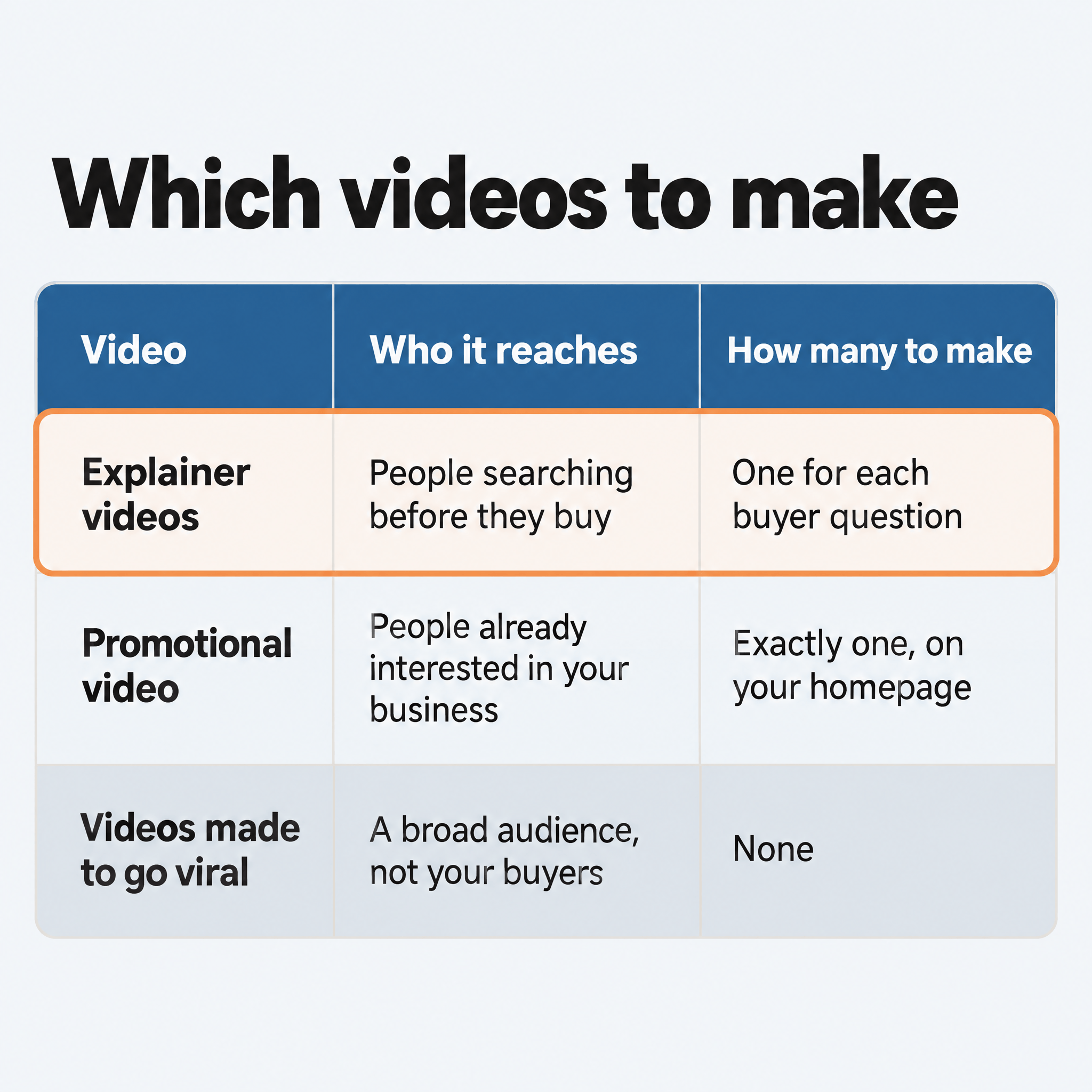
- Make explainer videos that answer the questions buyers search before they buy.
- Make one promotional video for your website, then stop.
- Don’t try to go viral.
I’ve been saying for a few years now that blog posts are the most effective form of digital marketing, unless someone in your business actually likes making videos. Video has always worked better than blog posts. But most businesses don’t have anyone who likes being on camera, so for them, blog posts have been the better choice.
Now you don’t need anyone on camera. Since Anthropic released Claude Opus 5.5 in September 2026, Claude can make a high-quality video from a few minutes of someone talking into a microphone. That makes video the most effective form of digital marketing right now, even if your videos never go viral.
At TJ Digital, we make videos for our own business every day, and those videos are how almost all of our clients find us.
Table of Contents
Should your business try to make videos that go viral?
Going viral is the wrong goal for a business video. All things being equal, more views are better. But making a video that goes viral is hard, and to even have a chance, the video has to appeal to a broad audience.
A video made for a broad audience isn’t made for the people who are interested in buying what you sell. So most of the time, you end up with a video that doesn’t bring in leads and doesn’t get many views either.
Do you need a promotional video about your business?
Most businesses’ first idea for a video is one about why people should pay them money. Make exactly one video like that and put it on your homepage. People who search for your business by name will find it there.
Don’t make more than that one. Apart from people who are already interested in your business, nobody searches for a video like that, and nobody wants to see it in their feed. So promotional videos get very few views.
What is an explainer video?
An explainer video answers one question your buyers have. The ones worth making answer the questions people search in Google or ChatGPT before they buy a product or service like yours. The people searching those questions are already thinking about buying, and they may not have heard of you yet.
When you’re starting out, make short vertical videos, usually two minutes or less. They’re easier to make, and viewers expect less production value from them.
How do you choose explainer video topics and titles?
Pick explainer video topics the way you’d pick blog post topics: by what buyers search before they buy. Each video answers one of those searches.
To build the list, write down the questions prospects ask you before they buy. Then rewrite every question the way a buyer would type it into Google. YouTube’s help pages suggest the same exercise: pretend you’re searching for your video and think about what you’d type into the search bar.
Start each video’s title with that search term. That way, the video can show up in the same search results you’d target with a blog post. YouTube also recommends keeping titles short and putting the most important words near the beginning.
Say you install solar panels, and homeowners often search “how long do solar panels last” before they ask anyone for a quote. That search is a good topic for a video. Its title would start with those words: “How Long Do Solar Panels Last? What Homeowners Should Expect.”

Can your videos show up in Google and AI answers?
Your videos can show up in Google search results alongside blog posts. Google can show videos in its main search results and in Google Images, among other places, according to Google’s video documentation.
Not every search shows videos, though. In Semrush data reported in August 2026, Google showed its row of video results on fewer than one in five searches.
For the questions buyers search before they buy, I see far less competition from other videos than from other blog posts. I don’t expect that to last once more businesses realize how easy video has become.
Video can also help your business show up in Google’s AI answers. Google’s AI Overviews are the AI summaries at the top of many search results, and they link to the pages they draw from.
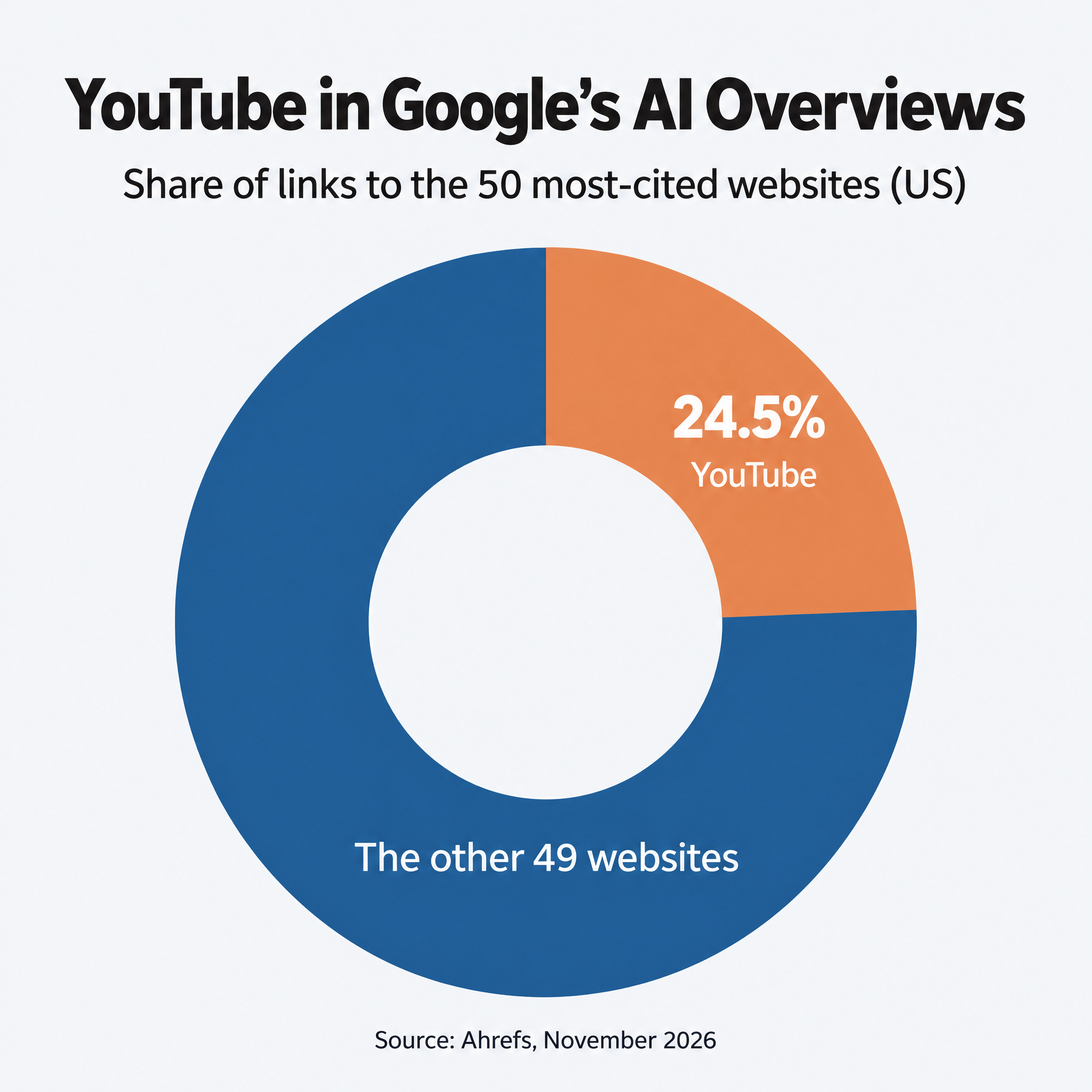
YouTube is the website those summaries link to most. In Ahrefs’ November 2026 count of US AI Overviews, nearly a quarter of the links to the 50 most-cited websites went to YouTube. So a YouTube video that answers a buyer’s question is one more page of yours those summaries can link to.
Should you put the video on a blog post too?
Put each video on your website as well, in a blog post about the same topic. I’ve found the blog post will typically rank better with the video on it.
Can you post the same video on YouTube, TikTok, Instagram and other platforms?
In my view, you can safely post the same video on every platform. The videos I record go out on YouTube, TikTok, Instagram, Facebook, LinkedIn and X.
Google’s video documentation says that if you embed a YouTube video on your website, Google may index the video both on your page and on YouTube. The YouTube page is the likelier one to appear as a video result. Your page can still appear as a regular result.
Publishing the same blog post on several websites is different. When there are many versions of one article, Google says it can be difficult for its systems to identify the original.
How many views should a business video get?
An explainer video probably won’t get millions of views. A few hundred views from people close to buying is a good result, though. If every blog post you wrote for buyers got a few hundred views, you’d be thrilled.
And from what I’ve seen, people who watch a video are much more likely to become leads than people who read a blog post.
A video can also reach people who never searched for it, because YouTube, TikTok and Instagram show videos in people’s feeds and recommendations. Open with a strong hook and actually deliver some value, and the video can do well there too.
What if nobody in your business wants to be on camera?
If nobody in your business wants to be on camera, don’t push anyone into it. Viewers can tell when someone doesn’t want to be there.
How do you make marketing videos without anyone on camera?
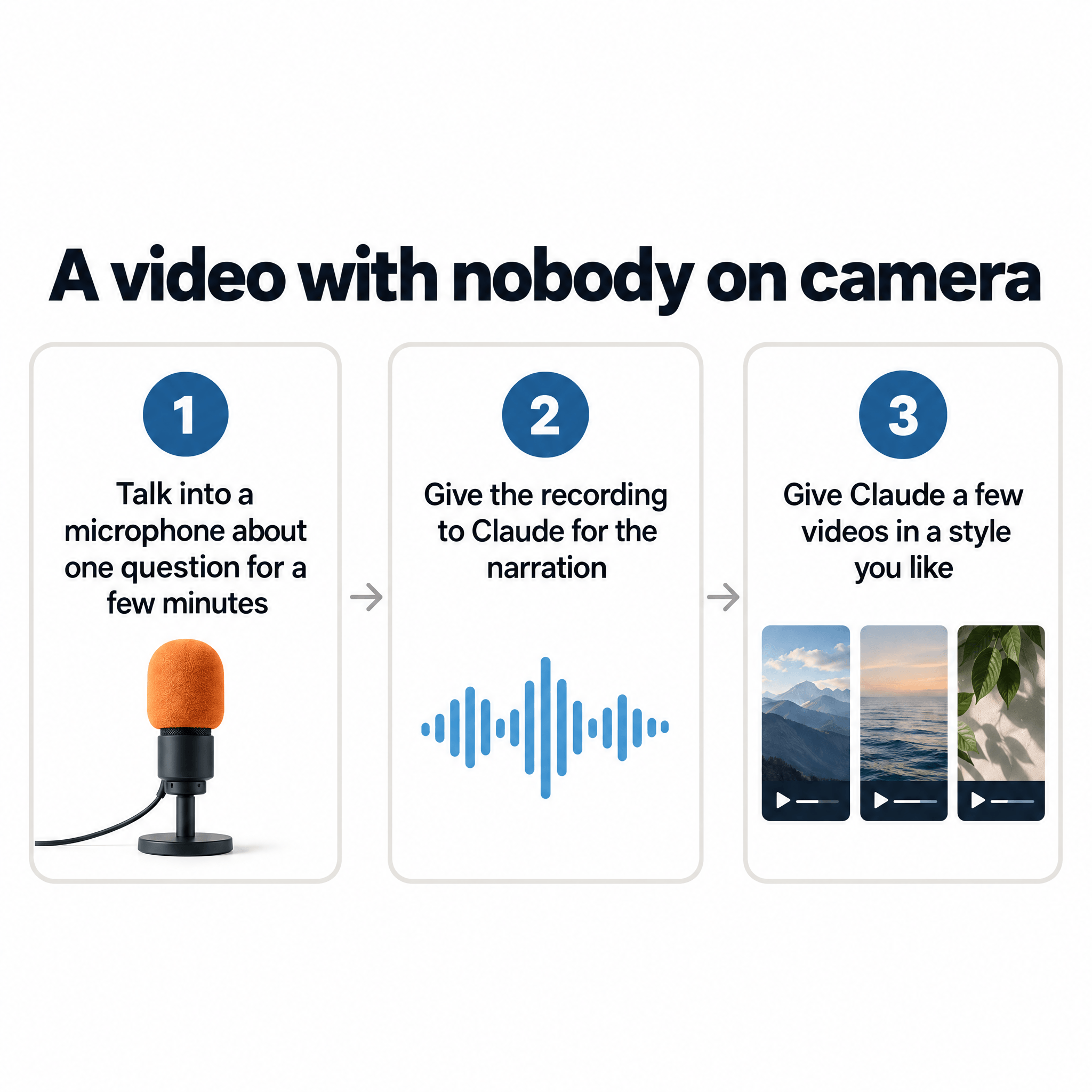
You can make a marketing video with nobody on camera in three steps:
- Have someone in your business talk into a microphone about the question for a few minutes. Rambling is fine. Their input gives the video your business’s experience and opinions, which AI can’t invent.
- Give the recording to Claude. Claude can clean up the audio and use it as the video’s narration. If the recording isn’t usable, Claude can transcribe it and write a new script from what you said. An AI-generated voice then reads that script.
- Find a few explainer videos in a style you like, give them to Claude, and tell it to make your video in the same style.
For our clients, we go a step further: we’ve documented dozens of video styles, and we refine them every time we use them. But a few examples are a fine place to start. Make your first video on one question from your list.
Do faceless videos work as well as someone on camera?
Armando Roggio writes in Practical Ecommerce that faceless videos, the ones with nobody on screen, may not build as much trust as a person speaking. So if someone in your business does like being on camera, exploit that relentlessly and have them record their own short videos. I’m on camera in my own daily videos, and it’s worked very well for us.
I’d skip using an AI avatar of you or your team, though, because viewers tend to feel tricked.
We make videos like these for our clients as part of their SEO and GEO campaigns, the work we do to help businesses show up in Google and AI search. If you’d like our help, or you have questions about any of this, reach out through our contact page or email me at tj@tjrobertson.com.