

ChatGPT sends websites very little traffic compared with Google. A study published in October 2026 looked at 100 websites and found that ChatGPT sent them less than 1% as many visits as Google’s organic search results did.
For most businesses that sell a product or service, that doesn’t matter much. People use ChatGPT to research and narrow down what to buy, often without clicking a single link.
Then they buy from the business they picked. If that’s your business, you get the sale, even though ChatGPT never sent you a visit.
ChatGPT’s small share of traffic is a real problem only when the visits themselves are your revenue, as they are for a website that earns money from ads or affiliate sales.
If you sell something, the number to watch is how often AI tools recommend your business. That’s the number one metric we track at TJ Digital, the agency I run.
How much traffic does ChatGPT send compared with Google?
ChatGPT sends websites 0.62% as many visits as Google’s organic search results, according to a study by SEO consultant Marie Haynes. That works out to about six visits from ChatGPT for every 1,000 from Google.
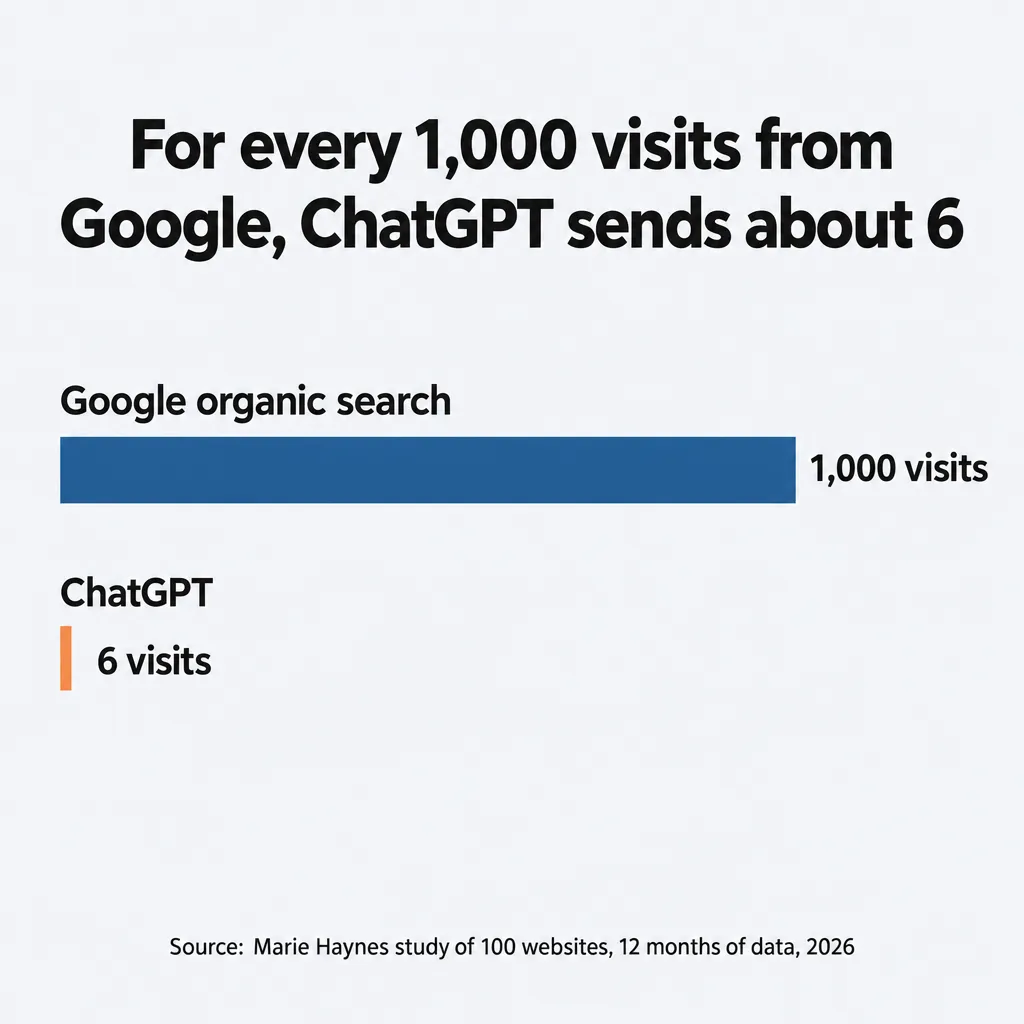
The study looked at 12 months of Google Analytics data from 100 websites, more than 145 million visits in all (MarTech). When the study also counted visits from every other AI chatbot, the total was still only 0.73% of Google’s organic visits.
One caution if you’re checking your own numbers: from about October 8 to 15, 2026, many ChatGPT links lost the tag that tells analytics a visit came from ChatGPT. Some of those visits were counted as Direct, the label analytics gives a visit it can’t trace to a source. That makes ChatGPT numbers for that week too low (Search Engine Journal).
If you haven’t set up tracking for AI visits yet, here’s how to track website visits from ChatGPT and other AI tools.
Why does ChatGPT send so little traffic?
One big reason ChatGPT sends so little traffic is that most of its answers don’t link to any websites. Similarweb estimates that in May 2026, only about 6.8% of ChatGPT prompts in the US got an answer with citations, the links to the websites behind the answer (Similarweb).
I can’t remember the last time I clicked through from a ChatGPT conversation to a website. And I hardly make an important purchase decision these days without using AI. I realize I’m probably in the top 1% of AI users, but the trend of using AI to decide what to buy is only going in one direction.
An August 2026 survey of US shoppers by Attentive asked people who used AI and then bought something where they made the purchase (Attentive). Only 10% bought inside the chatbot. The rest bought from a retailer or marketplace (59%) or directly from the brand (31%).
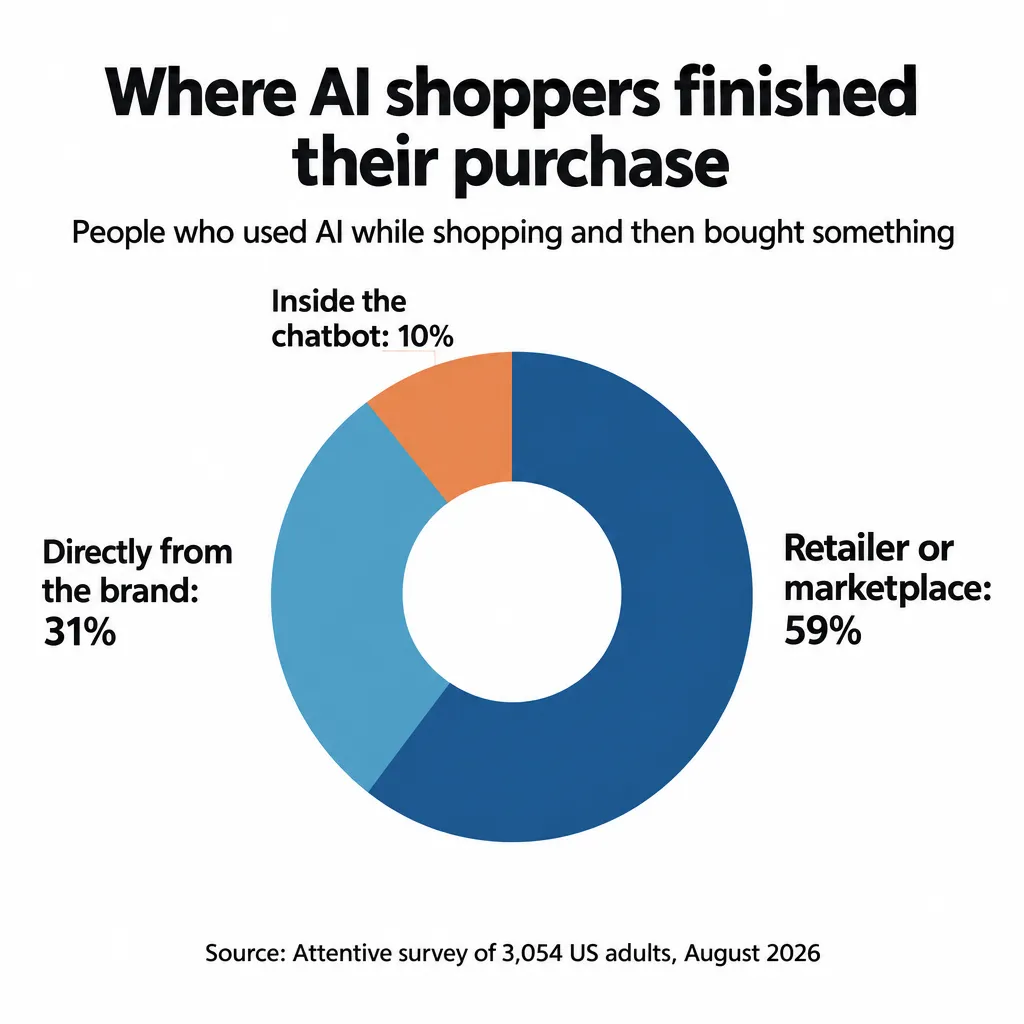
When someone picks your business in ChatGPT and then buys from you, the sale often doesn’t show up as ChatGPT traffic. They might search your name on Google or type in your website address, and your analytics credits Google or Direct for the visit. Or they buy from you on a marketplace or in a store, and your website never sees them.
How many people use AI to decide what to buy?
Most US shoppers have recently used AI to help them shop. Attentive surveyed 3,054 US adults who had shopped or researched a product in the past three months. In that time, 68% of them had used an AI chatbot for at least one shopping task.
Among the people who had used AI to shop, 71% said that at least half the times they used it, AI meaningfully affected which products they considered or chose.
AI apps are reaching a huge audience. OpenAI says more than 1.2 billion people use ChatGPT each week (OpenAI). In September 2026, Meta’s AI app, Muse, passed ChatGPT to become the No. 1 app on the US App Store (TechCrunch).
Maybe before Muse hit No. 1, you could have argued that people weren’t going to use AI to help them decide what to buy. At this point, I think it’s pretty clear what world we’re heading into.
Whether it’s ChatGPT or Muse or Grok Bot or Google’s AI Mode or Gemini, there’s a reason essentially every platform is focused on AI agents right now. I wrote about what Muse and AI agents mean for your website.
Does ChatGPT traffic matter for your business?
Whether ChatGPT traffic matters depends on how your business makes money. It’s the same split I made when Google’s AI answers started taking website traffic.
| How your business makes money | Does ChatGPT traffic matter? | What to watch |
| Ads on your website | Yes. People who get their answer in ChatGPT never see your ads. | Traffic |
| Affiliate sales | Yes. People who get their recommendation in ChatGPT never click your affiliate links. | Traffic and affiliate clicks |
| Selling a product or service | Not much. People can choose you in ChatGPT and still buy from you without ever clicking a ChatGPT link. | How often AI recommends you |
If you rely on website traffic for your revenue, because you run ads or earn affiliate sales, you might want to reconsider your business model. But if you sell an actual product or service, website visits are no longer the most important metric to track.
Is Google search going the same way as ChatGPT?
Old habits die hard, and most people are going to keep going to Google to search for what they want. But searching in Google is starting to feel more and more like talking with an AI agent, and I think pretty soon it’ll be entirely indistinguishable.
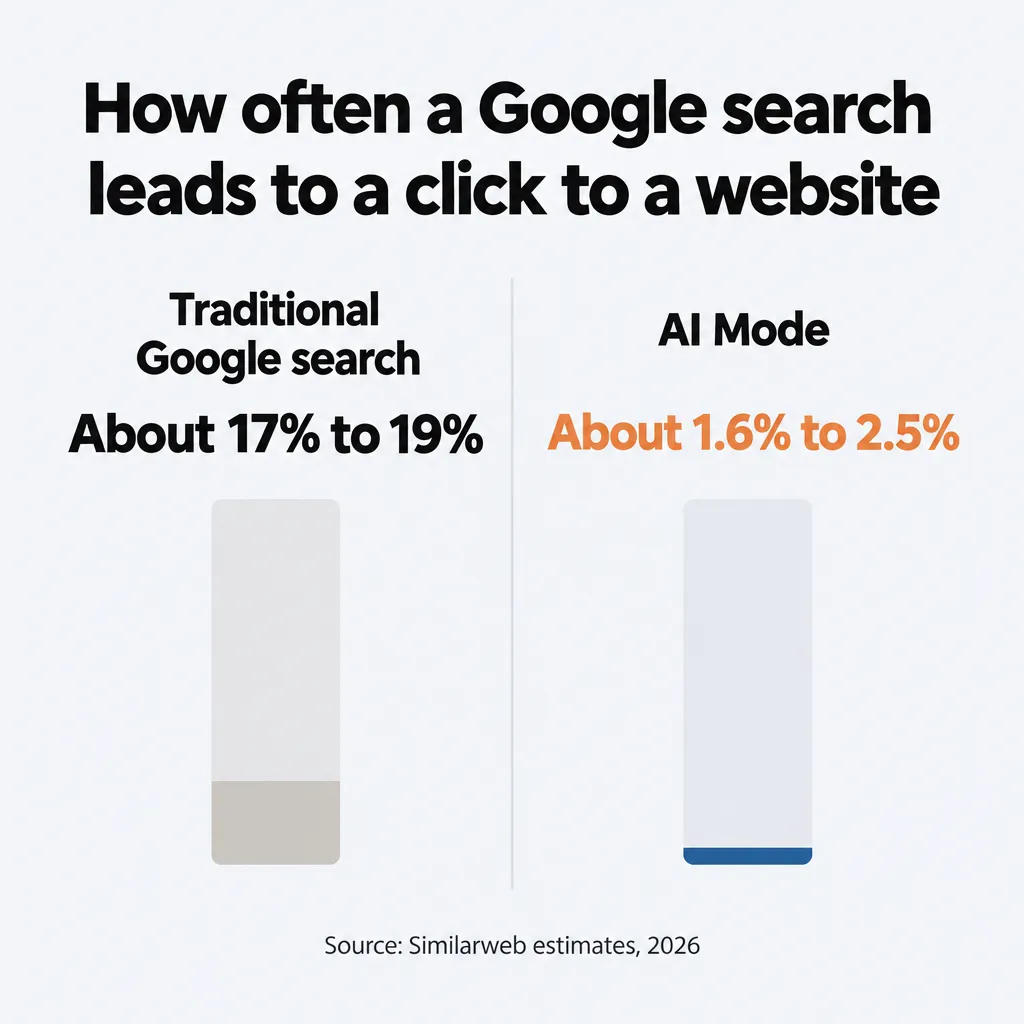
Google already answers many searches with AI, in AI Overviews at the top of the results and in AI Mode, its chat-style search. Both send far fewer people to websites than traditional results do.
Ahrefs found that the top-ranking page’s click rate is about 58% lower when an AI Overview appears (Ahrefs). In AI Mode, Similarweb estimates that searches lead to a click to a website about 1.6% to 2.5% of the time, compared with about 17% to 19% for traditional Google search (Similarweb).
Sometimes people just want to go to a website. I think that’s why Google is updating its AI answers to give you a link to the website when it’s clear that’s what you’re looking for. On October 15, 2026, Google announced that it’s adding more links to AI Overviews and AI Mode.
Isn’t a list of links still better than an AI answer?
Some people will still say, “I don’t want an AI response at all, just give me a list of websites.” But is that really the best experience for any search?
| What you’re looking for | What serves you best |
| A specific website | The link to that website |
| Information | The information itself |
| Analysis or research | A sophisticated AI that does the research for you, instead of you clicking through and digging into 10 to 20 different websites |
| Opinions | A summary of opinions from across the web, with links to dig deeper |
Doesn’t AI get things wrong?
If your response to all this is, “But TJ, AI gets things wrong,” I’d first wonder whether you’ve been paying attention to the AI models that have come out recently. Even if these models aren’t up to your standards yet, the solution still seems to be better AI. And if there’s one thing we can be certain of, it’s that better AI is on its way.
Does ChatGPT traffic convert better than Google traffic?
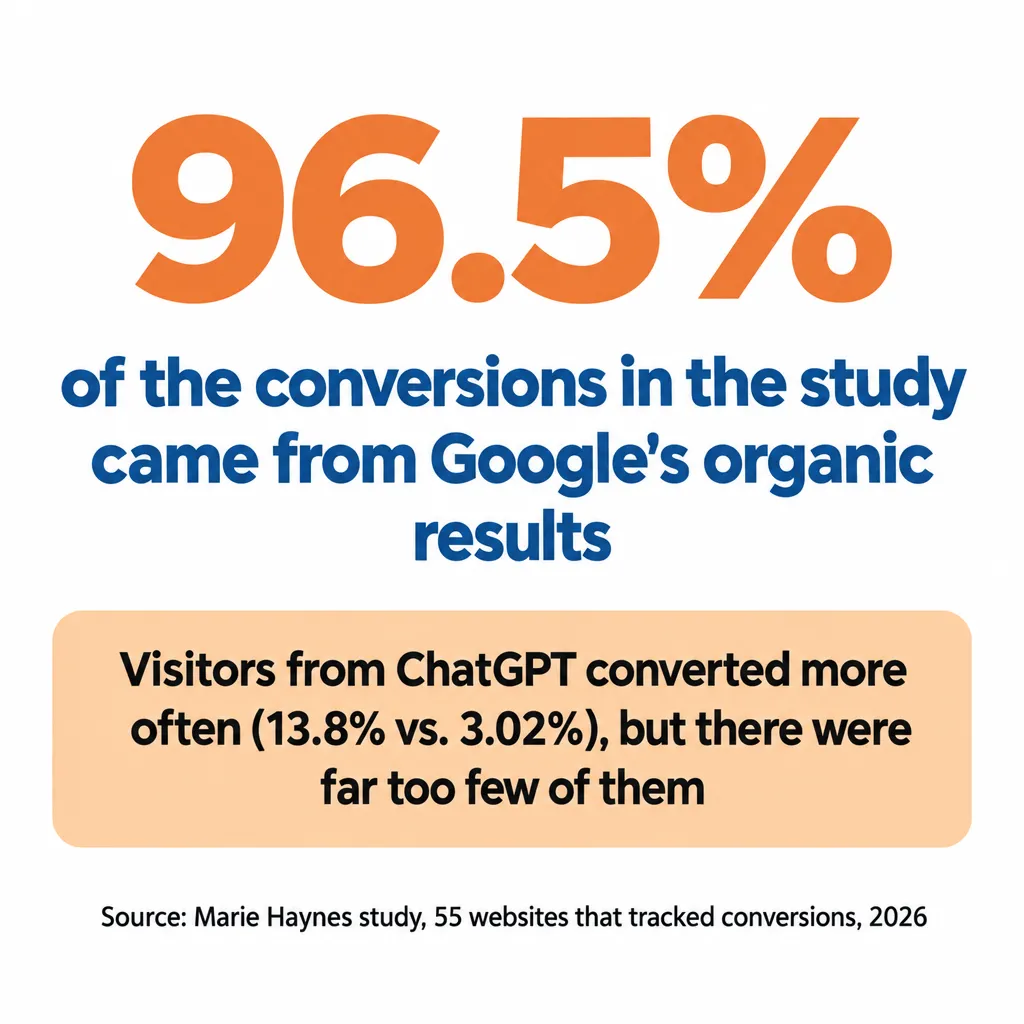
In Haynes’s study of 100 websites, visitors from ChatGPT converted at a higher rate than visitors from Google. On the 55 sites that tracked conversions in Google Analytics, 13.8% of visitors from ChatGPT converted, compared with 3.02% of visitors from Google’s organic results. The study doesn’t say what counted as a conversion, so it may mean different things on different sites.
There were so few ChatGPT visitors, though, that Google’s organic results still brought in 96.5% of all the conversions the study analyzed (Search Engine Journal).
Is AI search worth investing in if Google still sends most customers?
AI search is worth investing in if you sell a product or service. Google’s own search results are turning into AI answers, so getting recommended by AI includes getting recommended in Google’s AI Overviews and AI Mode.
Marie Haynes, who ran the study, concludes that businesses shouldn’t focus on getting mentioned in ChatGPT and other chatbots. She says they should put their effort into Google, including AI Overviews and AI Mode, because Google sends far more people to businesses than ChatGPT does.
I think ChatGPT matters more than her numbers show, because her study only measures what shows up in Google Analytics. Google Analytics can’t tell when ChatGPT is the reason someone bought from you.
The evidence on whether AI recommendations turn into sales is still limited. People who hear about a business from AI and later type its address straight into their browser show up in analytics as Direct visits. Growth advisor Kevin Indig looked for those visits on 12 websites. In that sample, he couldn’t detect them yet (Search Engine Roundtable).
That’s a small sample. His test also only looked at website traffic, so it couldn’t count people who found a business through AI and then bought in a store or on a marketplace.
When Eliot Dill, the founder of PressMeGPT, asked nearly 400 people who signed up for his product how they found it, roughly 45% said AI. Google Analytics didn’t show that: it filed 88.3% of his site’s visits under Direct, so it couldn’t say where most of his visitors came from (HackerNoon).
That’s one business, and the answers are self-reported.
What should you track instead of ChatGPT traffic?
Track how often AI tools recommend your business when your customers ask about what you sell. That includes ChatGPT, Google’s AI Mode and AI Overviews, and wherever else people are searching.
When we start a campaign, we set up tracking on about 50 buying prompts. Buying prompts are the questions customers ask AI when they’re choosing who to buy from. Most of them don’t include a business name, like “best [product] for [situation].”
We use Peec.ai to run those prompts every day in ChatGPT, Google’s AI Mode and Google’s AI Overviews. It records how often each answer recommends the business and its competitors. Because the prompts don’t change, the numbers show whether AI is recommending the business more or less often over time.
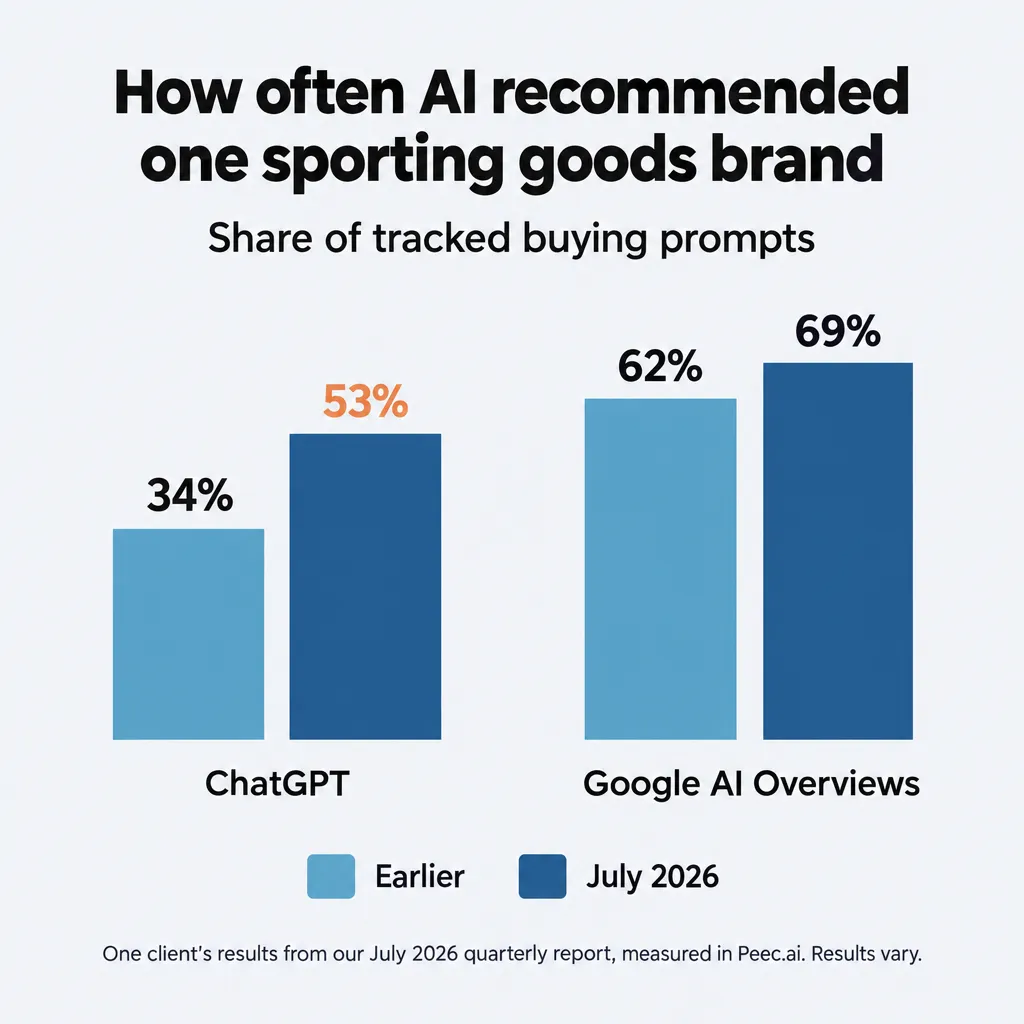
In our July 2026 quarterly report for a sporting goods e-commerce client, ChatGPT recommended the brand on 53% of tracked prompts, up from 34%. In Google’s AI Overviews, the rate rose from 62% to 69%. Results vary from client to client, and not every quarter looks like that one.
You can get a rough idea for your own business by asking ChatGPT and Google’s AI Mode the questions your customers ask and noting whether you come up. AI answers change from one run to the next, so a single check won’t tell you much. You need the same prompts, repeated over time.
To see whether AI recommendations are bringing in business, watch how often people search for your business by name. If AI recommends you more often, you’d expect those searches to grow. You can see them in Google Search Console, Google’s free report on the searches your website shows up for.
I explain how we track AI recommendations and searches for your name together in my post on how to measure SEO success.
It also helps to ask new customers how they found you. Some may name ChatGPT or another AI tool even when your analytics shows no AI visit.
If AI isn’t recommending you yet, here’s how to get recommended by ChatGPT and Google AI.
If you want help tracking how often AI recommends your business, or getting that number up, reach out through our contact page or email me at tj@tjrobertson.com.