Google says it’s adding more links to AI Overviews and AI Mode to make exploring the web “simpler, more visual, and more engaging.” I think the bigger reason is that Google wants to replace its traditional list of search results with AI answers.
A lot of people come to Google just to get to a particular website. For them, a long AI answer gets in the way. I think that’s a big reason Google still shows the traditional results underneath its AI answers.
With the right links at the top of the AI answer, those people won’t need the traditional results anymore.
Google’s announcement is about making links easier to see and click, and that sounds like it should mean more traffic for websites. Google doesn’t actually promise that, though. If AI Overviews have taken traffic from your site, I wouldn’t count on this update to bring it back.
I’ve been in digital marketing for 17 years. Today I run TJ Digital, where we do SEO and GEO for small and medium-sized businesses. GEO means getting a business recommended in AI answers, including Google’s AI Overviews and AI Mode.
What Did Google Announce About Links in AI Overviews and AI Mode?
On October 15, 2026, Google announced five changes that add links to its AI answers or make those links easier to see and click. The announcement came from Hema Budaraju, a vice president of product management at Google.
| Change | What Google says it does | Status |
| Inline links, placed higher | Google has already added substantially more links within the words of its AI answers. Now it’s launching updates to place those links higher up in more of its answers. | Launching |
| A section for official sites | When only one or two official sites can complete a task or give you the exact information you need, those links get their own section at the top of the answer. | Testing |
| More news carousels | Carousels of recent articles are coming to more locations and languages. They highlight the sites you’ve picked as Preferred Sources. | Rolling out |
| More prominent links to related articles | Links at the end of some AI answers get image thumbnails and “a more clickable design.” | No date given |
| Clickable creator names | Names on video results link to the creator’s Search profile, a Google page that lists their channels and other work. | Testing, AI Mode only |
Google’s post doesn’t say whether most of these changes apply to AI Overviews, AI Mode or both. Google also hasn’t said when the official-sites section and the clickable creator names might move beyond testing.
Will the New AI Overview Links Send More Traffic to Your Website?
I don’t expect the new links to send much more traffic to most websites. Google hasn’t claimed they will. Its announcement never mentions traffic or visits to websites, and it gives no numbers on clicks.
As I read them, most of these changes point people to something they already had in mind: the official site for a task, a news site they picked as a Preferred Source, or the Search profile of a creator whose video they found. If people find your site by searching for a topic or a problem, the changes that could send you clicks are the inline links and the related-article links.
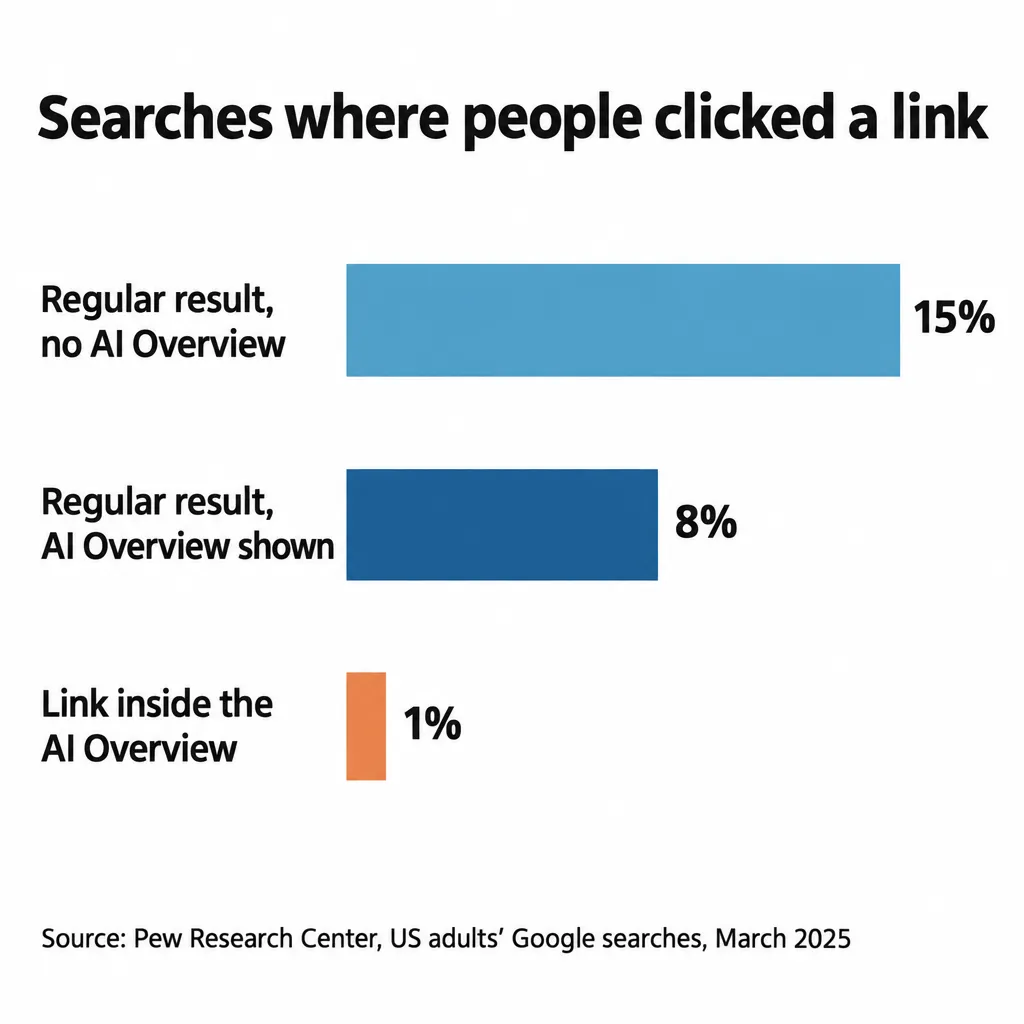
So far, the links inside AI answers haven’t made up for the clicks those answers take away. When Pew Research Center tracked US adults’ Google searches in March 2025, people clicked a regular search result about half as often when an AI Overview appeared: on 8% of those searches, compared with 15% of searches without one. They clicked a link inside the AI Overview itself on just 1% of the searches that showed one.
In a 2026 experiment, researchers at the University of Pennsylvania and Northeastern University switched people to AI Mode for all of their Google searches for a week. Those people clicked through to websites much less often than people using Google as usual.
Both studies were done before this update, so neither one shows whether moving links higher in the answer gets them clicked more.
Google has told website owners that AI hasn’t cut the clicks Google sends them. In August 2025, Liz Reid, Google’s head of Search, wrote that total organic clicks from Google Search to websites had been “relatively stable” year over year. She said Google was even “sending slightly more quality clicks to websites than a year ago,” meaning clicks where people don’t quickly come back to Google.
In July 2026, Google CEO Sundar Pichai told investors that Google was now sending “billions of clicks to websites every week through AI features in Search.”
Neither Reid nor Pichai shared the data behind those statements. Pew, meanwhile, found that people click regular search results about half as often when an AI Overview appears. I think Google has repeatedly gaslit website owners about how much traffic its AI sends them.
You can’t measure the effect on your own site yet, either. Search Console’s report for AI Overviews and AI Mode shows how often your pages appeared in AI answers, but it doesn’t show clicks. Google has said it will “introduce additional metrics over time,” without saying which ones or when.
Why Would Google Send People Away From Its Own Search Results?
I think Google is willing to send people away from its results page because people who come to Google just to get to a particular website were going to leave anyway. Someone who types their bank’s name to get to its login page will click through to the bank’s site no matter what Google shows. The only question is whether they click a link in the AI answer or scroll down to the traditional results to find it.
I think Google wants them clicking from the AI answer because it wants AI answers to replace the traditional results. At Google I/O in May 2026, Liz Reid said “Google search is AI search through and through,” as reported by PPC Land.
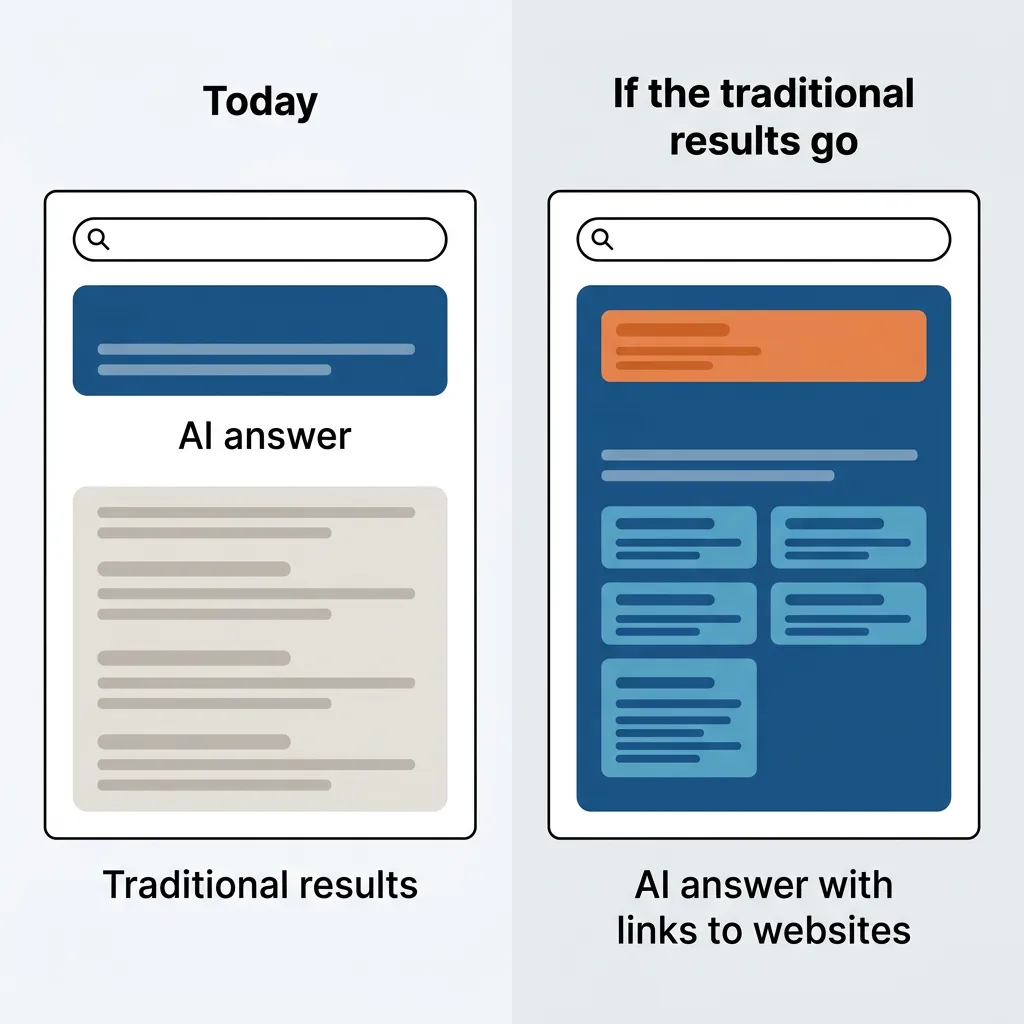
Right now, Google Search is a hybrid: an AI answer at the top, with the traditional search results underneath. The traditional results are still the quickest way to get to a particular site, like your bank’s login page or the one official page where you can renew a license.
Putting a link to the site people are looking for at the top of the AI answer gets them there without the traditional results. Google says its official-sites test builds on what it already does “to show links front and center when you’re looking to go to a particular site.”
If Google gets those links right, I think AI answers will be the best experience for almost any search. If you want information or a recommendation, you get it right away in the AI answer. If you’re using Google to get to another website, the links you want are right at the top.
The update also comes as news publishers warn of sharp drops in their traffic, according to AFP. In June 2026, the UK’s competition regulator required Google to credit publishers’ content “using clear links” in its AI search results. I think the UK rule and the publishers’ warnings may also be part of why Google is adding these links. Google’s announcement doesn’t mention either one.
Will Google Get Rid of the Traditional Search Results?
Google hasn’t said it will get rid of the traditional search results, but I expect it to. In a May 2026 interview on the Hard Fork podcast, Pichai was asked whether the classic results would go away and AI Mode would become the default. He didn’t give a yes or no, but he said, “Sources and links will always be there as part of it,” according to Search Engine Journal.
Google’s I/O post in May also told people, “You’ll continue to get a range of results from Search, just like you do today.”
When the traditional results do go, I expect Google to show links to websites inside the AI answer instead, as this update is starting to do. That would fit what Pichai said, since the links would still be there as part of the answer. I made the longer case in AI will replace Google search soon.
What Should You Do If Your Business Relies on Google Traffic?
If your business relies on Google traffic, stop judging your website by how much traffic it gets. Focus on getting your business recommended in Google’s AI answers instead. The exception is a site that makes money from the traffic itself.
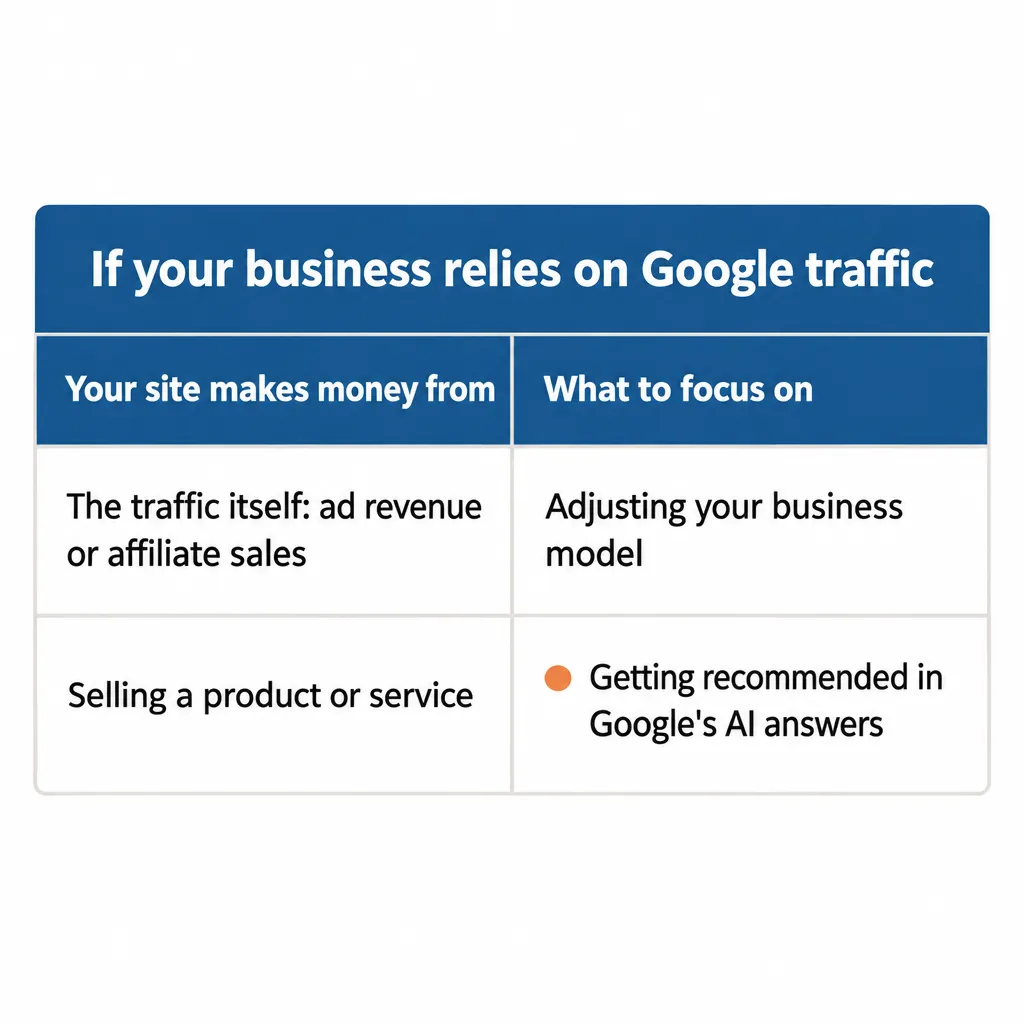
If your revenue comes directly from traffic, like ad revenue or affiliate sales, losing Google traffic can be devastating. I think you’ll have to change your business model some. I wrote about what I think those sites can do instead.
For businesses that sell a product or service, the goal of a website has always been sales. For years, traffic from Google was simply how a lot of them got those sales.
That’s why being recommended in Google’s AI answer is way better than just ranking at the top of Google. A recommendation reaches the buyer even if they never click through to your site. I’ve written about how to get Google AI to recommend your business.
The truth is, Google isn’t going to become any less influential over what people buy. People are going to rely on it more.
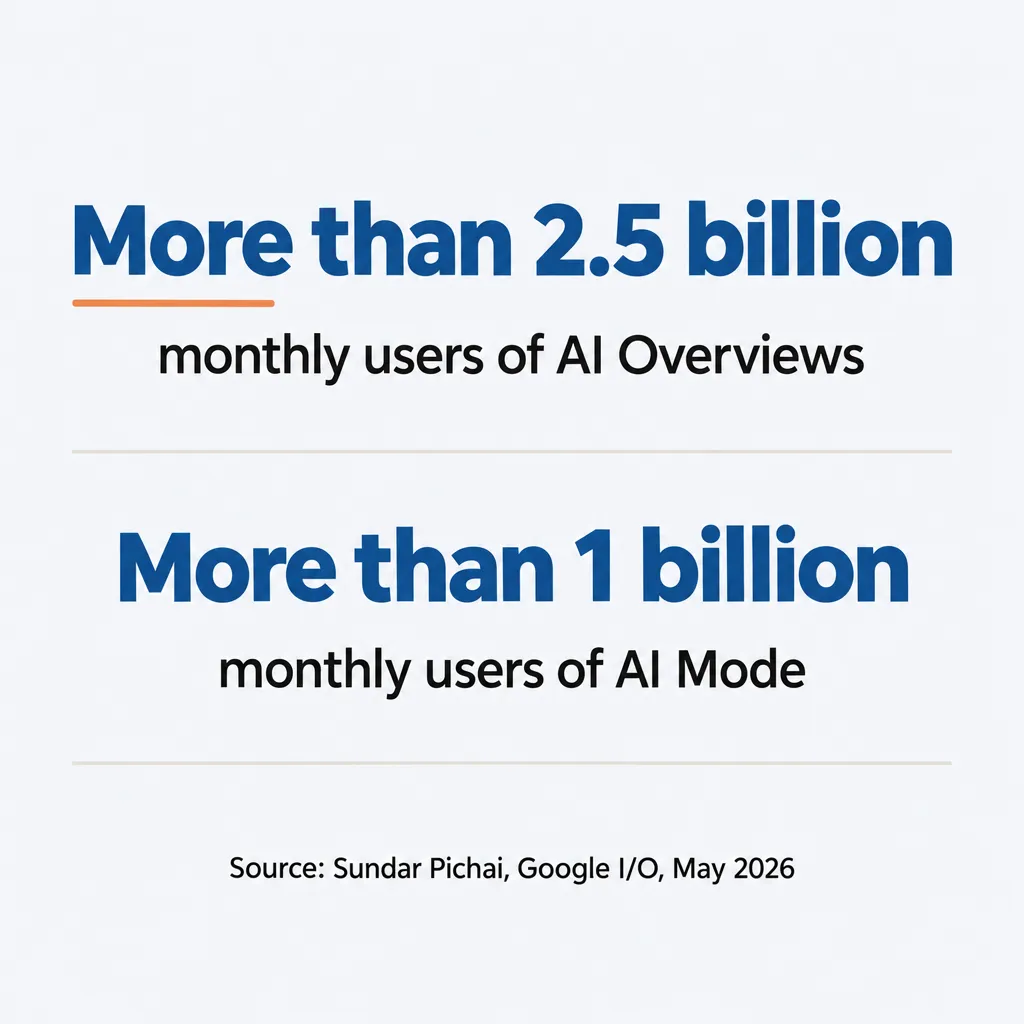
At Google I/O in May 2026, Pichai said AI Overviews had more than 2.5 billion monthly users. AI Mode had passed 1 billion monthly users within about a year of launching.
My advice is to stop worrying so much about website traffic. More and more software is being built for AI agents to use. AI agents are AI tools that browse websites and complete tasks for people, and your website is one of the places they’ll go.
I’m not saying nobody will visit your website. But expect fewer and fewer people visiting it themselves, and more and more AI agents visiting it on their behalf. Make sure those agents can find your website and use it.
Start by putting complete information about your business on your site. Then make sure an agent can fill out your forms, book appointments and check out. I covered the details in how to prepare your website for AI agents.
If you have questions about what Google’s AI answers mean for your business, reach out through our contact page or email me at tj@tjrobertson.com.