What Does Gemini 4 Hydrogen Mean for SEO in 2026?
By TJ Robertson, Founder and Lead Strategist at TJ Digital
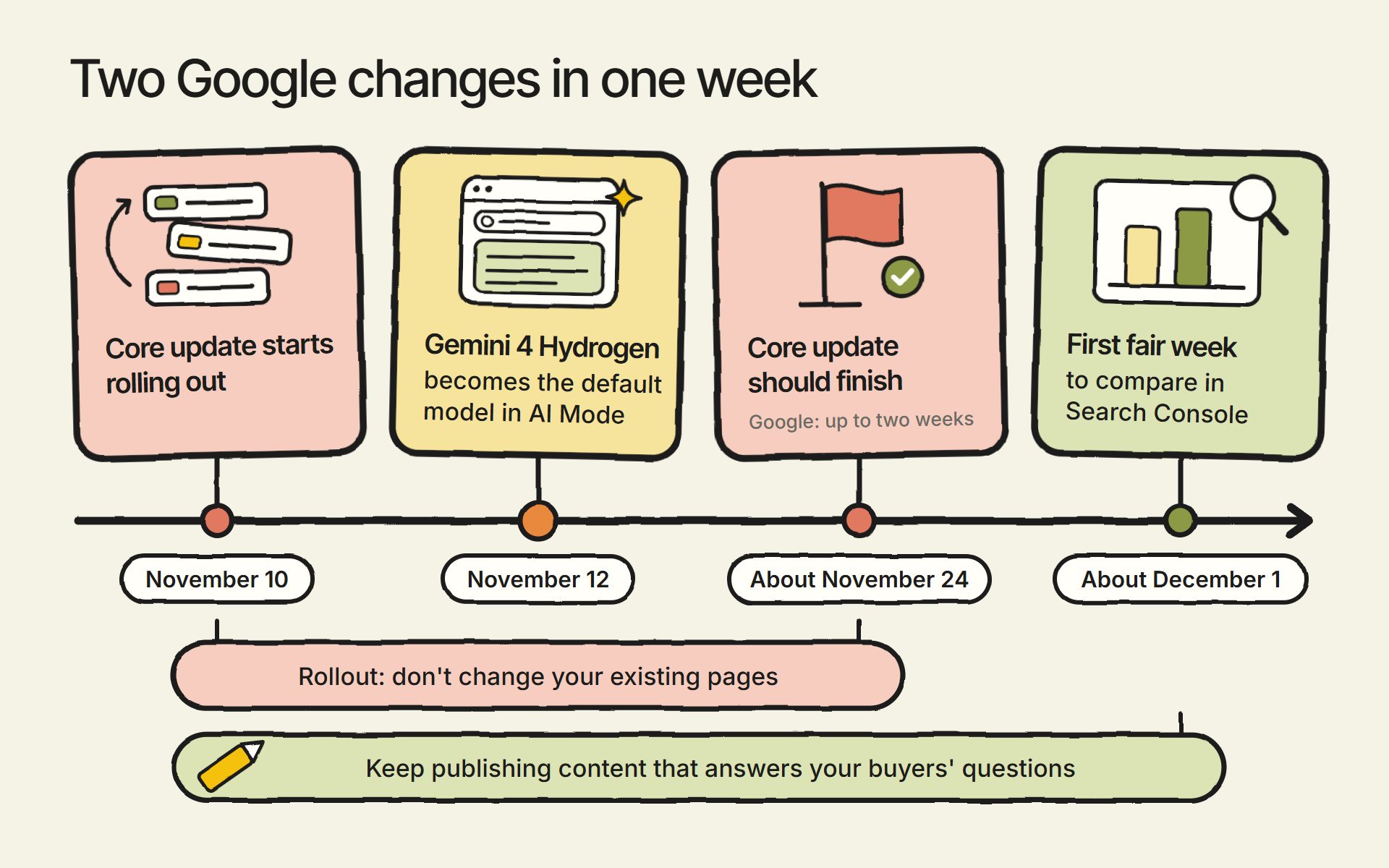
Google made two changes to Search this week. On November 10, 2026, it started rolling out the November 2026 core update, a broad change to how it ranks the regular results. On November 12, it made a new AI model, Gemini 4 Hydrogen, the default in AI Mode, and started using it for the hardest questions in AI Overviews.
I think Hydrogen is the bigger change for your visibility over time. If it’s as smart as Google says, Google’s AI answers will get better, and more of your buyers will rely on them. So the work that pays off now is getting your pages cited in them, with content that answers the questions your buyers ask.
My advice on the core update is simpler: don’t change your existing pages until it finishes, around November 24, then check your numbers in Search Console.
At TJ Digital, we do SEO and GEO, which means we help businesses show up in Google’s regular results and in AI answers. From August to October 2026, we studied 193,507 answers from AI Mode, AI Overviews and ChatGPT to see which pages get cited.
Gemini 4 Hydrogen vs the November 2026 Core Update
Google hasn’t linked the two changes. They just landed in the same week, and they touch different parts of Search.
| Gemini 4 Hydrogen | November 2026 core update | |
|---|---|---|
| Started | November 12, 2026 | November 10, 2026 |
| What it changes | The AI answers in AI Mode and some AI Overviews | Rankings in the regular results |
| How Google describes it | “The biggest model upgrade to Search yet” | “A regular update” that may take up to two weeks |
| When it ends | It’s the new default model, so it doesn’t end | About November 24, by Google’s timeline |
| What to do now | Publish content that answers your buyers’ questions | Don’t change existing pages until it ends; check Search Console a week after |
What Is Gemini 4 Hydrogen?
Gemini 4 Hydrogen is Google’s newest AI model, the third in its Gemini 4 family and the one built to be fast. Until this week, Gemini 4 models were only in AI Mode for paying subscribers. Now everyone who uses AI Mode gets one. (If you want to know how it compares with Google’s bigger Gemini 4 models, I covered those in Is Gemini 4 Carbon the Best AI Model?)
In its announcement, Google lists four things Hydrogen does better:
- Understanding complicated questions, including ones with several parts or bad typos.
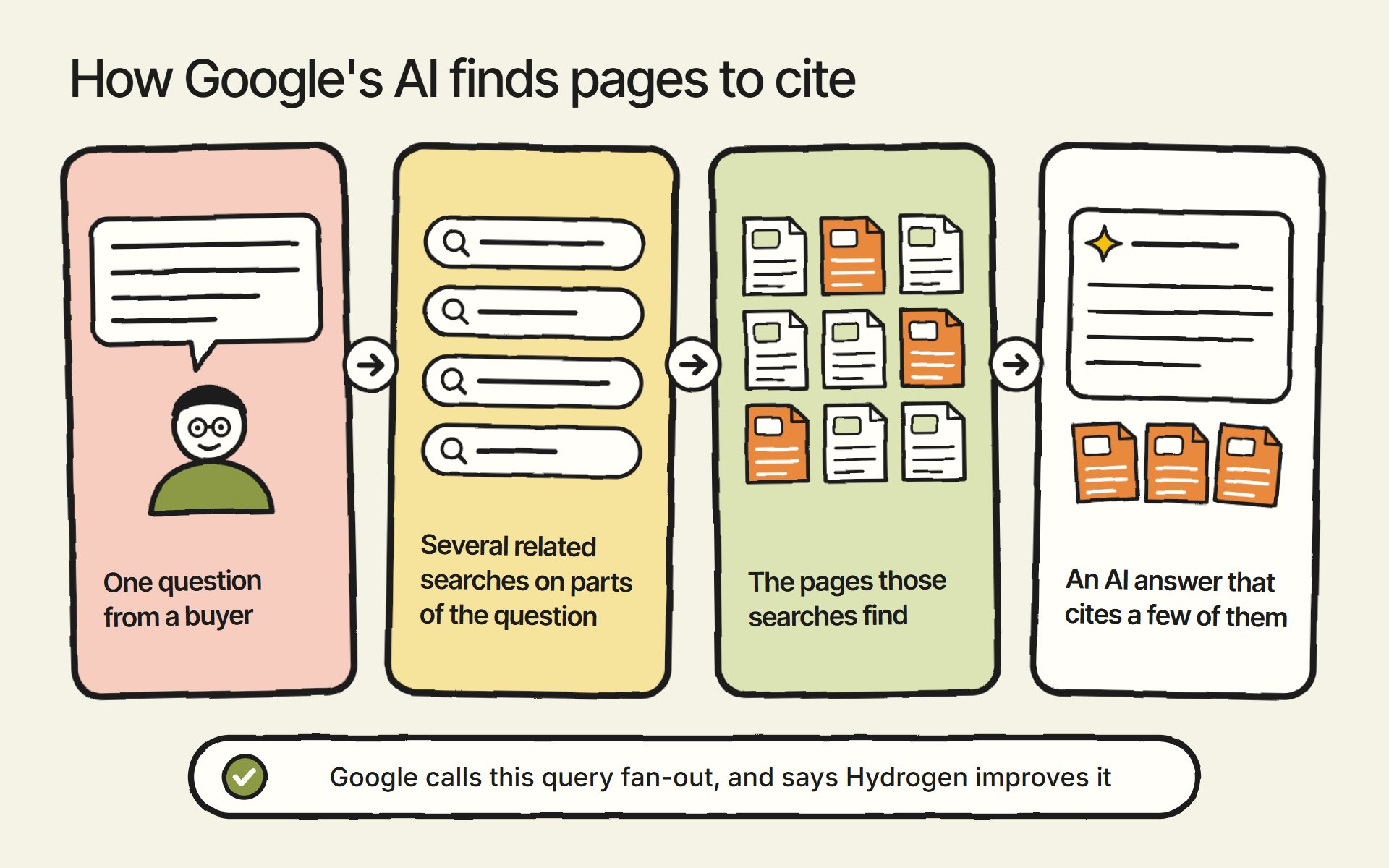
- Researching the answer. Before Google’s AI writes an answer, it runs several related searches on the parts of the question, a technique Google calls query fan-out. Google says Hydrogen improves this, connecting people to “a broader range of helpful links than before.”
- Visual answers, with more images, comparison tables and structured responses.
- Languages, with better answers in every language AI Mode supports.
Google’s announcement includes no data on clicks or traffic. As of November 13, I haven’t seen anyone measure Hydrogen’s effect on traffic, and we haven’t either. Hydrogen only reached Search on November 12.
Is Hydrogen Used in AI Mode, AI Overviews or the Regular Results?
In May 2026, Google brought AI Overviews and AI Mode together into one AI Search experience. (I covered what Google I/O 2026 meant for SEO at the time.) Hydrogen doesn’t write all of it, though.
Hydrogen is now the default model in AI Mode. In AI Overviews, Google uses it only for what Robby Stein, Google’s VP of Product for Search, called “your hardest questions” (reported by Search Engine Roundtable). Google hasn’t said which questions count as the hardest.
Google also hasn’t said whether Hydrogen changes the regular results, the list of links below the AI answer. Until it does, treat ranking changes in the regular results as the core update’s doing.
How Does Hydrogen Change What It Takes to Show Up in Google?
I think Hydrogen will move more of your buyers’ searches into Google’s AI answers. That makes getting cited in them more valuable every month.
If Hydrogen is as smart as Google claims, the AI answers should get much better. Better at identifying reliable sources. Better at getting people the information they’re looking for without making things up. And better at showing them exactly what they’re looking for: links when they want links, content when they want content, and an answer when they just need an answer.
The better it gets at those things, the more people will use the AI features. And the more people use them, the more confident Google will get about replacing the regular results with an AI-generated answer. Google hasn’t said when or whether that will happen, and I won’t guess a date, but I think Hydrogen is one more step toward it.
Search engines still matter for your business. AI is now the one using them: it searches on your customer’s behalf and brings back the answers it found. So we’re now doing SEO for the AI.
How do you get cited in Google’s AI answers?
Google says its AI features need nothing beyond regular SEO. Its own guide puts it this way: “optimizing for generative AI search is optimizing for the search experience, and thus still SEO.”
Ranking in Google’s top 10 helps, especially in AI Overviews, but you don’t need it to get cited. In our AI citation study, only 2-5% of the pages AI cited were in Google’s top 10 for the question. Each engine cited 24 to 45 different pages per question over eight weeks, and the top 10 only holds 10.
In my view, the one thing that keeps mattering more is high-quality content that answers the questions people, or AI, search for when they’re interested in buying your product or service.
Our study also compared the pages AI cited with pages that ranked in Google’s top 10 for the same question but weren’t cited. The cited pages had a few things in common:
- They answer the question at the top. Cited pages opened with a direct answer 20% of the time, compared with 5% for the top-10 pages AI passed over.
- They’re recent. Pages published or updated in the past 12 months had 88% higher odds of being cited.
- They put the year in the title. Pages with the year in the title had more than twice the odds of being cited.
- They show prices. Pages with prices had 28% higher odds.
The rest of what we found is in how to get cited in AI search.
Do backlinks still matter?
Backlinks and the other traditional ranking factors still matter. In my experience, though, they matter less with every update.
Is the November 2026 Core Update Related to Hydrogen?
Google hasn’t connected the November 2026 core update to Hydrogen. The core update is a separate change to how Google ranks pages in its regular results, and it re-evaluates sites across the web, so some pages move up and others move down.
Google described it as “a regular update designed to better surface relevant, satisfying content for searchers from all types of sites.” It said the rollout may take up to two weeks, which puts the finish at about November 24. As of November 13, the Search Status Dashboard lists its November 10 start and no end date yet.
This year’s two earlier core updates, in March and May, each finished in about 12 days. So this one could end a little before November 24.
Core updates are fairly routine, but each one is when Google re-evaluates websites against its latest ranking factors. So if you’ve recently made changes or improvements to your website, you’re about to find out what Google thinks about those changes.
Was My Traffic Change Caused by Hydrogen or the Core Update?
If your Google traffic moved this week, you can’t yet tell for sure whether Hydrogen or the core update caused it. Nobody can, because they started two days apart. Three checks narrow it down:
- When the change started. Hydrogen reached Search on November 12. A change that started on November 10 or 11 came before Hydrogen, so the core update is the likelier cause.
- Whether it shows up in AI answers. Search Console’s Performance report counts clicks from AI Overviews and AI Mode together with clicks from the regular results, so it can’t separate them. Search Console’s generative AI report can: it shows, by day, how many impressions each of your pages got in AI Overviews and AI Mode. It doesn’t show clicks or the searches people typed. I explain where to find it and how to read it in Google Search Console’s AI report.
- November 9 to 11 in that report. Google says a logging error under-counted AI impressions on those three days. Leave them out of any comparison, because a jump on November 12 may partly be the error ending.
For a fuller method, I walk through it in how to tell if a Google traffic drop means you lost visibility.
What Should You Do About the Core Update Right Now?
My advice is to leave your existing pages as they are until the core update finishes. If you change pages during the rollout, you won’t be able to tell whether your changes or the update moved your numbers. Once it ends, Google’s core updates guidance gives this order:
- Watch the Search Status Dashboard for the date the update ends.
- Wait at least a full week after it ends. If it ends around November 24, that’s about December 1.
- Compare that week with the week before the update started. In Search Console, look at your top pages and your top searches.
- If the drop is small, leave it. Google’s words are “There’s no need to take drastic action.”
- If the drop is large, review your whole site for content that’s “helpful, reliable, and people first,” as Google puts it, and skip quick fixes.
The week after the update ends will likely include Thanksgiving (Thursday, November 26). If your business is seasonal, compare with the same weeks last year too.
That advice is about editing the pages you already have. Keep publishing new content through all of this, because content that answers your buyers’ questions is what I expect Hydrogen to favor.
If you have questions about any of this, or want to know what these changes mean for your site, reach out through our contact page or email me at tj@tjrobertson.com.