

Google isn’t cracking down on AI content. On October 1, 2026, it added a few sentences to its guidance on AI-generated content, saying it’s “critical” to fact-check and review that content before you publish it. It didn’t add a penalty or any new rule against AI content.
Google is still fine with you using AI to write your content. The penalty that applies to AI content is for publishing lots of low-value pages made mainly to rank in search, whether a person or AI wrote them. If you’re publishing content to help your customers, that penalty isn’t aimed at you.
So keep publishing, and review each piece before it goes live. In my experience, the best AI models can do the fact-checking if you give them your sources. A person should still read the finished piece.
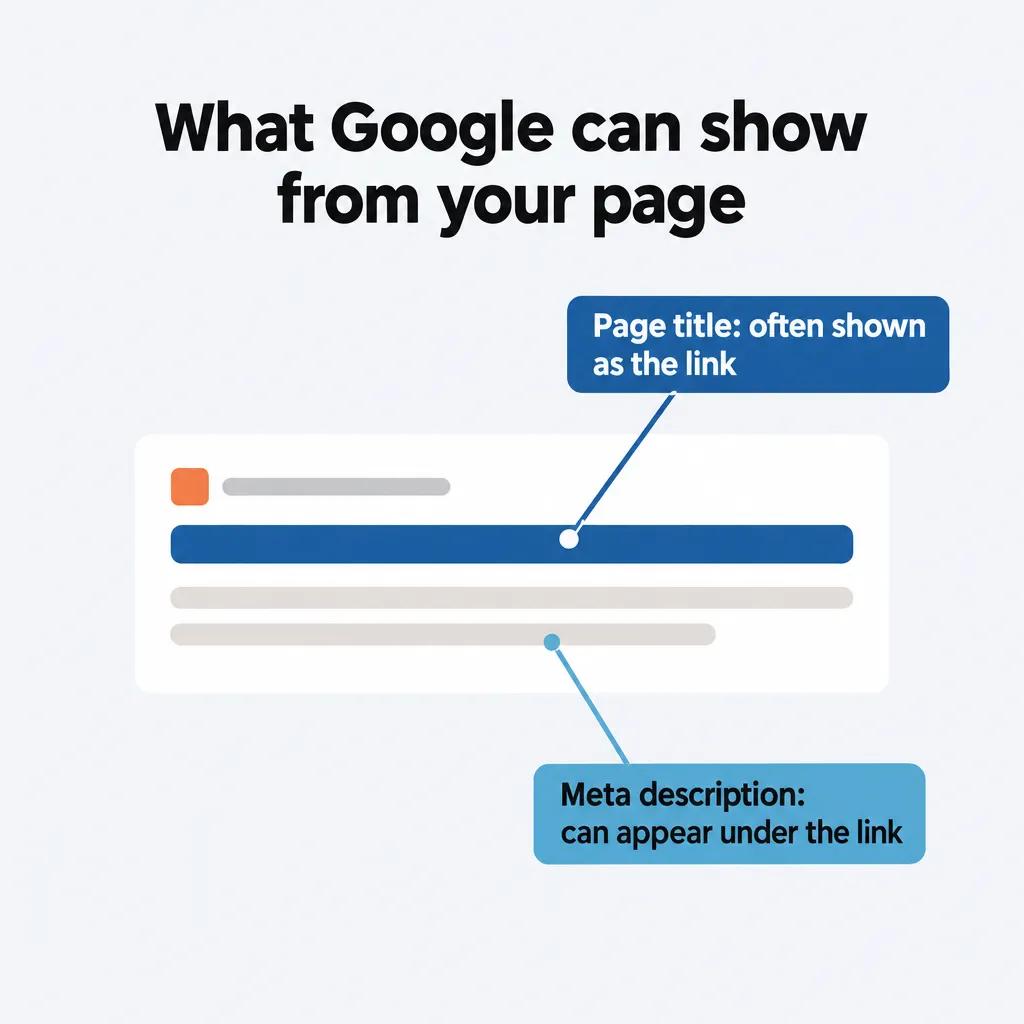
That review should include each page’s title and meta description, because Google can show both in its search results.
At TJ Digital, we use AI to write content for businesses in e-commerce, software, home services, legal and plenty of other industries. Claude, Anthropic’s AI model, does most of the hands-on work. People review all of it before it reaches the client.
What did Google change on October 1, 2026?
Google edited two of its pages on October 1, 2026. It didn’t touch its spam policies, the page that lists what Google penalizes:
| Page | What changed on October 1 |
| Guidance on using generative AI content | Three sentences added and one reworded, saying to fact-check and review all AI-generated content before publishing |
| Guide to creating helpful content | New lines on what makes content high quality, including effort and accuracy |
| Spam policies | Nothing. The page was last updated on August 28, 2026. |
On the generative AI page, only one paragraph changed. Before October 1, it read:
> “When creating content for the web, focus on accuracy, quality, and relevance, especially when automatically generating the content. This includes metadata like `<title>` elements, meta description elements, structured data, and alternate texts for images, which can appear in Search results.”
Now it reads, with the new wording in bold:
> “When creating content for the web, focus on accuracy, quality, and relevance, especially when automatically generating the content. Keep in mind that generative models don’t retrieve facts, but predict a likely sequence of words based on their training data. Because of this, generative AI outputs may contain inaccuracies (also known as hallucinations). It is critical to manually factcheck and review all AI-generated content for accuracy and trustworthiness before publishing. This review also applies to metadata like `<title>` elements, meta description elements, structured data, and alternate texts for images, which can appear in Search results.”
Google logged this edit in its Search Central changelog the same day.
The edit to the helpful content guide added lines describing what Google’s quality raters look for in a page. Raters are people who grade search results for Google. Two of the new lines matter for AI content:
- Effort: “using generative AI to produce large amounts of text without manual oversight or curation represents little to no effort.”
- Accuracy: “For informational pages, the content should be factually accurate.”
The effort line describes large amounts of AI text published without anyone overseeing or curating it. The way I read it, reviewing AI content before you publish it is the kind of oversight that line is talking about.
Is Google penalizing AI content after the October update?
The October update doesn’t penalize AI content. Google’s changelog lists it as an update to its documentation, the help pages it writes for site owners. It announces no change to how Google ranks or penalizes content.
Google’s stated reason for the edit is “To get our documentation in sync with our presentations we use at our developer events.” So the page now says in writing what Google already tells people at its events.
Google does call the fact-check “critical,” so take it seriously. Still, the page never says the review is required and never mentions a penalty for skipping it. It also says to check “manually” without defining what that means, so a check done with AI’s help isn’t ruled out.
I think the more important point, and the one most people seem to be missing, is that Google is totally fine with you using AI to generate content. Google just rewrote part of its page on using AI content, and everything it added is about checking for accuracy. The only line on the page that points to a penalty was already there before October 1: using AI to generate many pages without adding value for users may break Google’s spam policies.
I think this is just about the clearest signal you could expect from Google that it doesn’t care what process you use to create your content. It just doesn’t want you spamming its index with low-quality content.
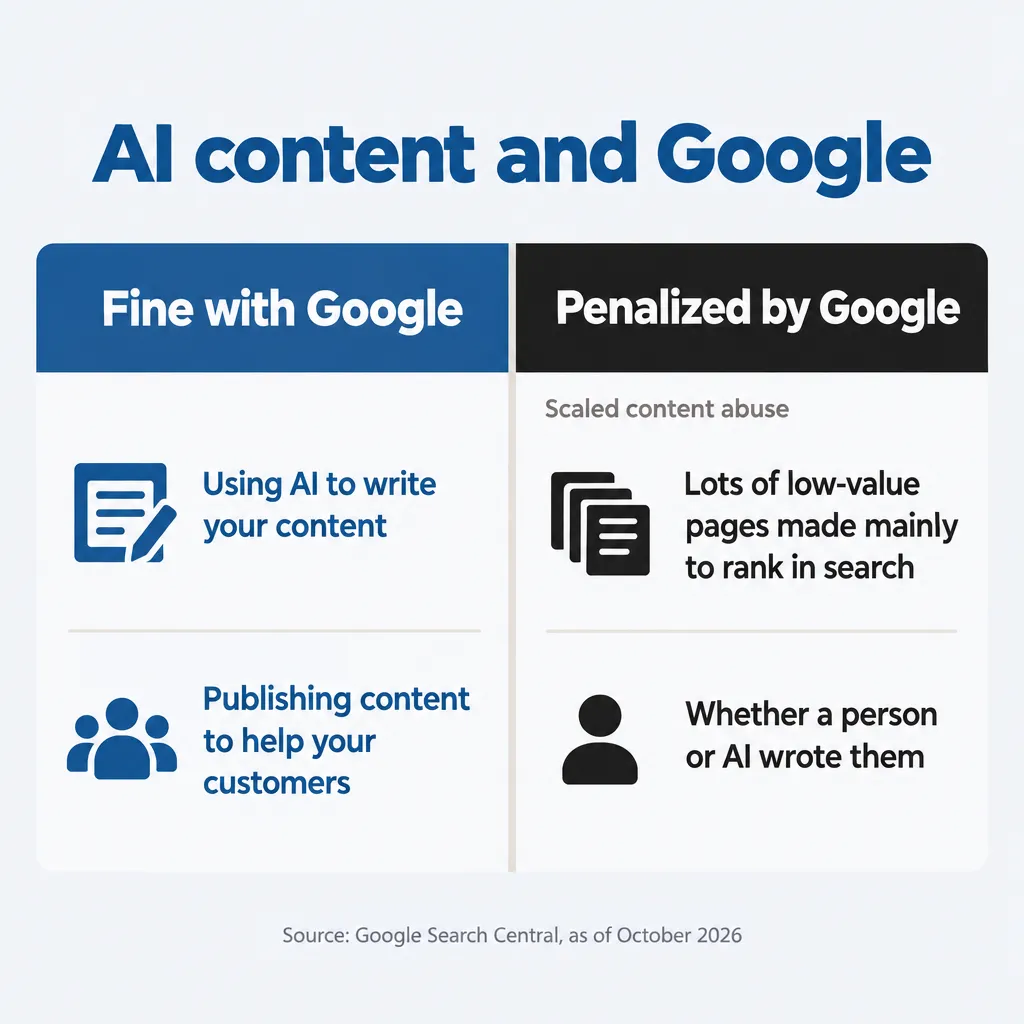
Google’s own wording is close to that. A February 2023 blog post on AI content describes Google’s “focus on the quality of content, rather than how content is produced.” The same post says, “Appropriate use of AI or automation is not against our guidelines.”
Breaking Google’s spam policies can get a site ranked lower or removed from search. The policy that matters for AI content is called scaled content abuse.
Scaled content abuse means publishing lots of pages made mainly to rank in search that offer little value to the people reading them. It applies to all content, “no matter how it’s created.”
Since the spam policies didn’t change on October 1, the update gives you no new reason to worry about AI content you’ve already published. If you’re wondering whether your own publishing could count as scaled content abuse, I covered that in how much content is too much.
Can Google detect AI content through watermarks?
Google hasn’t said it checks the text on websites for AI watermarks. A text watermark is a hidden pattern an AI model builds into the words it chooses. You can’t see it, but a detector from the company that made the model can find it.
Only some AI text carries a watermark, depending on the tool:
- Gemini: Google has marked text from its Gemini app with its SynthID watermark since 2024.
- Claude: Anthropic’s support page shows watermarks on text from 9 of the 16 Claude models it lists, including Opus 5.5. Anthropic says it’s still working on adding them to its older models.
- Other AI tools: Anthropic says several other major AI providers are adding watermarks too, to comply with the EU AI Act.
Anthropic’s text detector is in a limited early release, open only to eligible groups such as regulators, fact-checkers and researchers. Neither of Anthropic’s watermark pages names Google Search, or any other search engine, among those groups.
People have been speculating since August that Google would use watermarks to penalize AI content. Neither page Google updated on October 1 mentions watermarks, and neither do its spam policies.
A watermark also can’t show how much of a page AI wrote. Anthropic says its watermark “cannot distinguish ‘Claude wrote this’ from ‘Claude heavily edited this.'”
I went through how these watermarks work in more detail in AI content watermarks and what they mean for SEO.
Does Google check whether content is accurate?
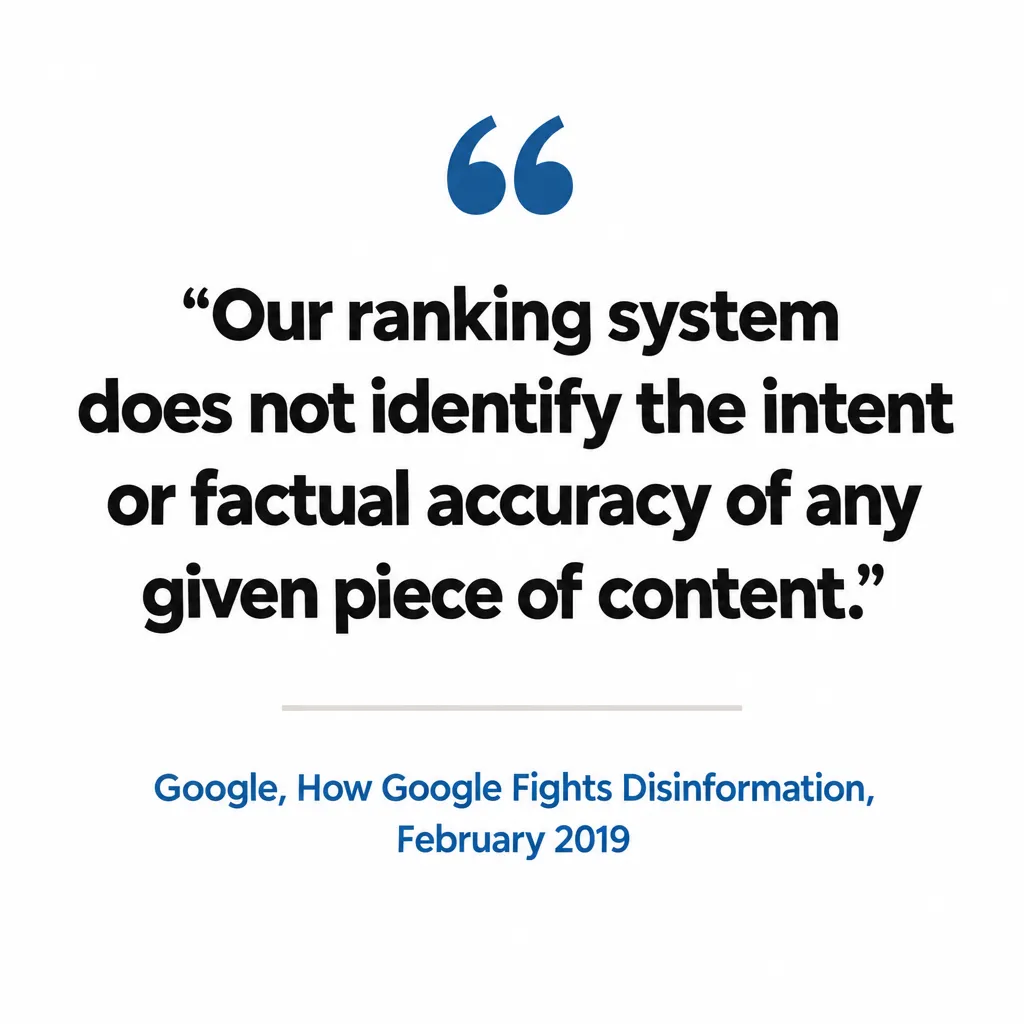
The truth is, in most cases Google’s algorithm has no idea whether your content is factually accurate. Google said so in its 2019 paper How Google Fights Disinformation: “Our ranking system does not identify the intent or factual accuracy of any given piece of content.” The paper says Google looks for sites that show expertise, authority and trustworthiness instead.
Accuracy still matters to Google, even though its algorithm can’t check it directly. Google’s quality raters are trained to check whether informational pages are factually accurate. Google uses their grades to check whether its ranking systems are putting the right pages on top.
Your readers notice errors too. One wrong number or made-up quote gives them a reason to doubt everything else on the page.
Do you still need to fact-check AI content?
You should still fact-check AI content before you publish it. Google says so, and generally, I think that’s right.
What should you review before publishing AI content?
Check the article itself, then the four kinds of metadata Google names, because they “can appear in Search results”:
- The article: every fact, figure, quote, name and date. Check each one against a source, and make sure each quote is word for word and credited to the right person.
- The page title: the headline Google often shows as the link in its results. Make sure every number, year and claim in it matches the page.
- The meta description: the summary that can appear under that link. Make sure it describes this page and doesn’t promise anything the page doesn’t deliver.
- Structured data: code that describes the page to Google, such as an article’s author or a product’s price. Make sure every value matches what the page says.
- Image alt text: the written description of each image, which screen readers read aloud. Make sure it describes what’s actually in the image.
I wrote more about titles and meta descriptions in metadata optimization for AI search.
Can AI do the fact-checking for you?
In my experience, the best AI models, given proper instruction and good sources, are now much better at fact-checking than any human I know. I find that models like Opus 5.5 very rarely hallucinate these days.
And when one does say something inaccurate, it seems to me the most common cause is that a person gave it something inaccurate to reference. Again, that assumes you’re using the smartest models with proper instruction.
Anthropic’s published numbers come from tests of how accurately Opus 5.5 answers questions and writes reports, so they don’t measure fact-checking directly. They do show how accurate the model is, and where it still falls short.
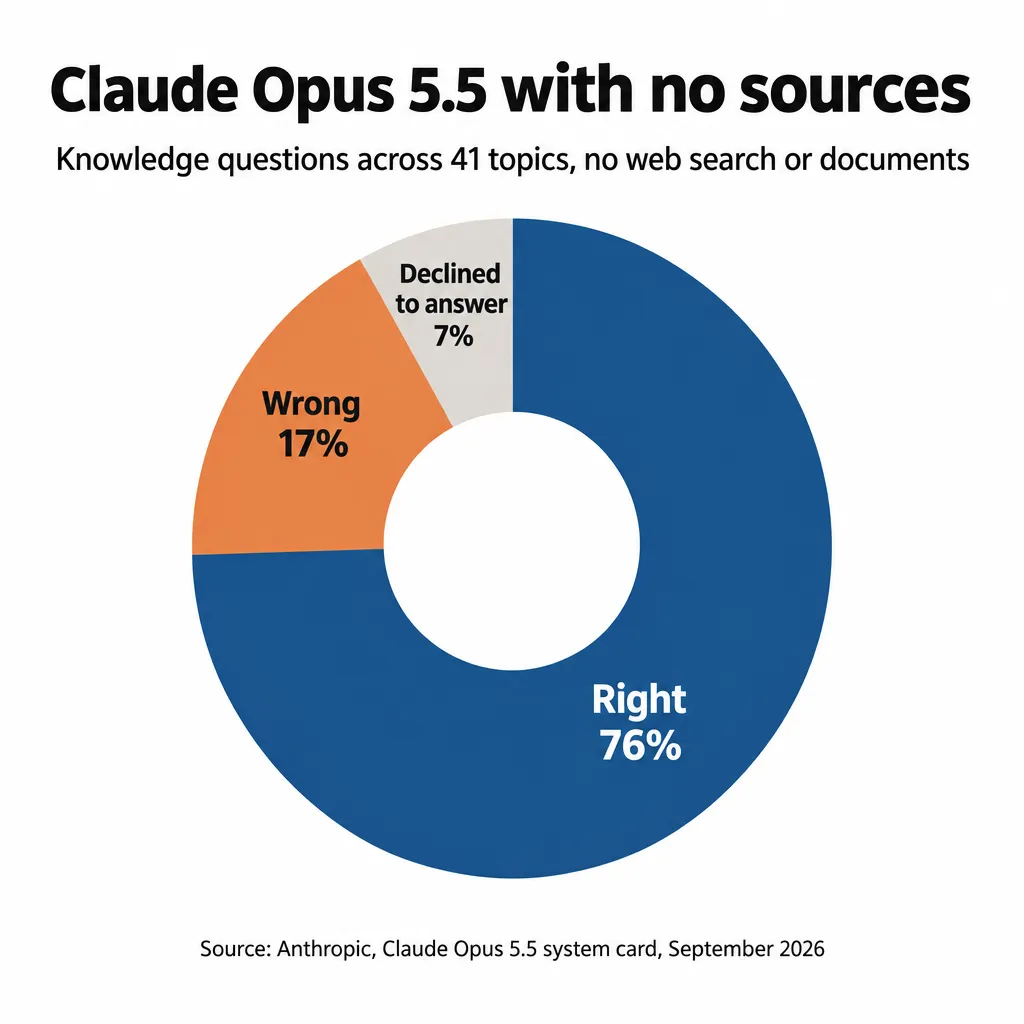
Anthropic’s system card for Opus 5.5 is its report on how it tested the model. In one test, the model answered knowledge questions across 41 topics with no web search or documents to work from. It got 76% right, 17% wrong and declined to answer the other 7%.
In a second internal test, Opus 5.5 wrote reports on a company’s quarterly results using only what it could find on a test copy of the web, where the company’s earnings release was hard to locate. An automated grader checked every figure and quote in the reports against the sources. A report failed if it contained even one invented figure or quote.
16 of the 18 reports passed, and 2 did not. The two tests measure different things, so their numbers don’t compare directly. Neither result is perfect, which is why a person should still read the finished piece.
So when you use AI to fact-check, set it up like this:
- Give the model your sources, and make sure they’re accurate in the first place.
- Tell it to use only those sources.
- Have it cite the source for each fact.
- Have it check the finished draft against those sources.
- Have a person read the finished piece before it goes live.
What decides whether AI content does well in Google?
AI content can do well in Google if it’s useful and original, the same as any other content. Google’s AI optimization guide puts it plainly: “Don’t just recycle what others on the internet have already said, or could easily be produced by a generative AI model.”
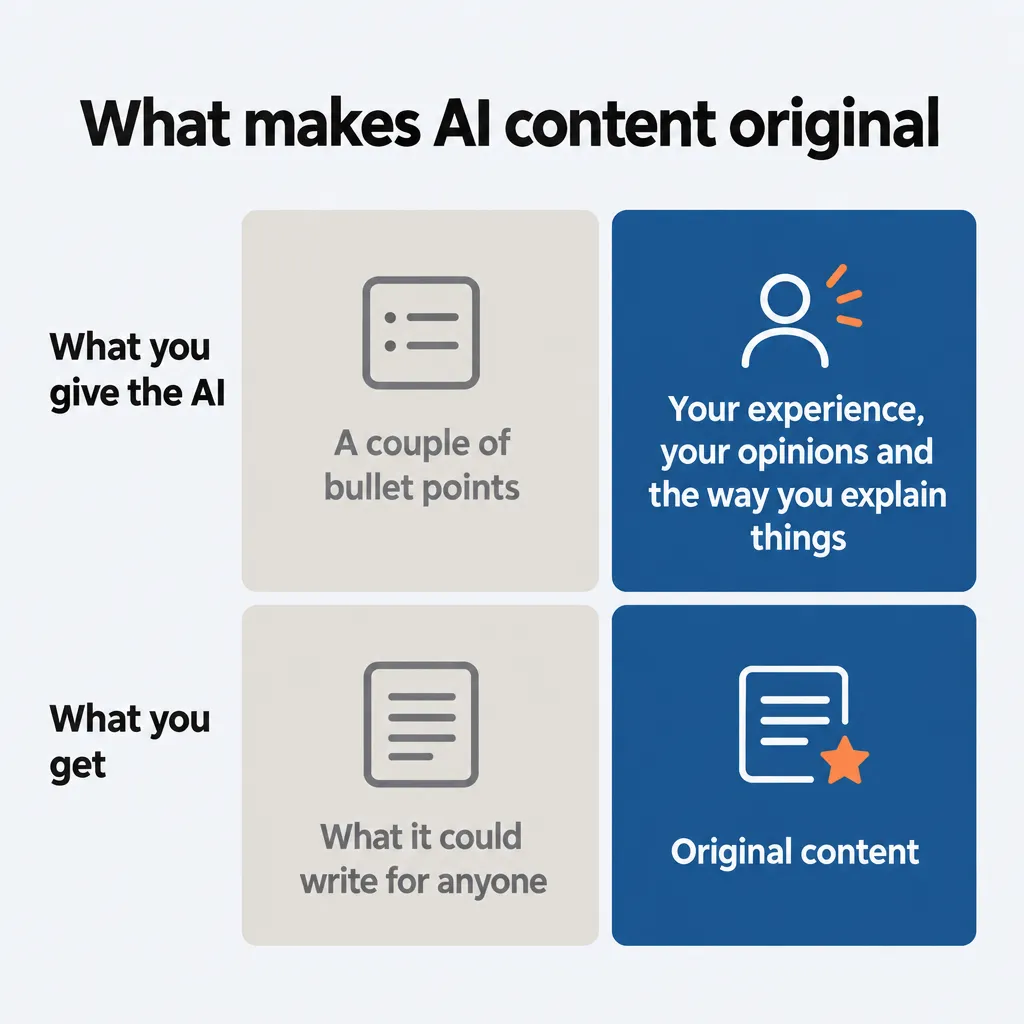
So you shouldn’t just give ChatGPT or Claude a couple of bullet points and hand over your content marketing. With only a couple of bullet points to go on, a model can only write generic content that could be about any business.
Getting these models to create high-quality content that represents your brand is hard to do. In my experience, even with the best models, getting AI to sound like you and your brand is much harder than getting the facts right. Your experience, your opinions and the way you explain things are what make the content original.
For our clients, we build a Brand Ambassador, a knowledge base about the business that our AI works from, so what it writes sounds the way that brand talks. If you’re doing this yourself, I wrote about how to make AI writing sound like you and about building an AI content strategy that ranks.
At the end of the day, content you’re proud of that accurately reflects your brand is all that really matters. So don’t get too hung up on the process or whether you used AI. Google certainly isn’t.
If you have questions about any of this, or about how your own AI content holds up, reach out through our contact page or email me at tj@tjrobertson.com.