
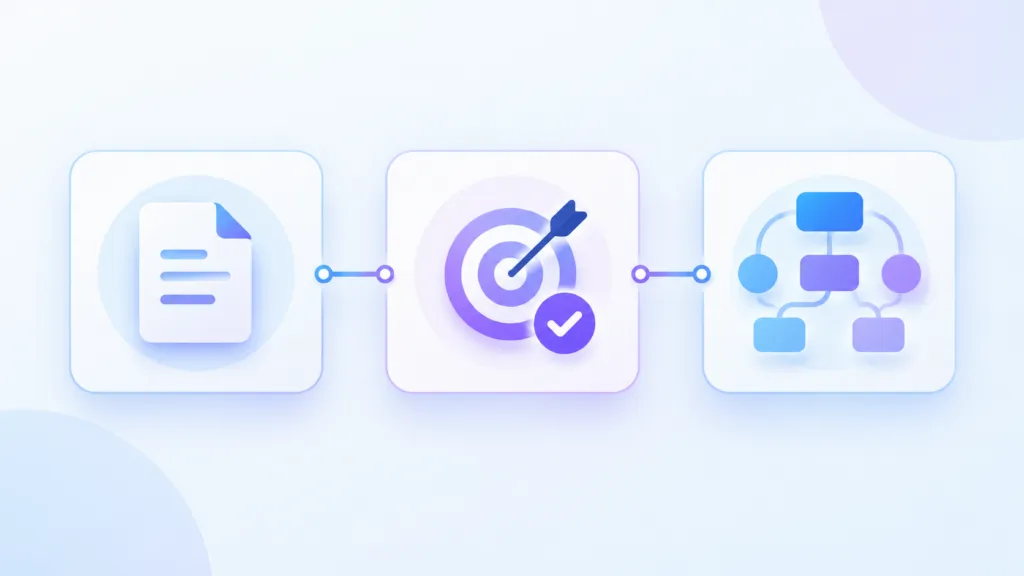
Claude skills work best when they follow three rules:
- Every piece of information lives in exactly one skill.
- Each skill explains the goal, gives Claude the context it needs, and defines what done looks like.
- Any complex system Claude works in, like Notion or Salesforce, gets its own skill that other skills link to.
At TJ Digital, we use AI in every workflow, and skills are how we keep that work consistent from one client to the next.
I recently recorded a video meant to be handed to your AI. The first few lines are for the human, and after that I’m talking directly to Claude, asking it to build a meta skill. This article covers the rules from that video, plus a few more worth adding.
Table of Contents
ToggleWhat Is a Meta Skill for Claude?
A meta skill is a Claude skill about writing skills. Claude loads it whenever you ask it to create a new skill or update an existing one, so every skill you build follows the same standards.
I’m using a meta skill to refresh every skill at our agency. It works whether you already have a library of skills that need cleaning up or you’ve never built one.
@tjrobertson52 How to get Claude to write better skills: give it this video and let it build your meta skill #ClaudeAI #AIAgents #AISkills
♬ original sound – TJ Robertson – TJ Robertson
How Do You Build a Meta Skill With Claude?
Claude can write the meta skill for you. Here’s the process I use:
- Give Claude your rules for writing skills, along with the reason behind each one.
- Ask it to propose rules of its own and push back on any of yours it disagrees with.
- Have it read Anthropic’s latest prompting guide for the model you’re using and pull in anything relevant.
- Once you agree on the guidelines, have it draft the meta skill following those exact guidelines.
The meta skill has to follow its own rules. If it breaks them, every skill it builds will inherit the problem.
Why Should Each Piece of Information Live in One Skill?
Each piece of information should live in one skill so there’s only one copy to keep up to date. My first rule is don’t repeat yourself, across your whole skill library and within each individual skill.
When the same instruction lives in four skills, you have four places to update every time it changes, and eventually one gets missed. Now Claude is holding two versions of the truth and has to guess which one you meant.
How Should One Skill Reference Another?
One skill should reference another by linking to it. We do this with our Notion setup. One skill explains how our workspace is structured, and every skill that touches Notion points to it.
Does This Information Need Its Own Skill?
Information needs its own skill when more than one skill will use it. If only one task depends on it, it usually belongs inside that task’s skill. A few questions help you decide:
- Will other skills need this information now or soon? Give it its own skill.
- Is it specific to one task? Keep it inside that task’s skill.
- Would adding it make an existing skill harder to follow? Split it out and link to it.
How Detailed Should Claude Skill Instructions Be?
A Claude skill should explain the goal and give Claude the context it needs, then leave most of the decisions to the model. My second rule is to write skills in a way that respects the model’s intelligence.
Anthropic’s skill authoring guide makes the same point. It tells skill authors to assume Claude is already very smart and to add only the context it doesn’t already have.
When Should a Skill Include Rigid Rules?
A skill should include rigid rules only when you have evidence they’re needed. Maybe Claude kept making the same mistake in testing, or a client flagged something specific. When you do add a rule, explain its purpose right after it so Claude understands why it’s there.
Here’s what that looks like in practice:
| Rule on its own | Rule with its purpose |
| Never use em dashes. | Never use em dashes. Readers see them as a sign of AI writing, and our clients don’t want their content read that way. |
| Never put the year in a URL slug. | Never put the year in a URL slug. The URL would have to change every time we update the article. |
A stated purpose lets Claude apply the rule to situations you didn’t anticipate. A bare rule only covers the exact case you wrote down.
What Does “Done” Look Like for a Skill?
Every skill should define what a finished result looks like. That tells Claude when it can stop and when it still has work to do.
“Done” can be as simple as a checklist of what the output must include. It can also be a description of who will read the output and what they need to walk away with.
Should You Tell Claude to Think Carefully?
No, you don’t need to tell Claude to think carefully. You can remove any instruction along the lines of “think carefully,” “take your time,” or “use a thinking block,” because the latest models know how much to think.
How Often Should You Update Your Skills?
Review any Claude skill written more than a few months ago. Rules that were necessary for an older model are often dead weight for a newer one.
Every so often, remove the guardrails from a skill and test it without them. More capable models need fewer rules, and you’ll usually find some of yours aren’t doing anything anymore. A major release like Claude Fable 5.1 is a good time to run that test.
When Does a System Need Its Own Claude Skill?
A system needs its own Claude skill when it’s complex enough that Claude can’t work in it reliably without a map. Task managers like Notion and CRMs like Salesforce usually qualify. That’s my third rule.
The system skill explains how everything is structured, and every skill that asks Claude to work in that system links to it. You explain the structure of your Notion workspace once, and every other skill reuses it.
Which Systems Need Their Own Skill?
Complex, custom systems need their own skill, and simple ones usually don’t. Here’s how I’d sort them:
| System type | Examples | Needs its own skill? | What Claude should do |
| Complex, custom structure | Notion, Salesforce, a custom database | Yes | Read the system skill before acting |
| Simple, standard structure | Google Drive, Gmail, Slack | Usually not | Look around before acting |
| Simple tool that has grown complex | A heavily customized Drive or Slack workspace | Consider it | Map the system, then write the skill |
We cover this layered setup in more detail in our guide to how you structure your company data for AI.
What Should Claude Do Before Working in Gmail or Slack?
Claude should look around a system before working in it. Even when a system doesn’t warrant its own skill, every skill that touches an outside system should tell Claude to explore it first.
A few minutes spent seeing how the folders, labels, or channels are organized makes Claude faster and more accurate. If the system turns out to be more complex than expected, Claude should consider mapping it completely and turning that map into a skill.
What Other Claude Skills Best Practices Should You Follow?
A few more rules are worth adding to any meta skill. Most of them come from the Agent Skills specification, the open format Claude skills are built on.
- Write a description that says what and when. The description is what Claude reads to decide whether to load a skill. If a skill never triggers, the description is the first thing to check.
- Keep the main file short. The spec recommends keeping SKILL.md under 500 lines and moving detailed reference material into separate files that load only when needed.
- Respect the context budget. Only a skill’s name and description (about 100 tokens) load at startup. The full instructions load when the skill activates, and the spec recommends keeping them under 5,000 tokens.
- Let Claude say it doesn’t know. If information is missing, the skill should tell Claude to flag the gap. That makes Claude less likely to fill the hole with something made up.
What Do People Ask About Writing Claude Skills?
How long should a SKILL.md file be?
Keep SKILL.md under 500 lines. Anything longer should move into reference files that Claude opens only when the task calls for them.
What should a Claude skill description include?
A Claude skill description should say what the skill does and when to use it. The spec caps descriptions at 1,024 characters, so use the specific words someone would type when asking for that task.
Can Claude write its own skills?
Yes. Anthropic’s skill-creator skill builds new skills through conversation, and a meta skill keeps that output consistent with your standards.
How Can a Brand Ambassador Help Your Business Use AI?
A Brand Ambassador lets AI represent your business accurately. It’s an AI project we build for every client, and it knows everything about your company and talks the way your brand talks.
If you have questions about any of this, reach out through our contact page.