
SEO is changing in three ways because of AI:
- More searches now end in an AI answer.
- Google uses AI to judge which pages best answer a search, and in my experience, its judgment is improving much faster than it used to.
- The day-to-day work of SEO is getting much easier, because AI can now do most of it.
What isn’t changing is how pages get found. Google still ranks pages on the same fundamentals it has used for 20 years, like links from other websites and how relevant a page is to the search. And the AI tools writing those answers still run searches in a search engine to find their sources.
For most businesses, the right response is to keep doing the SEO fundamentals.
I’ve been doing SEO for 17 years. Today I run TJ Digital, where we do SEO and GEO for small and medium-sized businesses: we help them show up in Google and in AI tools like ChatGPT.
Is SEO Going Away Because of AI?
SEO isn’t going away, and Google says so itself. In its guide to optimizing for generative AI features, Google writes: “From Google Search’s perspective, optimizing for generative AI search is optimizing for the search experience, and thus still SEO.”
Some agencies and consultants now sell GEO, short for generative engine optimization, as a whole new discipline for getting a business into AI answers. In my view, SEO includes GEO. SEO is changing very quickly, but that doesn’t mean every part of it is changing, despite what the GEO grifters are saying.
How Are AI Answers Changing Search?
The first and most obvious way SEO is changing is that when you search on Google or ChatGPT, you often get an AI answer. Google said in June 2026 that AI Overviews, the AI summaries at the top of its search results, have over 2.5 billion monthly active users.
Google also has AI Mode, a chat-style version of its search. In May 2026, Google said AI Mode had passed one billion monthly users a year after its debut. It also said AI Mode queries were “more than doubling every quarter since launch.”
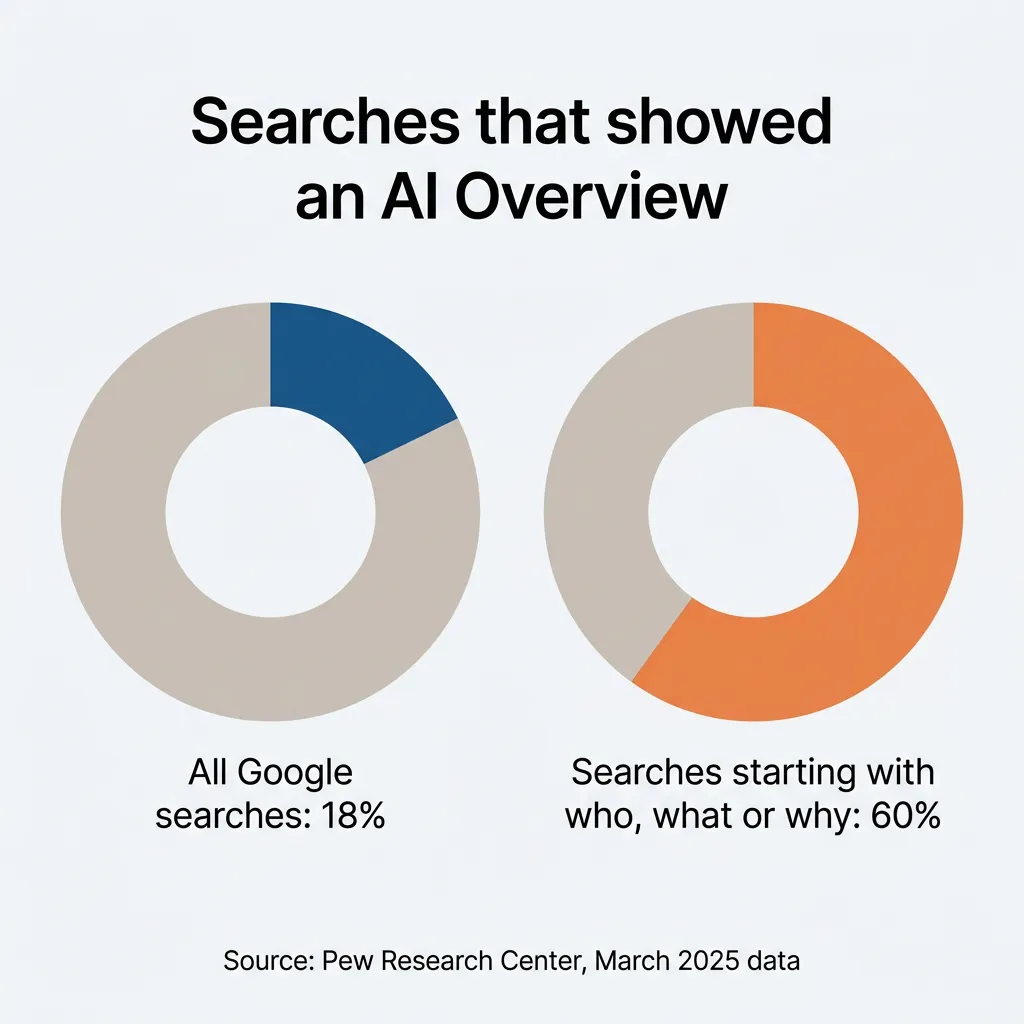
Not every search shows an AI answer yet. Google’s own documentation says AI Overviews often don’t show up, because they only appear when Google’s systems decide they add something to the regular results. When Pew Research Center counted them in March 2025, 18% of Google searches showed an AI Overview.
Questions were far more likely to get an AI Overview. In Pew’s data, 60% of searches that started with words like “who,” “what” or “why” had one.
Pew’s count is from more than a year before Google’s user numbers, so it can’t tell you how common AI answers are today. Google’s own numbers show they’re growing fast. At our agency, we work on the assumption that very soon, every search will end in some kind of AI response, even if that response still includes traditional blue links.
Will AI Answers Cost You Traffic?
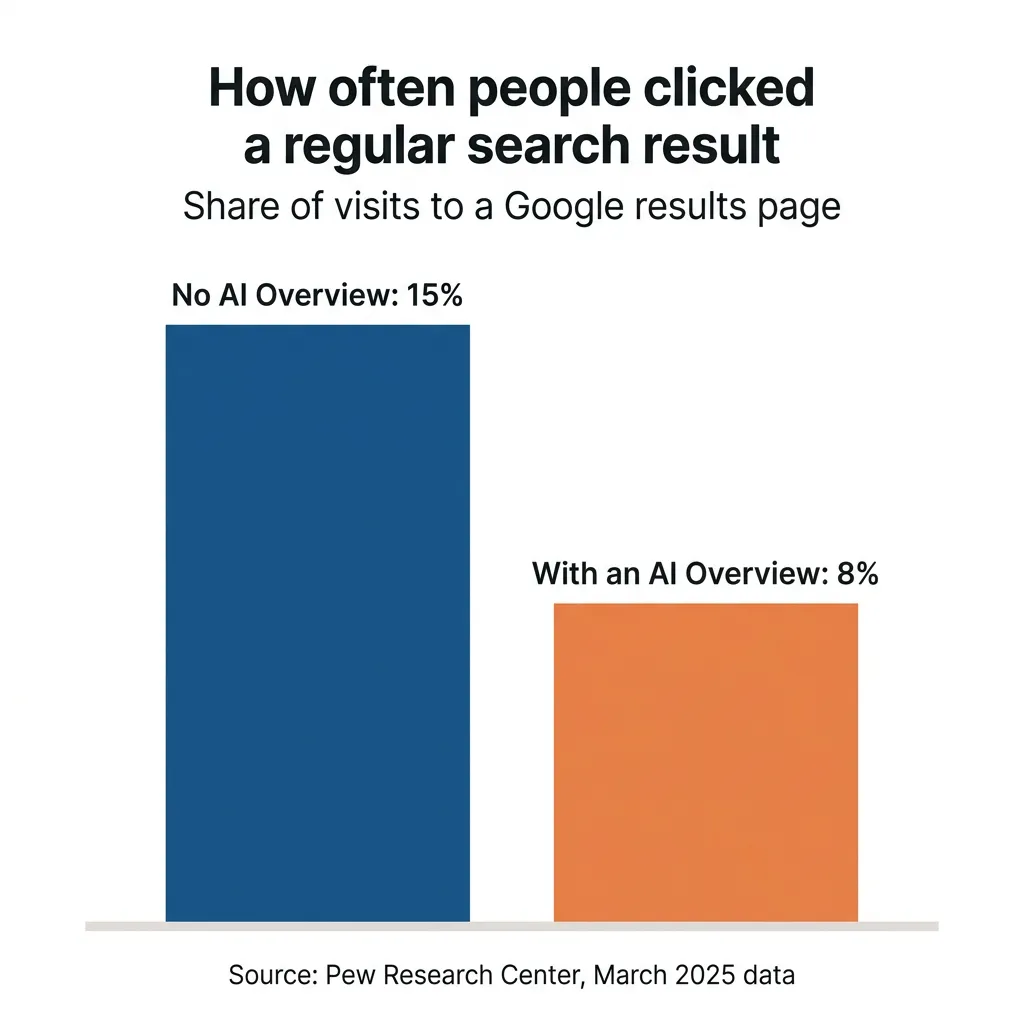
Nobody can say yet how much AI answers will change traffic for a business like yours, because the evidence points both ways. In Pew’s March 2025 data, people clicked a regular search result about half as often when Google showed an AI Overview: on 8% of visits to a results page, compared with 15% when there wasn’t one.
Google said in August 2025 that the total number of clicks from its unpaid results to websites has been “relatively stable year-over-year.” Both findings can be true at once, because they measure different things. Pew measured how often a single search leads to a click, while Google counted total clicks.
Google also says AI is leading people to search more. More searches with fewer clicks on each one can add up to about the same number of clicks in total.
Independent studies that report big drops in search traffic mostly look at news sites, so they tell you little about a local service business or a small online store. Your own numbers are a better guide. In Google Search Console, Google’s free tool for site owners, you can see whether your clicks from Google are actually going down.
Do Search Engines Still Matter If AI Gives the Answer?
Search engines are still just as important when an AI gives the answer. When you ask an AI something, you’re no longer dealing with the search engine directly. The AI works out what you’re trying to find, then runs its own searches in a search engine and reads the results to write its answer.
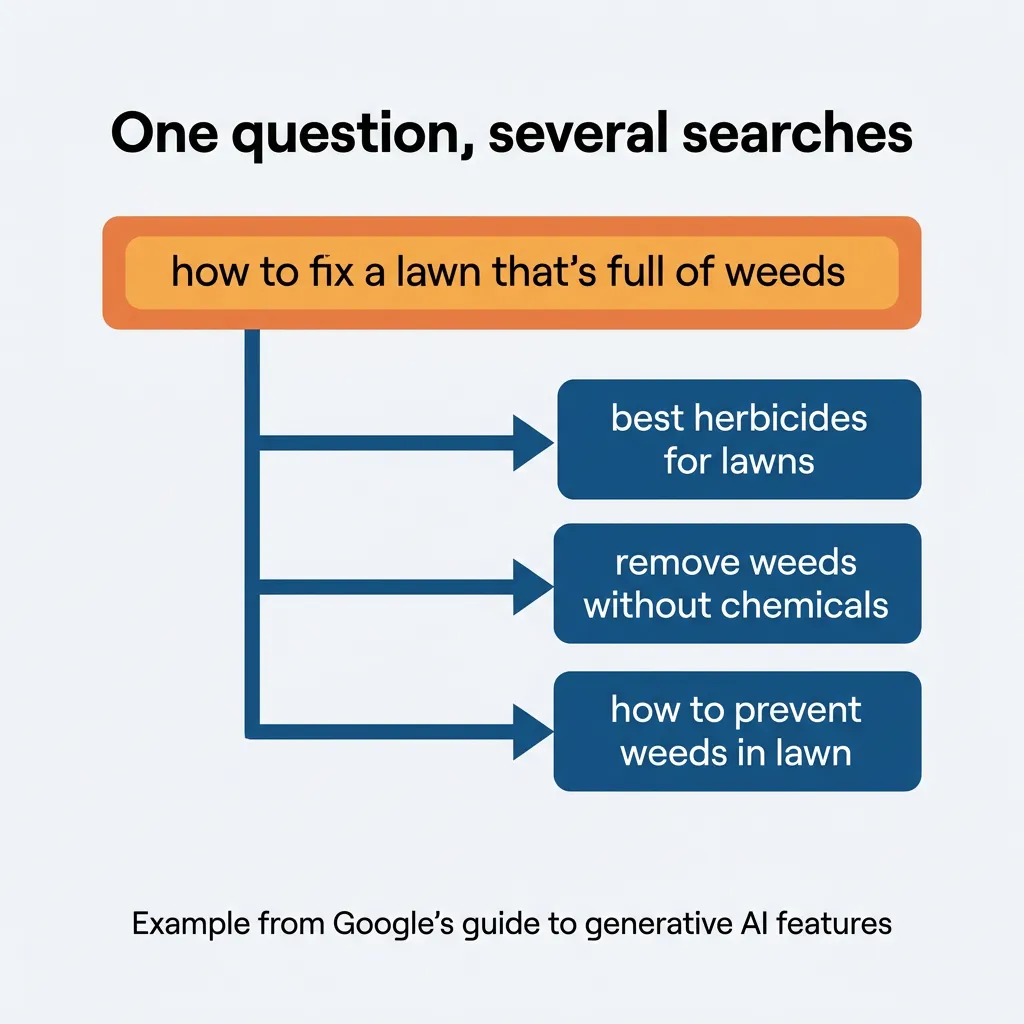
Google calls this query fan-out. In its guide to generative AI features, Google gives the example of someone searching “how to fix a lawn that’s full of weeds.” To answer, the AI might also search “best herbicides for lawns,” “remove weeds without chemicals” and “how to prevent weeds in lawn.” I go into more detail in my post on query fan-out.
That’s why I’d argue search engines are even more important now: one question to an AI can turn into a whole series of searches like these.
Because the AI finds its sources through search, where your pages rank still matters. Google says its own AI features are “rooted in our core Search ranking and quality systems.”
What Does SEO Aim For When AI Writes the Answer?
When we think about SEO now, we’re thinking about three goals:
- Get found by the AI’s searches. This is actually the easy part, because the AI looks at so many pages for each answer.
- Get cited by the AI, as one of the sources it names or links to in its answer. I explain what affects that in my post on how to get cited in AI search.
- Get recommended. Ultimately, the goal is to influence the AI to recommend your business instead of your competitors. I cover that in my post on how to get recommended by AI.
Is Google’s Algorithm Changing Because of AI?
Google’s algorithm is changing because of AI, and that’s the second way SEO is changing. I focus on Google because, in my view, it’s by far the most sophisticated search engine, and every other search engine is just trying to be Google.
Some SEOs would argue that Google’s algorithm really hasn’t changed that much, and in a lot of ways they’re right. It still relies heavily on PageRank, which judges a page partly by the links pointing to it from other websites. Google’s ranking systems guide says PageRank was “one of our core ranking systems used when Google first launched,” and that it “continues to be part of our core ranking systems.”
Google also still relies on semantic relevance, meaning how well a page matches what the searcher means, even when the page doesn’t use the exact words they typed. Google has used AI to judge that since 2015, when it launched RankBrain.
Google has always been improving its algorithm. In my experience, Google is improving it much more rapidly now, thanks to AI.
Is Helpful Content Enough to Rank on Google?
In my experience, helpful content on its own isn’t enough to rank well, even though Google would have you believe a good website and helpful content are all you need. Google’s guide to generative AI features says “plenty of content thrives in Google Search (including generative AI experiences) without any overt SEO at all.”
Google’s algorithm is improving, but it’s still far from perfect, and it’s much simpler than Google would like to admit. That’s why there are still plenty of ways to trick it.
Tricking Google is getting harder, though. Google’s spam policies are its rules against tricks meant to push a page up in the results. A site that breaks them can be penalized or even removed from Google entirely.
In May 2026, Google clarified that those rules also apply to its AI answers. It has also released four spam updates so far this year, each aimed at sites that break those rules. The latest started on September 24.
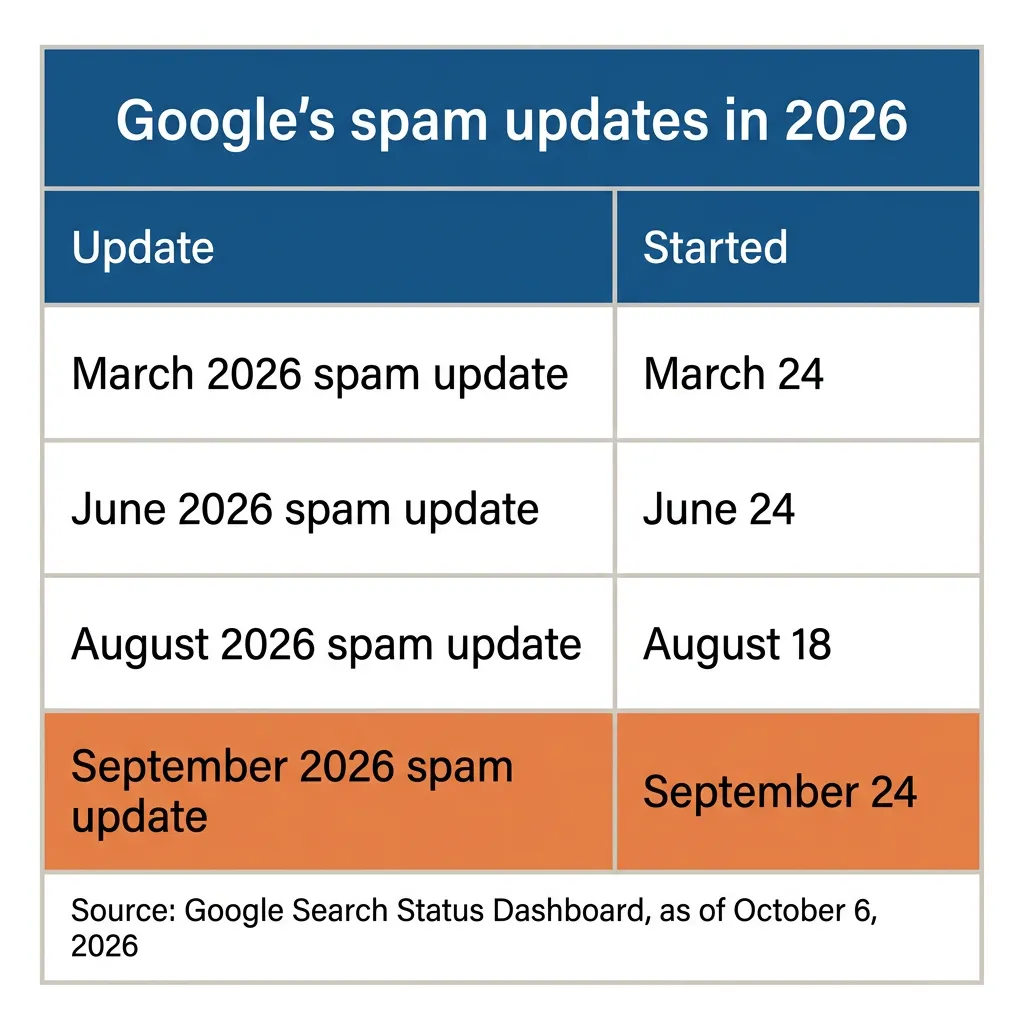
That’s why at our agency, we stay far away from anything that could get you in trouble with Google. I cover what Google’s June 2026 spam update means for GEO tactics in my post on Google’s 2026 spam update.
Is SEO Work Getting Easier With AI?
SEO work is getting much easier because of AI, and that’s the third way SEO is changing. That goes for the strategy as well as the hands-on work.
The hard part now is setting up your systems and structuring your knowledge base so that AI can do meaningful work for your business. Your systems are the written instructions and step-by-step processes the AI follows for each task. Your knowledge base is the information about your business, like your services, your customers and how you talk about what you do, written down so the AI can work from it. I walk through that setup in my post on how to run your business with AI.
Once that’s set up, most of the work we used to consider SEO work can be handled by AI. In my view, it can do that work better than any human ever could.
That frees up the people doing SEO, whether that’s your team or your agency, to focus on quality control. They check everything the AI produces and make sure it accurately represents your brand.
At TJ Digital, AI does most of the hands-on work on our campaigns, like writing blog posts and service pages, and people review all of it before it reaches a client.
Google agrees that people still need to check the work. Its guidance on using AI-generated content says: “It is critical to manually factcheck and review all AI-generated content for accuracy and trustworthiness before publishing.”
What Should You Do About SEO Now?
Keep doing the SEO that already worked, and let AI do more of the work without breaking Google’s rules. In practice, that means:
- Keep doing the fundamentals. Earn links from other websites, and make each page clearly match what people search for. Google’s own guide to AI search tells site owners to apply SEO best practices.
- Put your effort into pages that answer the questions your customers actually ask, using what you know from doing the work. Google’s guide calls generic advice that anyone could write “commodity content.” One example it gives is “7 Tips for First-Time Homebuyers.” It tells site owners to create “non-commodity content” instead.
- Set up your systems and knowledge base so AI can do the work, and have a person review everything it produces before it’s published.
- Don’t use AI to mass-produce pages just to rank. Google’s spam policies list this as an example of scaled content abuse: “Using generative AI tools or other similar tools to generate many pages without adding value for users.”
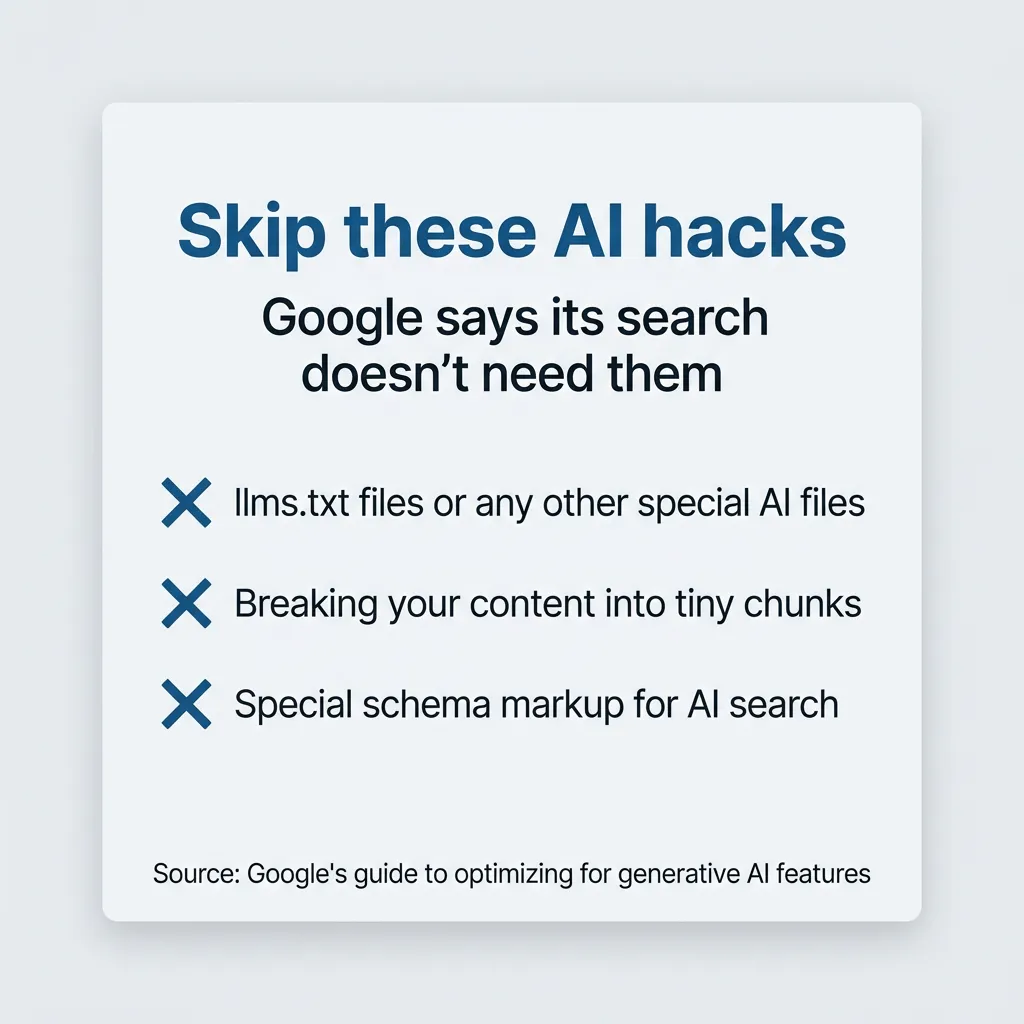
- Skip the “AI hacks” that some people sell as GEO packages. Google says its search doesn’t use llms.txt files (text files some sites add to describe themselves to AI tools) or any other special AI files. It says there’s no need to break your content into tiny chunks for AI. And it says there’s no special schema markup (code that labels the information on a page for search engines) you need to add for AI search.
- Check the generative AI report in Search Console. It shows how many times your pages were shown in AI Overviews and AI Mode, by page, country, device and date, but it doesn’t show clicks. Google rolled the report out to all websites by August 31, 2026. It only appears once your pages have been shown in AI features enough times.
If you have questions about any of this, or you want help with SEO and GEO for your business, reach out through our contact page or email me at tj@tjrobertson.com.