

I think 2027 will be the year AI agents go mainstream, meaning the year AI finally changes how the average person uses the internet.
We’ll look back on 2026 as the year AI dramatically changed the way we work, at least for any work that can be done on a computer. But so far, the way most people shop and get things done online hasn’t changed much at all. I expect that to change next year because we’re finally getting competent AI agents that are easy to use and can actually help the average consumer, by comparing prices, filling in forms and checking out for them.
If you run a business, that means getting your website ready for AI agents now, because they’ll be visiting it on your customers’ behalf. At TJ Digital, we track how ChatGPT and Google’s AI answer buyers’ questions for the businesses we work with, so I watch this shift closely.
Are people actually using AI agents yet?
Most people aren’t using AI agents for everyday things online yet.
In a Menlo Ventures survey of US adults in July 2026, 41% of people who use AI said they’d tried an AI agent. But the agents they used most were coding and work tools, like OpenAI’s Codex and Anthropic’s Claude Code, not agents for everyday shopping or errands. I wrote about how agents are changing work in AI agents will change the way we work in 2026.
Will you have to set up your own AI agent?
The average person isn’t going to take the time to set up their own AI agent, and they won’t have to. The companies building agents for consumers are putting them directly into the products people already use.
I think within a year, using an agent will look a lot like doing a Google search or opening Instagram. There’s still a lot of awkwardness to untangle before using an agent feels smooth. But anyone who’s gone through the effort of setting one up for themselves knows it’s a far better way to use the internet.
Some consumer agents are already built into apps people use every day. Others still cost money or have a waitlist:
| Agent | What it does for you | How you get it |
| Checkout in Google’s AI Mode and Gemini | Buys from eligible stores without leaving Google, paying with Google Pay (Google) | In Google’s AI Mode and on Gemini’s website (UCP guide), at the stores that offer it so far (Merchant Center Help) |
| Amazon’s Alexa for Shopping | Its Buy for Me feature can complete a purchase for eligible products with your saved address and card (Amazon) | Free in the US, with no Prime membership or Echo device needed |
| Meta’s Muse | Handles tasks like email, booking travel and filling in forms (Meta) | Free for most of what people need, in its own app and in WhatsApp (US) |
| Apple’s new Siri | Takes actions in apps, like drafting an email or editing and sharing a photo (Apple) | Built into iOS 27, in beta with daily usage limits |
| Chrome’s auto browse | Compares prices, fills in forms and adds things to a cart (Google) | Paid: Google AI Pro and Ultra subscribers in the US |
| OpenAI’s dots | Agents that work toward goals you give them, day and night, using their own computer and browser and the apps you choose to connect (more than 4,000 are available) (OpenAI) | Paid: OpenAI’s Pro and Business Premium plans |
| Anthropic’s Claude Duet | Works in the background on tasks like scheduling meetings and replying to messages, and lets you know when it’s done (Anthropic) | Waitlist, starting with US subscribers on Anthropic’s Pro and Max plans |
What has been holding AI agents back?
I think AI agents have been held back by a coordination problem: websites and agents have each been waiting on the other. Websites haven’t wanted to go through the effort of becoming agent-friendly, because there aren’t many agents yet. And agents have struggled to catch on, because the internet is hard for agents to use.
Most websites were built for people. An agent has to figure out what each button and form field does by looking at the page, and a wrong guess means the task doesn’t get done. I explain how agents read a page in how AI agents use your website.
To me, it feels like in the last month or two, we’ve gotten over the hump and solved the hardest parts of this problem. Two standards aim to give agents and websites a shared way to work together:
- The Universal Commerce Protocol (UCP) lets an agent check out on an online store. Google developed it with Shopify, Etsy, Wayfair, Target and Walmart. Amazon, Meta and Microsoft now help develop it too (UCP). Its rules are public, and it’s already in use: it’s the standard behind the checkout in Google’s AI Mode and Gemini.
- WebMCP is a proposed standard that lets a website tell an agent what it can do on a page, like checking availability or booking, so the agent doesn’t have to guess (Chrome for Developers). Chrome and Edge are still testing it, so it isn’t a finished part of either browser yet. Even so, ChatGPT’s desktop app added WebMCP support to its built-in browser in late August (Search Engine Journal). And Commerce.com, which hosts almost 100,000 online stores, has turned WebMCP on for all of them through Cloudflare, which Commerce.com uses to run those stores’ websites. Cloudflare announced it on October 21 (Cloudflare).
I’m clearly not the only one who thinks we’re over the hump. Essentially every major AI company is all in on agents right now, launching or expanding agent products this fall.
Some big websites are still blocking agents, though. In September, Amazon blocked Meta’s Muse from shopping on Amazon.com, saying Muse didn’t identify itself as an AI agent.
In a statement quoted by TechCrunch, Meta put it this way: “Turning away a personal agent means turning away the customer behind it.” Meta has an obvious interest in saying that. But if an agent can’t use your website, the person it’s shopping for may buy from a competitor whose site it can use.
Are AI agents overhyped?
Maybe the AI companies going all in on agents are all wrong. Or maybe they’re right, and the agents they’re building will soon be visiting your website.
Most outside forecasts are more cautious than my 2027 call. Menlo Ventures’ forecast is one that matches it. Forrester expects a smaller group in 2027, one in 20 US and UK consumers, while Mastercard and Mark Zuckerberg expect wider use, but later:
| Who | What they predict | By when |
| Menlo Ventures, a venture capital firm, in its predictions for 2027 (report) | “Regular agent use becomes mainstream.” | 2027 |
| Forrester, October 2026 (Forrester) | “One in 20 US and UK consumers will replace traditional shopping with conversations.” | 2027 |
| Mastercard, September 2026 (The Paypers) | One in ten online shoppers will routinely use AI agents to shop and pay | 2030 |
| Mark Zuckerberg, on Meta’s earnings call in July 2026 (PYMNTS) | Billions of people will have a personal agent | Within five years, so by about 2031 |
Agents still have real problems, too. OpenAI’s own launch post for dots says, “Dots can still make mistakes, so always review consequential work.”
Security is the other big unsolved problem. An agent that can act inside your accounts can be tricked by a web page with instructions written for the agent, like telling it to send out your personal information. I go into that risk in is it safe to let AI agents run without supervision.
What changes for your business when AI agents go mainstream?
The biggest change for a business is who visits your website. I’d start preparing for a world where most visitors to your website are AI agents visiting on behalf of a person, and where most of your customers become customers without ever visiting your website.
That doesn’t make your website less important. If anything, it’s more important, because AI still reads business websites to decide who to recommend.
In our AI citation study, we looked at how ChatGPT, Google AI Mode and AI Overviews answered the buyer questions we track for our clients, from late August to late October 2026. None of the questions named a brand, so the AI had to choose the businesses itself. Company websites, yours or a competitor’s, got 67% of the citations, meaning the pages the AI pointed to as its sources.
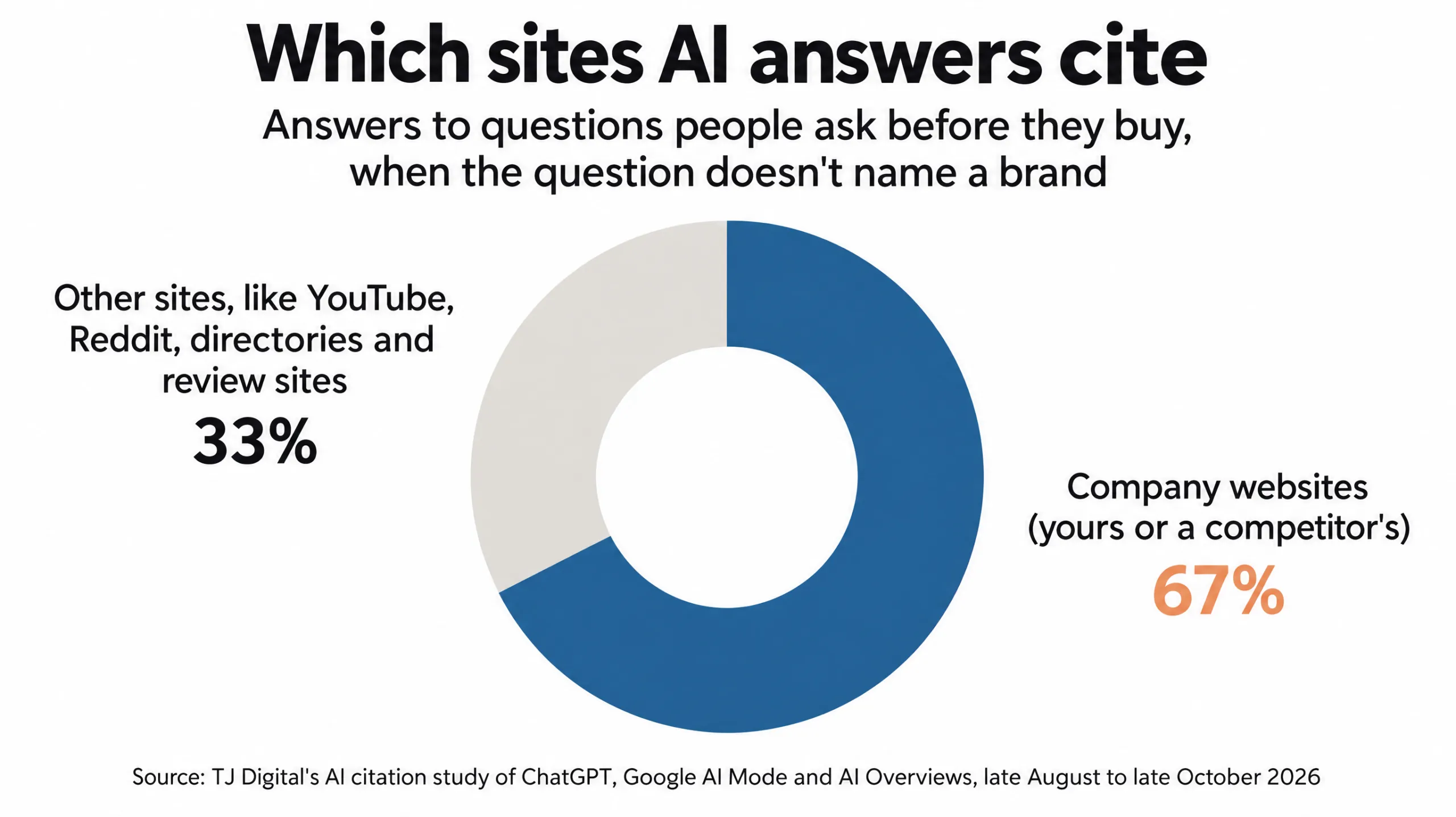
AI also cites third-party sites, like directories and review sites, depending on the industry. YouTube and Reddit show up too, mostly in Google’s AI answers and hardly at all in ChatGPT’s.
So getting found and chosen by AI is pretty straightforward. Make the kind of content AI looks for when people are deciding what to buy, and publish it to as many platforms as possible, mainly your website and your social media channels.
But that’s nothing new. What is new is how much it matters that AI can actually use your website.
Will AI agents make purchases on your website?
Yes, I expect they will. In 2027, I think it’s finally going to be important for your business that an AI agent can go to your website and make the transaction. Up until now, AI has helped people find the website or brand they want to buy from, then handed the last step back to them. You got your recommendation from AI, then went to the website and bought it yourself.
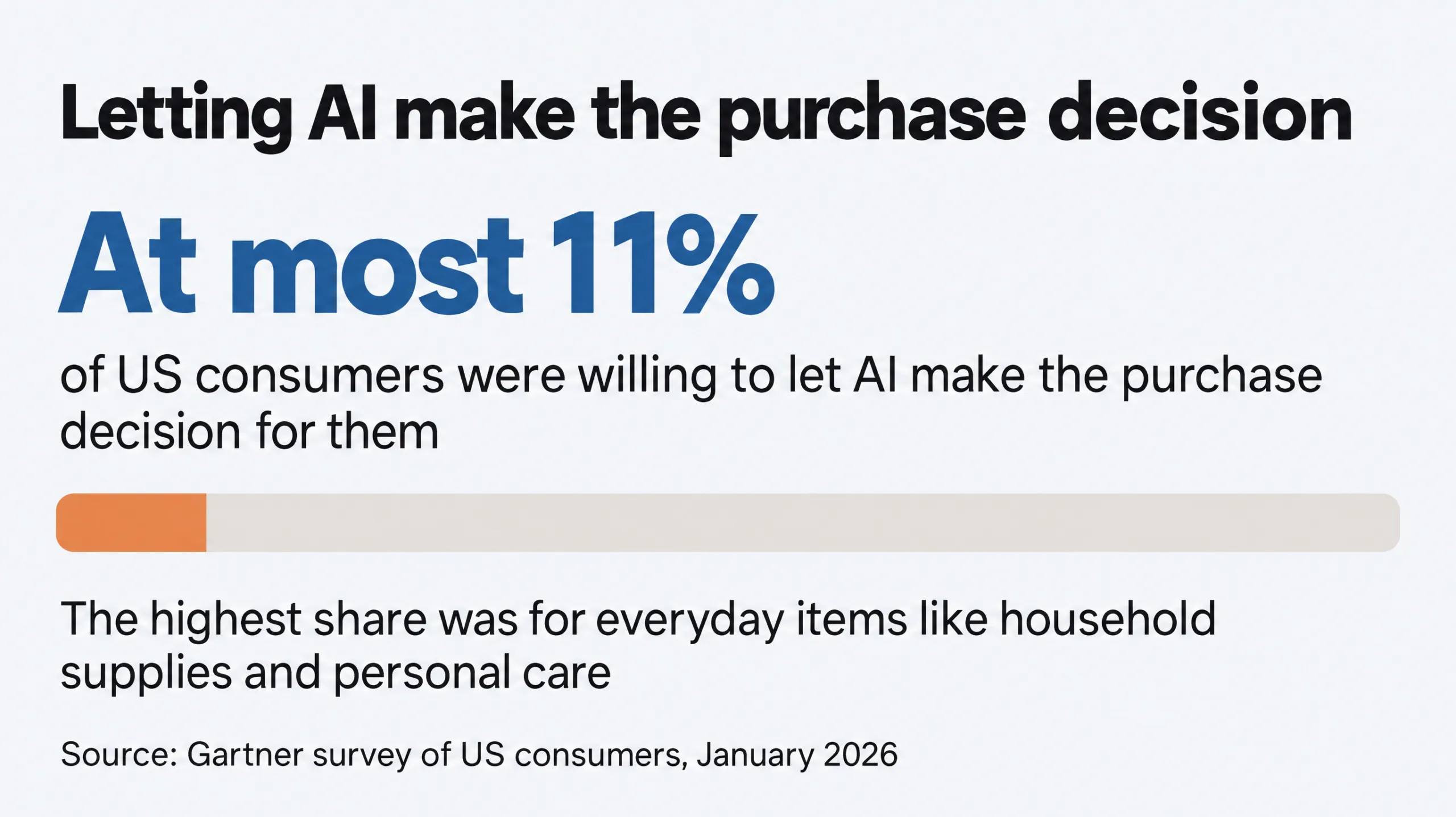
Several of today’s agents are built to ask before they buy. Chrome’s auto browse, Meta’s Muse and Anthropic’s Claude Duet each stop for your OK before a purchase or payment. Most shoppers aren’t ready to hand the buying decision to AI, either. In a Gartner survey of US consumers in January 2026, willingness to let AI make the purchase decision was highest for everyday items like household supplies and personal care, and even there it was only 11%.
I also expect those purchases to go through the business’s own checkout. In March 2026, OpenAI scaled back Instant Checkout, the feature that let people buy without leaving ChatGPT (Forrester). Now a shopper in ChatGPT finishes the purchase on the merchant’s website, or in an app the merchant has built to run inside ChatGPT.
How do you get your website ready for AI agents?
Getting your website ready for AI agents means giving them a direct way to buy, fill in forms and find information, so they don’t have to guess at each button. Which setup you need depends on what your site does:
- If you sell products online, set up UCP so agents can check out on your store. If your store is on Shopify, Shopify sets this up for you: it’s switching on direct checkout in Google’s AI Mode and Gemini, which runs on UCP, by default for eligible stores. To qualify, a store has to sell to shoppers in the US, Canada or Australia and meet a few other conditions. It’s rolling out gradually, so check Sales channels > Agentic in your Shopify admin to see whether your store has it yet (Shopify). Other stores set it up in the UCP integration hub in Google Merchant Center, where you test your checkout and tell Google you’re ready to go live. The hub is still in early access in the US, so once your store supports UCP, you fill out an interest form. I walk through it in how to use Google’s UCP integration hub.
- If your website has forms or tools, like quote requests, bookings or calculators, set up WebMCP so agents can use them directly. I cover how in WebMCP explained.
- Give agents instructions they can follow to use your website, in an agents.md or llms.txt file. Both are text files at your site’s address, like yourdomain.com/agents.md or yourdomain.com/llms.txt, that tell an agent what your site offers and where to find it. Shopify gives every store an agents.md file by default, which tells shopping agents what the store sells and how to buy from it (Shopify). It also puts the same content in the store’s llms.txt, so if you’re on Shopify, you already have both. I’m not sure which one is going to become the standard, but either is cheap to add. I cover llms.txt in my post on llms.txt.
The point is, AI agents are coming, and it’s worth preparing your website now. My post on SEO for AI agents covers the rest of what I’d do, including how to get agents to recommend you.
If you have questions about getting your website ready for AI agents, reach out through our contact page or email me at tj@tjrobertson.com.