
What Information to Put on Your Website for AI in 2026

By TJ Robertson, Founder and Lead Strategist at TJ Digital
Short answer:
- Detailed information about your company, products and services
- Your pricing, or at least a starting price, on a pricing page
- Your top customer reviews, on a reviews page
- Timelines, outcomes and what it’s like to work with you, on an FAQ page
- Your awards and recognitions, on an awards page and your homepage
If you want your business to be found and recommended by AI, you should probably be putting way more information about your company on your website.
I run TJ Digital, an agency that helps businesses show up in Google and in AI search, and I talk to business owners every week. They have all kinds of reasons for leaving this information off their websites: it would make the site look cluttered, they don’t like to share pricing, or they just haven’t gotten around to it. What they usually don’t realize is how big a difference it makes in how often AI recommends them.
How Does AI Research a Business Before Recommending It?
When someone goes to ChatGPT, or more often in my experience Google, and says they want to buy a product or service like yours, the AI researches companies like yours before it answers. It looks for what each company offers, what it charges, what customers say about it, what it’s like to work with and what awards it has won. Both Google and OpenAI say their AI can run several searches to answer a single question.
Some of those searches are specific to your industry. But many of them are the same in every industry, like searches for a company’s reviews or its pricing, so they’re largely predictable.
What Happens If AI Can’t Find Information on Your Website?
When AI can’t find a key piece of information about your company, it either leaves your company out of its answer or guesses, based on whatever else it can find about you online.
The most important thing to understand is that some of your competitors will be sharing this information, even if you’re not. So when AI leaves you out, it still has businesses to recommend: the ones whose information it found.
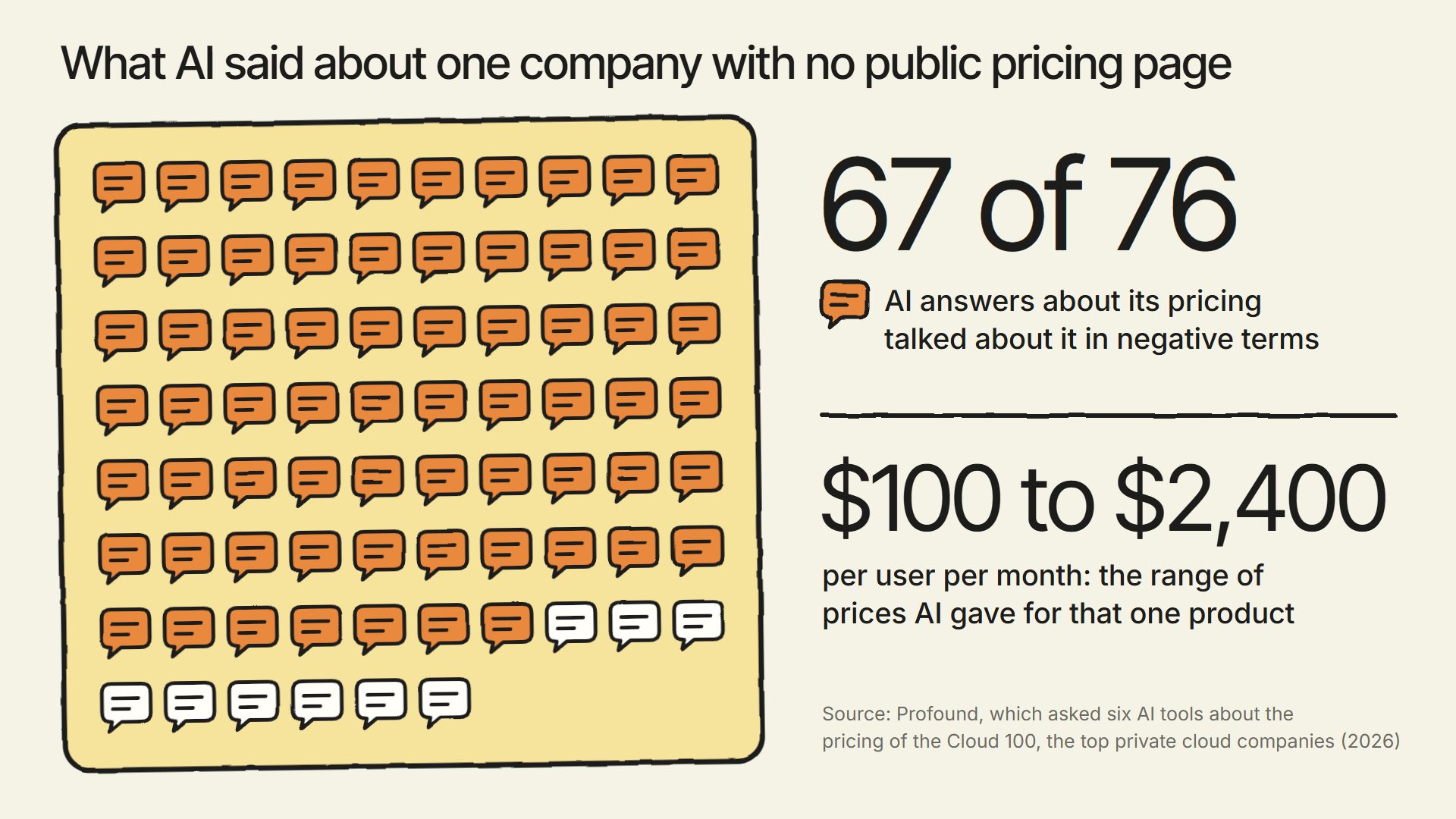
When AI guesses, it works from what other people have written about you on other websites. A study by Profound, a company that sells software for tracking what AI says about brands, shows how that goes for pricing. Profound asked six AI tools, including ChatGPT and Google’s AI, to evaluate the pricing of the companies on the Cloud 100, a list of the top private cloud companies.
One of those companies, an AI company, has no public pricing page. Profound collected 76 AI answers about that company’s pricing, and 67 of them talked about it in negative terms. The AI got its information from third-party sites, often Reddit threads.
The answers didn’t agree on the price, either. For that one product, the answers ranged from $100 to $2,400 per user per month. As Profound put it, “Even if you try to hide your pricing, it’s being talked about elsewhere.”
The same is true of any information that’s important for AI to find. That’s why I recommend answering every question someone might have about your business on your own website.
Should You Put Your Prices on Your Website?
In almost every case, you should put your prices on your website, or at least a starting price. Pricing may be the most important information AI wants to know, and leaving it off is the most common mistake I see business owners make.
When ChatGPT searches the web to answer a question, its answer may include links to its sources. Those links are called citations. In our study of 193,507 AI answers, pages that showed prices were more likely to be cited than similar pages that didn’t: their odds of being cited were 28% higher.
There are legitimate reasons not to show pricing, and sometimes you really can’t. But the two reasons I hear most often aren’t good ones.
What If You’d Rather Explain Your Pricing on a Call?
A lot of owners don’t want to share prices until they have the person on the phone, because they want to explain the pricing. You can give that same explanation on your website. The AI doing the research can’t get on a call with you, so whatever you’d say about your pricing on the phone needs to be on the page.
What If Your Price Depends on Too Many Factors?
Plenty of businesses can’t give a hard number because the price depends on so many things. You can still show a starting cost. A price that says “starting at,” with an explanation of what moves it up from there, gives AI a real number to work with, so it doesn’t have to guess.
Which Pages Should You Add to Your Website for AI?
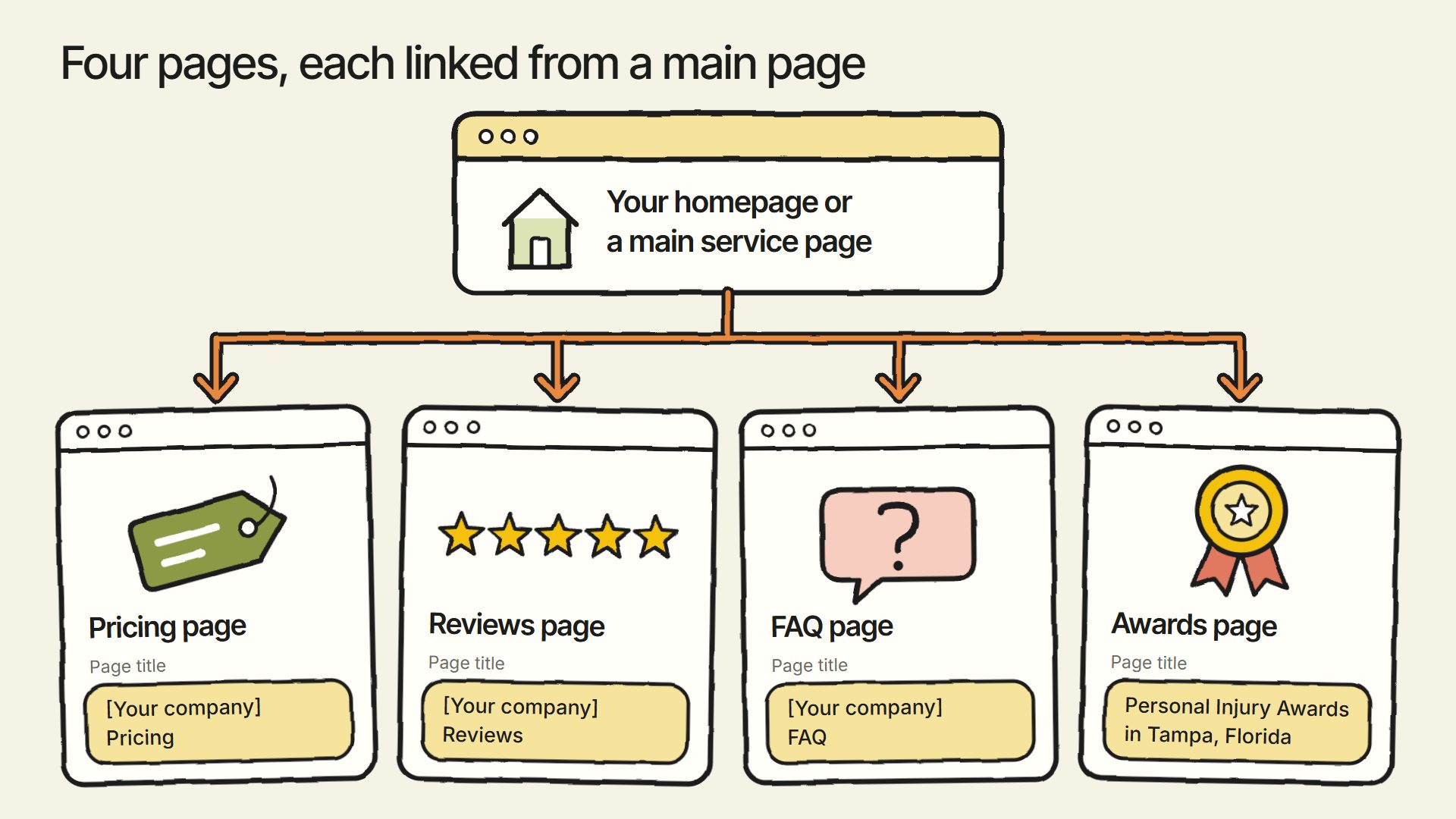
Add four pages to your website: a pricing page, a reviews page, a company FAQ page and an awards page. Giving each kind of information its own page means you don’t have to clutter your homepage or your main service pages with paragraphs of information.
A pricing page
Your pricing page should show your starting cost and clearly explain what the customer gets for that money. It’s the same explanation you’d give someone on a sales call.
A reviews page
A reviews page shows your top customer reviews in one place on your own website, so AI can see what people say about you without having to search other sites. If you don’t have many reviews yet, here’s how to get more Google reviews.
A company FAQ page
A company FAQ page should answer every question someone might ask before buying from you, including how long things take, what results to expect and what it’s like to work with your company. I go through what to include in how to build an FAQ page that gets your business recommended by AI.
An awards and recognitions page
An awards and recognitions page lists every award and recognition your business has received. Your awards should also go on your homepage.
AI looks for awards on purpose. In the AI answers we track, a search for “[your industry] awards” is one of the most common searches AI runs while it researches a business. For a personal injury law firm, for example, that would be a search like “personal injury awards.” I explain what AI does with those results in how AI uses industry awards to decide who to recommend.
How Do You Make Sure AI Finds These Pages?
Make sure each of these pages has at least one link pointing to it from one of the main pages of your website, such as your homepage or a main service page. A page that nothing on your site links to is much harder for AI to find.
Then give each page a title that matches what someone, or an AI, might search for when looking for that information. That means the page’s title tag (the name shown in search results) and the main heading on the page. For example:
- [Your company] Pricing for your pricing page
- [Your company] Reviews for your reviews page
- [Your company] FAQ for your FAQ page
Your awards page is the exception. Name it after your industry and location, like Personal Injury Awards in Tampa, Florida for a law firm in Tampa, because AI searches for awards by industry.
Do that, and I’m confident those pages will start getting cited by AI, and AI will start recommending your business more often as a result. For the rest of what it takes, see how to get Google AI to recommend your business.
If you have questions about any of this, reach out through our contact page or email me at tj@tjrobertson.com.