
What Is Gemini 4 Neon Good At?

By TJ Robertson, Founder and Lead Strategist at TJ Digital
Short answer:
- Knowledge work, like research, reports and pulling answers out of long documents
- Analysis across spreadsheets, PDFs, charts, audio and video
- Writing, by the early signs
Google released Gemini 4 Neon on November 18, 2026. Claude does most of the hands-on work at TJ Digital, and Neon is the first Google model that’s made me consider moving some of that work off Claude.
What Is Gemini 4 Neon Best At?
Google built Neon for knowledge work and analysis, and that’s where it’s strongest. You can give it the files a real project involves, like long PDFs, spreadsheets, charts, recordings and video, and ask it to find answers in them, compare them or turn them into a report.
Argon, Google’s first Gemini 4 model, was a big improvement for Gemini. But I don’t think it’s quite up to par with the best models Anthropic and OpenAI have out today.
Google’s own numbers put Neon at that level. Its announcement says Neon ranks third overall on the Artificial Analysis Intelligence Index, a leaderboard an independent company builds from many tests. Google’s chart puts it close to Claude Opus 5.5 and GPT-6.2 Sol.
How Is Gemini 4 Neon Different From Carbon, Argon and Hydrogen?
Neon is a faster model adapted from Carbon, Google’s strongest Gemini 4 model. It has also taken Argon’s place in the Gemini app’s model list, though developers can still use Argon in the API for now.
| Model | What Google built it for | Label in the Gemini app |
|---|---|---|
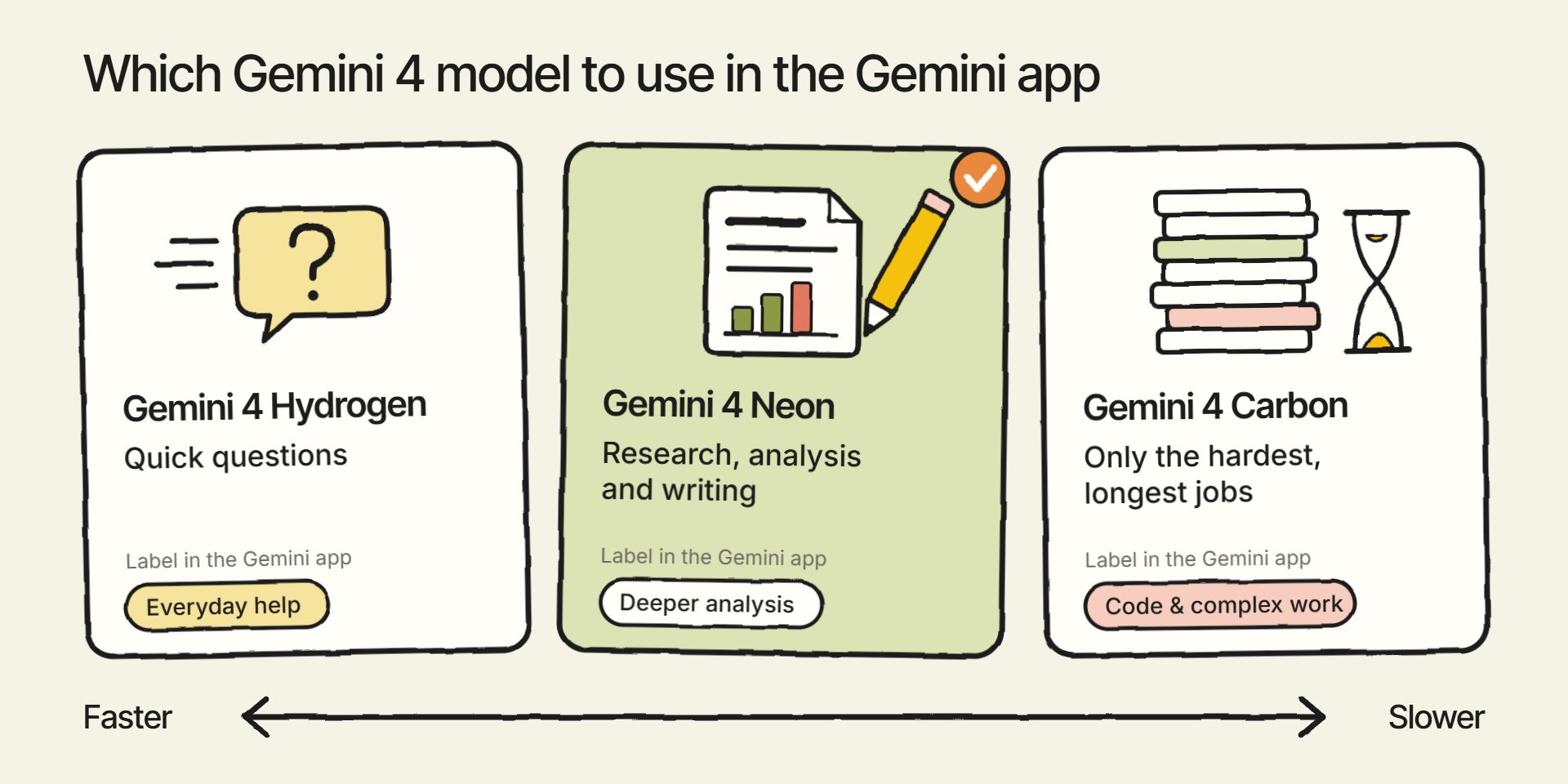
| Gemini 4 Hydrogen | Fast, everyday tasks | “Everyday help” |
| Gemini 4 Neon | Depth and efficiency: analysis, knowledge work and coding | “Deeper analysis” |
| Gemini 4 Carbon | The hardest, long-running projects | “Code & complex work” |
| Gemini 4 Argon | Most software engineering and knowledge work | Replaced by Neon |
That puts Neon in the middle of Google’s lineup: faster than Carbon, and built for harder work than Hydrogen. In developer Flavio Copes’s tests, Neon wrote about twice as fast as Carbon.
My first impression is that Neon is also better than Carbon in a lot of ways. One Hacker News user’s own tests found the opposite: that Neon is “far below Carbon in terms of quality.”
Which Gemini 4 Model Should You Use?
In the Gemini app, use Neon for anything that takes real thought, like research, analysis or writing, and Hydrogen for quick questions. Carbon is worth the wait only for the hardest, longest jobs.
Hydrogen also runs inside Google Search as the default model in AI Mode. I wrote about what Hydrogen means for SEO separately. My Gemini 4 review covers Carbon and Argon in more detail.
Why Does an AI Model’s Writing Matter If You Don’t Write Blog Posts?
An AI model’s writing matters even if you never use it to write a blog post. I’ve spent over a thousand hours trying to get AI to write better, and what I’ve learned is that being a good writer is mostly about being a good communicator.
It’s about understanding what’s important and making your point clearly, without over-explaining things that are unimportant or obvious. You need that every time a model explains its analysis, answers a question or summarizes a document for you.
OpenAI released GPT-6.2 on November 17, and it got some lackluster reviews. The biggest complaint I saw by far was that it’s a terrible communicator, and that makes it very painful to work with.
I think GPT-6.2 is probably the best model in the world at scientific research and 3D modeling. But from the reviews I’ve read, a lot of people find it hard to use even for that work, because its answers are hard to follow. At this point, I’m just not interested in that model.
And the newest models aren’t always better writers. All the labs are hyper-focused on making their AI better at coding, which makes sense, because that’s where most of the economic value is right now.
Coding is also easier to improve. A computer can check automatically whether code works, which gives a lab a clear way to tell whether a new model is better at it.
As models get better at coding, they generally get more intelligent, and so better at everything else. But they seem to be getting worse in some other ways, and one of those is writing.
We saw this happen with Claude, starting around Opus 4.7 and really hitting peak cringe around Opus 5. Claude’s latest models are much, much better at writing, but still not great.
Is Gemini 4 Neon Good at Writing?
Neon seems to be a good writer, and that’s the main reason I’m excited about it. I can’t say yet whether it writes better than Claude, because when I say Neon is good at writing, that’s mostly anecdotal right now.
Google’s announcement says “Neon writes clearly, with well-structured responses and a natural, direct tone.” On Hacker News, one commenter replied to that line with “This is an underrated quality of Gemini models.”
I’ve seen the same quality in earlier Gemini models. When I compared a Gemini 4 Argon draft with a Claude Opus draft, the Argon draft was about as good.
It’s really hard to create a good benchmark for writing. One of the best known, ToneBench, has AI models write YouTube scripts in one YouTuber’s voice, then has judges, mostly other AI models, grade the drafts.
AI models aren’t great judges of writing. And because every draft is graded against one person’s voice, a high score doesn’t tell you much about how a model will write for you.
Neon isn’t on ToneBench yet. I’ve collected the main writing benchmarks and studies in our AI writing research library.
I’m planning to test Neon’s writing a lot this weekend, and I’ll keep you posted. I post a video every day, and you can follow along on YouTube, TikTok, Instagram, LinkedIn, X or Facebook.
Is Neon Good for Coding?
Google built Neon for complex coding, among other things. But if you’re serious about coding, you should probably still be using Claude. Even Google’s own comparison chart, as Digital Trends reports it, has Neon behind Claude Opus 5.5 on two coding benchmarks.
How Much Does Gemini 4 Neon Cost, and Where Can You Use It?
For most people, the cost of Neon is the cost of a Google AI subscription. It’s available in three places:
- Gemini app: Neon comes with Google AI Pro ($19.99 a month in the US) and Google AI Ultra. It isn’t in the free plan, though free users can get Hydrogen when the app’s Auto setting picks it.
- Gemini for business: businesses can choose Neon from the model list.
- Gemini API: developers can use Neon on the paid tier.
Developers pay by the token, a small chunk of text that’s often part of a word. Input tokens are what you send the model, and output tokens are what it writes back.
| Model | Input price per million tokens | Output price per million tokens |
|---|---|---|
| Gemini 4 Neon | $3 | $15 |
| Gemini 4 Carbon, through November 30 | $2 | $10 |
| Gemini 4 Carbon, from December 1 | $4 | $20 |
Google’s pricing page shows Neon costing more per token than Carbon until December 1, and less after that.
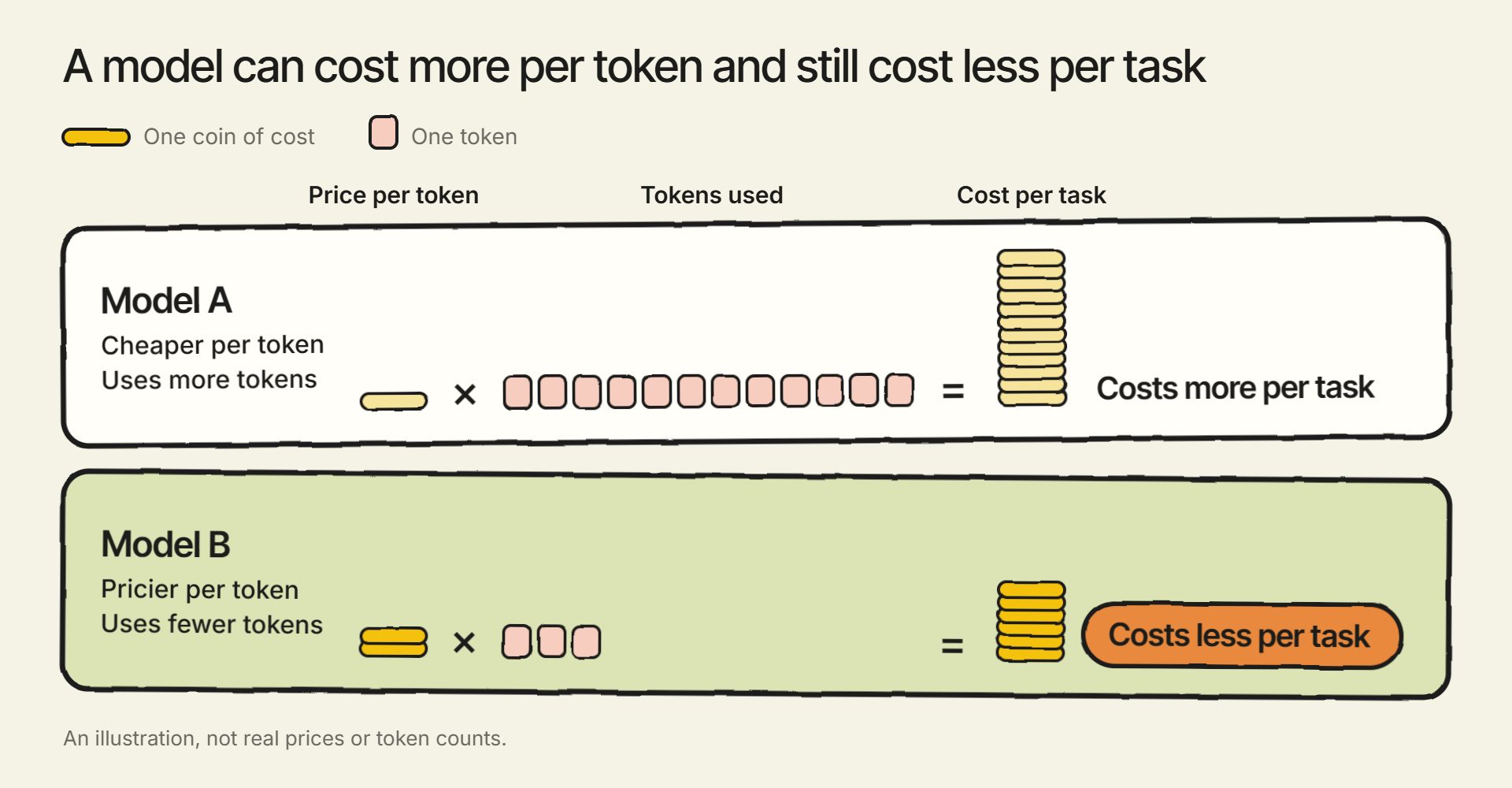
Google also says Neon costs 32% less per task than Carbon at Neon’s default thinking setting, which controls how much the model reasons before it answers. A model can cost more per token and still cost less per task, because a task’s cost depends on how many tokens the model uses to finish it.
Neon is cheaper per token than Claude Opus 5.5, but in Flavio Copes’s tests, its cost per task depended on the job. It cost 1.7 to 3 times as much as Opus 5.5 on two short coding tasks, because it spent more tokens reasoning. On a search through a long document, it cost 42% less.
If cost matters to you, run a few of your real tasks through it and check what they cost.
Should You Switch to Gemini 4 Neon?
Neon is worth trying, but I wouldn’t move all your work to it yet. I’ll have to do a lot more testing before I give my final review.
For anything other than serious coding, pick a task you already do every week, like an analysis, a report or an important email. Give the same request to Neon and to the model you use now, and see which answer you’d actually use.
My first impression is that Google is cooking. Carbon, Hydrogen and Neon have all been good models.
If you have questions about any of this, reach out through our contact page or email me at tj@tjrobertson.com.