
Claude Fable 5.2 vs Opus 5.5 and When to Use Each

By TJ Robertson, Founder and Lead Strategist at TJ Digital
I’d keep Opus 5.5 as your default model and switch to Fable 5.2 when you want the model to make the big decisions for you. Fable 5.2, which Anthropic released on November 9, 2026, is remarkably good at decision making: figuring out what to do and how to go about it.
That makes it the better choice for open-ended work where you give it a goal and let it choose the approach, for your hardest problems, and for code reviews where a missed bug would be expensive. When your prompt already makes the decisions, the two models produce about the same work, and Fable 5.2 costs twice as much per token.
Claude does most of the hands-on work at TJ Digital, and people review all of it. Since Fable 5.2 came out, I’ve been testing it on our own work and watching a lot of other people’s demos.
Is Fable 5.2 Better Than Opus 5.5?
Fable 5.2 beats Opus 5.5 on nearly every benchmark Anthropic published, but its judgment is what stood out to me right away. Early testers reported something similar in Anthropic’s launch post: compared with previous models, they found Fable 5.2 “has better judgment on ambiguous tasks.” It’ll take a few weeks before anyone really knows what it’s capable of.
Plenty of Fable 5.2 demos don’t show that judgment, though. I’ve watched a lot of people make video games, 3D models and videos with it, and some of the results blew my mind. Others were just about as good as what Opus 5.5 makes.
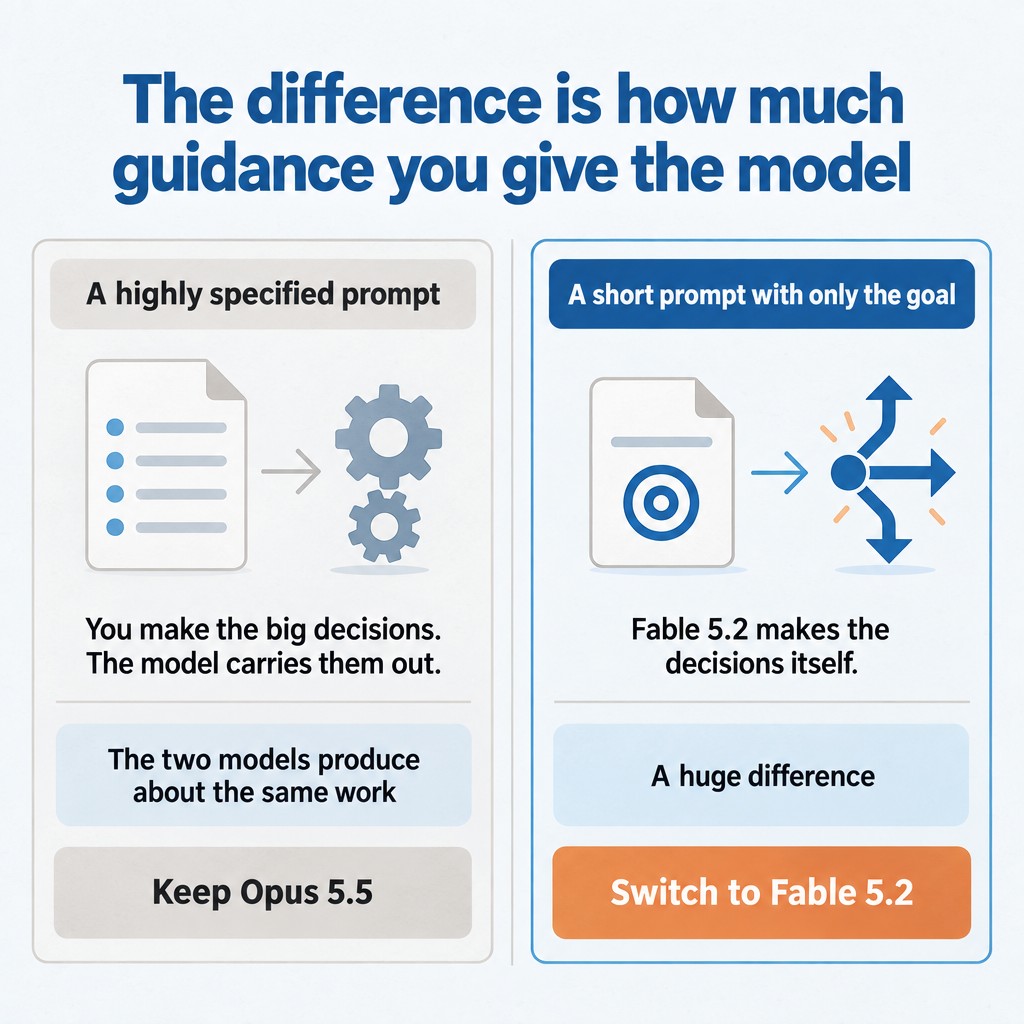
The difference, in my estimation, is how much guidance the person gave the model. A lot of creators use the exact same prompt to test every model, so they feel like they’re truly testing apples to apples. And many of those prompts were written for older models, so they’re highly specified: the person makes the big decisions, and the model’s job is to carry them out.
In terms of execution, Opus 5.5 is already amazing, so on those prompts I didn’t notice a big difference between the two. I noticed a huge difference when people let Fable 5.2 make the decisions itself. Those were shorter prompts that gave it the goal without telling it how to get there.
When to Use Fable 5.2 Instead of Opus 5.5
Anthropic recommends Opus 5.5 as the starting point for most coding and knowledge work, and its launch post calls it “our strongest daily driver.” I’d switch to Fable 5.2 for:
- Open-ended work where you give it the goal and want it to choose the approach, the angle or even the topic
- Your toughest problems, especially ambiguous ones where it isn’t clear what a good answer looks like
- Multistep research, and analysis that has to end in a finished document, spreadsheet or deck. Anthropic lists both as typical uses for Fable 5.2.
And I’d keep Opus 5.5 for:
- Work your prompt or instructions already spell out, like a detailed brief, a template or a Claude skill
- Anything Opus 5.5 is already doing well. Anthropic’s model docs suggest moving to Fable 5.2 when Opus 5.5 still falls short at a higher effort level.
How Much Better Is Fable 5.2 Than Opus 5.5?
How far Fable 5.2 leads Opus 5.5 on Anthropic’s own benchmarks depends on the kind of work. On knowledge work, the gap can be huge: on the Remote Labor Index, Fable 5.2 scored 41.3 to Opus 5.5’s 21.3. On the coding benchmarks, it leads by about 4 to 8 points, and on computer use by about 2.
All of these are Anthropic’s scores, with each model at its highest available effort setting unless the table notes a lower one.
| Benchmark | What it measures | Fable 5.2 | Opus 5.5 |
|---|---|---|---|
| Remote Labor Index | Knowledge work | 41.3 (at High effort) | 21.3 |
| AA-Briefcase v1.1, rubric score | Knowledge work | 66.1 | 61.2 |
| AA-Briefcase v1.1, Elo rating | Knowledge work | 1785 | 1800 |
| AutomationBench | Business workflows | 51.4 | 42.5 |
| WANDR (relaxed) | AI agents doing large data-collection tasks | 82.1 | 72.3 |
| Humanity’s Last Exam, with tools | Expert-level academic knowledge and reasoning | 74.2 | 67.7 |
| FrontierSWE v2 | Coding as an agent, working on its own | 69.9 | 62.3 |
| FrontierCode 2.0 | Whether open-source maintainers would merge its code changes | 49.1 (at Xhigh effort) | 45.5 |
| OSWorld 2.1 | Using a computer | 89.3 | 87.2 |
| Terminal-Bench-Science 0.1 | Scientific research done by an AI agent | 74.6 | 58.7 |
| RoboDojo Sim | Controlling a simulated two-armed robot from camera images | 64.9 | 39.4 |
Opus 5.5 is ahead on one score, AA-Briefcase’s Elo rating (1800 to 1785), and Fable 5.2 is ahead on the same benchmark’s rubric score (66.1 to 61.2).
Anthropic also says it deliberately limited the research abilities that could most directly speed up AI development, including tuning the low-level code that runs on AI chips and improving how language models are designed. In those areas, Fable 5.2 performs at about Opus 5.5’s level. Anthropic says the limits don’t affect agentic coding, hardware development or general AI and machine learning research.
When Anthropic released Opus 5.5 in September, it said Opus 5.5 performs at the level of Fable 5.1 on most work. So if you tried Fable 5.1 and found Opus 5.5 just as good, that’s what you’d expect. Fable 5.2 is a big step up from 5.1: on FrontierCode, it scored 49.1 to Fable 5.1’s 32.4.
Anthropic released Mythos 5.2 the same day. It’s the same model as Fable 5.2 without certain cyber and biology safeguards. Vetted organizations can use it through Anthropic’s cyber and life sciences verification programs, and Claude Enterprise customers through Claude Security.
Fable 5.2 vs Opus 5.5 for Coding
For everyday coding, I’d use Opus 5.5. A typical ticket already says what needs to be done, and in the early tests I’ve found, the two models tied on ordinary code changes. Fable 5.2 is worth paying for on design decisions and on code reviews where a missed problem would be expensive.
The most thorough hands-on test I’ve found so far is from paddo.dev. The author ran both models at Medium effort on 17 tasks from a production codebase, 52 runs per model. A run passed if the code passed the project’s own tests.
| Task | Opus 5.5 | Fable 5.2 |
|---|---|---|
| Six ordinary changes | 13 of 20 runs passed | 13 of 20 runs passed |
| Four large changes with detailed specs | 4 of 4 runs passed | 4 of 4 runs passed |
| Seven bug fixes, given only the symptom | 27 of 28 runs passed | 23 of 28 runs passed |
| Code review of an Opus 5.5 fix that passed the tests but missed a routing gap | Caught the gap in 1 of 4 runs | Caught the gap in 4 of 4 runs |
According to the author, all five of Fable 5.2’s failed bug fixes were correct fixes. The tests rejected them because they expected an exact match.
Commenters in the Hacker News discussion of the launch found the two hard to tell apart on routine coding too. One ran 30 ordinary coding tasks and found that Fable 5.2 and Opus 5.5 each solved 26. Another said they’d never noticed a difference between the two on coding tasks, but saw a big difference between them on design and architecture.
How Much More Does Fable 5.2 Cost Than Opus 5.5?
Per token, Fable 5.2 costs exactly twice what Opus 5.5 does on the API. These are Anthropic’s standard API prices, per million tokens:
| Fable 5.2 | Opus 5.5 | |
|---|---|---|
| Input | $8 | $4 |
| Output | $40 | $20 |
Fable 5.2 still costs twice as much in fast mode and with the Batch API.
What a task costs depends on how many tokens each model uses to finish it, and the tests so far disagree on which model comes out cheaper:
| Test | Fable 5.2 effort | Opus 5.5 effort | Result | Fable 5.2’s cost per task |
|---|---|---|---|---|
| FrontierCode 2.0 (Anthropic) | High | Highest | Fable 5.2 scored 45.3, Opus 5.5 scored 45.5 | About half of Opus 5.5’s |
| WANDR (Anthropic) | Medium | Highest | Fable 5.2 matched Opus 5.5’s score | About 40% of Opus 5.5’s |
| paddo.dev coding test (independent) | Medium | Medium | Fable 5.2 passed 40 of 52 runs, Opus 5.5 passed 44 | About 1.6 times Opus 5.5’s |
The 45.3 is Fable 5.2’s FrontierCode score at High. At Xhigh, it reaches the 49.1 in the benchmark table. In dollars, Fable 5.2’s 52 runs in the paddo.dev test cost $127.93 at list prices, against $78.44 for Opus 5.5.
The big difference between these tests is the effort settings. If you already run Opus 5.5 at a high setting to get hard work right, Fable 5.2 at a lower setting may do the same work for less. If Opus 5.5 at Medium already does the job, Fable 5.2 will likely cost you more.
Which Claude Plans Include Fable 5.2?
Fable 5.2 is on every paid Claude plan: Pro, Max, Ultra, Team and Enterprise. On Enterprise, it’s off until an admin turns it on. How Fable use counts against your plan’s limits differs by plan, so check Anthropic’s help center for yours.
The paddo.dev author, on a $200 plan, ran Fable 5.2 86 times for that testing, along with some research agents. Afterward, the author’s weekly Fable allowance had gone from 5% used to 41% used.
Which Effort Level to Use With Fable 5.2 and Opus 5.5
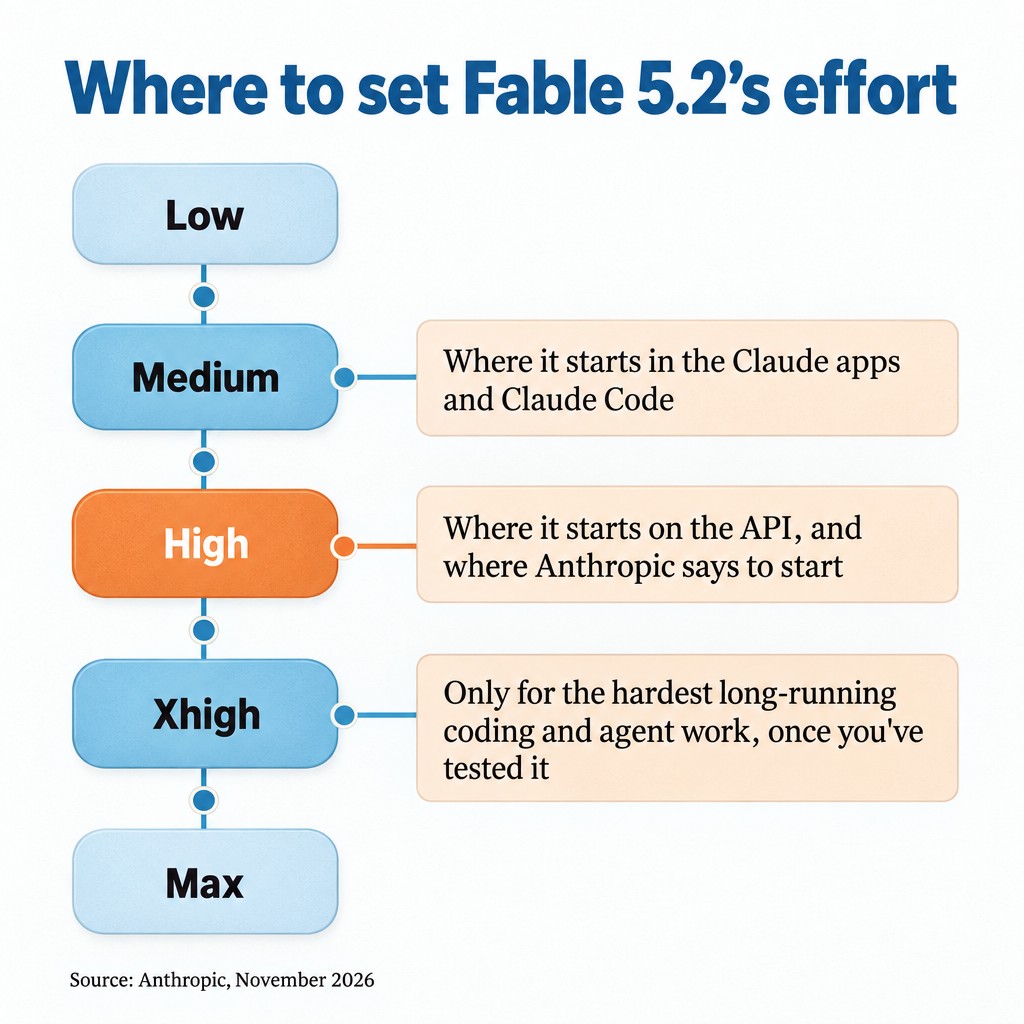
Start Fable 5.2 at High effort for the hard, open-ended work you’d use it for. That’s Anthropic’s guidance, and its docs say Fable 5.2 already gets most of the benefit of higher effort at High. They suggest Xhigh only for the hardest long-running coding and agent work, and only once you’ve tested it on that work and seen better results.
In the Claude apps and Claude Code, Fable 5.2 starts at Medium, so you’ll need to raise it. On the API, Fable 5.2 starts at High and Opus 5.5 starts at Medium, so set them to the same level if you’re comparing the two.
I explain what each level does, and when to use it with Opus 5.5, in Which Claude Effort Level Should I Use?
Do You Need to Prompt Fable 5.2 Differently?
From what I’ve seen in my own testing and in other people’s demos, Fable 5.2 does its best work with a shorter prompt than you’d write for Opus 5.5. Tell it what you’re trying to achieve and give it the context it needs, then leave the decisions about how to do it to the model.
I tested this by having Fable 5.2 make a video with our video editing skill, the written instructions Claude follows when it edits videos for us. Those instructions already lay out how to make specific types of videos, so the video came out about the same quality as Opus 5.5’s.
But I let Fable 5.2 choose the topic. I told it to pick whatever topic it thought would show off its capabilities best, and it chose how QR codes work. It did not disappoint.
For more on writing prompts that get good results, see my guide to getting high-quality output from AI.
The quickest way to see the difference yourself is to take one task where you’d normally make the big decisions yourself. Give Fable 5.2 and Opus 5.5 the same short prompt with only the goal, and compare the two results.
If you have questions about any of this, reach out through our contact page or email me at tj@tjrobertson.com.