
Most content repurposing strategies fail because the original content wasn’t built to be repurposed. Each platform’s algorithm rewards different formats, hooks, and structures. Content that wasn’t designed for a specific platform typically gets less than 1% of the reach that native content would get.
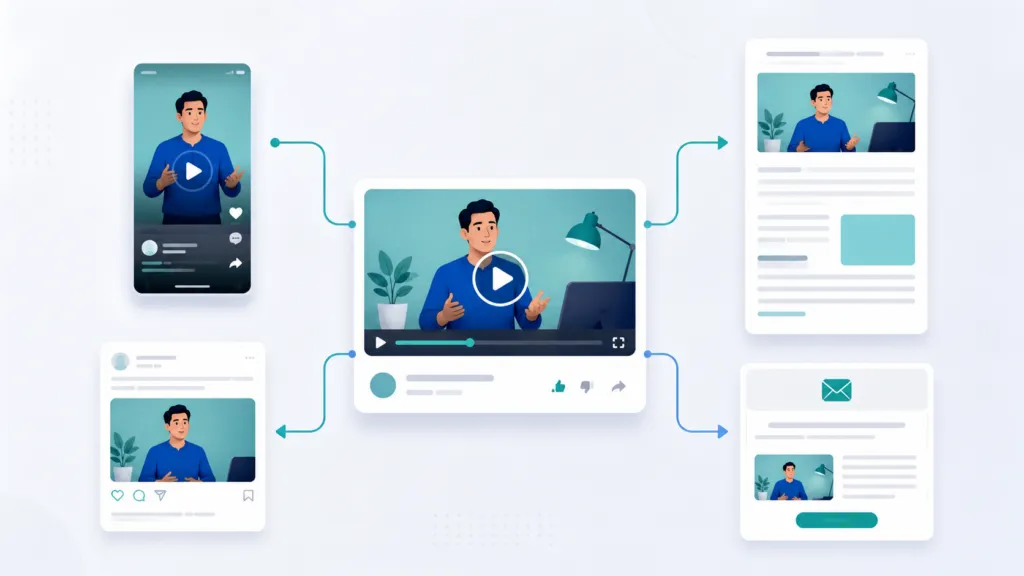
At TJ Digital, our entire marketing strategy is built on content repurposing. Every video I create gets turned into 8-10 additional pieces of content, and this approach has generated 2-3 new client inquiries per day with zero paid advertising. The key is that every piece of content is built around a specific search term before I ever hit record.
Table of Contents
ToggleWhy Most Content Repurposing Strategies Fail
I talk to business owners every week who tell me they have a mountain of content ready to repurpose. Podcast episodes, webinars, old blog posts. They figure they’ll turn it all into short-form videos, social posts, and new articles.
My response is usually, “Great. We’ll take a look, but probably not.”
Modern social algorithms actively penalize recycled and non-native content. Instagram’s April 2026 algorithm update stops recommending accounts that primarily post unoriginal content across photos, carousels, and Reels. TikTok flags obvious reposts and watermarked videos, reducing their distribution to nearly zero.
With today’s algorithms, falling flat typically means getting less than 1% of the views you’d get with native content. That’s functionally zero. You’re wasting your time.
@tjrobertson52 why doesn’t my repurposed content get views? Usually because it was never built to be repurposed #ContentRepurposing #ContentMarketing #SmallBusiness
♬ original sound – TJ Robertson – TJ Robertson
Can You Turn Old Podcasts or Webinars Into Short-Form Videos?
Not without heavy editing. The most common approach I see is businesses trying to chop a long podcast or webinar into short clips and post them across TikTok, Instagram, and YouTube Shorts.
This almost never works well. Short-form video is extremely competitive, and the most important part of any short-form video is the hook (the first 2-3 seconds).
According to Hootsuite’s TikTok breakdown, watch time in the first few seconds is the single strongest ranking signal on TikTok. If viewers scroll past in the first 3 seconds, the algorithm stops showing your video to new people.
Unless you’re intentionally inserting hooks throughout your podcast or webinar, you’re unlikely to get a compelling opening by just clipping that video. If you want to see a masterclass in how to do this well, watch Diary of a CEO with Steve Bartlett. He inserts deliberate hooks throughout every conversation.
Should You Start With Blog Posts or Video?
I recommend starting with video. A lot of people try to write a blog post first and then turn it into video, but the AI tools that convert written content into video still aren’t good enough in most cases.
There’s one exception. If the topics you’re writing about have virtually no competition in video, and people are actually searching for them, then AI-generated video can be effective. We’ve created a handful of videos for clients using NotebookLM (now called Gemini Notebook) that have gotten over 1,000 views.
But for most topics with any real competition, you’ll get better results starting with video.
Video also gives you better raw material. When you speak naturally about your area of expertise, you capture your actual voice, opinions, and personality. That makes every piece of repurposed content sound like you wrote it, because you did (just verbally).
AI has made this process much easier and more effective, but it still can’t work miracles with bad source material.
Can Video Transcripts Become Effective Blog Posts?
Yes, but only if the topic matches something people are actually searching for. The only blog posts that get real traffic are the ones that show up in search engines. Most of the time now, that means AI search platforms like ChatGPT, Perplexity, and Google AI Mode finding your content and using it to answer questions.
This is one of the most effective ways to influence AI search results. But the topic of the blog has to match something an AI or a person would actually search for. If no one’s searching for the content, no one will ever find it.
If the topic of your video is something people actively search for, that transcript will make a great blog post. Take the search term and put it at the front of the video title or caption too.
But if the video topic is purely conversational or entertaining without matching any search demand, turning it into a blog post is a waste of time.
What Works and What Doesn’t When Repurposing Across Platforms
| Approach | Does It Work? | Why |
| Chopping a podcast into random clips | Rarely | No hooks, no context, algorithms ignore it |
| Blog post to AI-generated video | Sometimes | Only works for low-competition topics with real search demand |
| Video transcript to SEO blog post | Yes, with conditions | Topic must match actual search queries people are typing |
| Short-form video to multiple platforms | Yes | TikTok, Instagram, YouTube, and other algorithms are similar enough |
| One video to blog, LinkedIn, Medium, Substack | Yes | One piece of content becomes 10+ with proper planning |
How to Plan a Content Repurposing Strategy That Actually Works
Start with a list of questions people are actually searching for before buying your product or service. If you’re a local business, include the location name in the topic. These are your content topics, and every piece of content you create should start here.
For each topic, craft a one to two sentence hook you can use to open a video. You can either create a standalone short-form video for each hook, or use the hooks throughout a longer podcast or webinar.
Post each short-form video as-is to TikTok, YouTube Shorts, Instagram Reels, Facebook, X, and LinkedIn. Each platform’s algorithm is slightly different, but they’re similar enough that the same short-form video works across all of them. The key is that every video must open with the hook.
Then take the transcript from each video and turn it into a blog post optimized for search. You could also turn it into a LinkedIn post, a Medium post, or a Substack post.
That’s how one piece of content becomes 10 or more pieces that actually perform on each platform. We’ve built an entire content machine around this exact process for our clients.
How Do You Create Strong Hooks for Short-Form Video?
The first 2-3 seconds of your video determine whether anyone watches the rest. TikTok, Instagram, and YouTube all weight early watch time more heavily than any other metric. If viewers scroll past in the first 3 seconds, the algorithm stops distributing your video entirely.
A reliable hook format is to open with a bold claim, a surprising statistic, or a provocative question. Deliver one concrete piece of data or insight, follow with a quick example, and end with a call-to-action.
Hooks have to be intentional. You can’t get a good hook by randomly clipping a longer video. Script or plan the opening of every piece of content before you record it.
I talk more about this in my guide on how to get clients from video without going viral.
How Should Local Businesses Approach Video Repurposing?
If you’re a local business, the same strategy applies with one important addition. Include your city, neighborhood, or service area name in your topics and hooks.
People searching locally almost always include geographic terms. “Best plumber in Seattle” or “window tinting near me” are how real people actually search. If your content includes those geographic signals, both traditional search engines and AI platforms are more likely to surface it for local queries.
This applies to both the video content and the repurposed blog posts. A blog post titled “Best Time to Replace Your Roof in Portland” will massively outperform a generic “When to Replace Your Roof” for a Portland roofing company.
How to Get Started With Content Repurposing
Content repurposing is the best marketing strategy available in 2026, but only if you plan for it from the start. Record with repurposing in mind, lead with hooks, and make sure every topic matches something people are actually searching for.
At TJ Digital, we help businesses build content repurposing systems that turn one short video into 8-10 pieces of high-quality content across every major platform. Contact us to learn how we can build this system for your business.