
No. A Markdown version of your website will not help you rank higher in Google, and it will not get you recommended more often by ChatGPT. Google has now said that directly, and the crawler experiments published over the past year back it up.
I still think you should do it. Same with an llms.txt file, and eventually a WebMCP setup.
I run TJ Digital, an SEO agency, so most of the people arguing about this in my feed are other SEOs. They keep landing on the wrong conclusion. Markdown is a user experience decision, and the user in question is an AI agent.
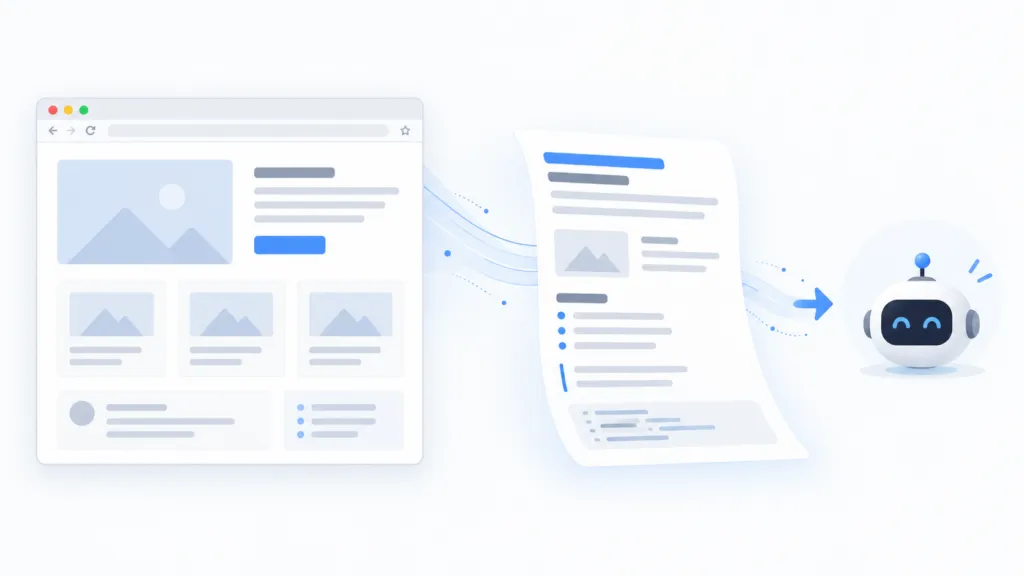
Cloudflare’s published example shows a page dropping from 16,180 HTML tokens to 3,150 tokens after conversion. That is roughly an 80% reduction in what an agent has to read to understand your page.
Here is what the evidence actually says, and how I would prioritize all of this.
Table of Contents
ToggleDoes a Markdown Version of Your Website Help SEO?
It does not. Google’s current Search Central guidance says you do not need to create Markdown or other machine readable files to appear in Google Search. The same guidance on generative AI features says AI text files like llms.txt neither help nor hurt your visibility or rankings.
That applies to AI Overviews and AI Mode too. Those features are grounded in Google’s normal Search index and ranking systems, so anything that does not affect ranking does not affect them either.
John Mueller and Martin Splitt spent a June 2026 Search Off the Record episode on this exact question. Their closing chapter is titled “Stick to HTML for the web.”
@tjrobertson52 Does your website need a markdown version? SEOs say it won’t help you rank. That’s true, and it’s still worth doing. #SEO #AISearch #AIAgents
♬ original sound – TJ Robertson – TJ Robertson
Why Does Google Want the HTML Version?
Two reasons, and both make sense.
First, search engines have gotten very good at reading HTML. HTML already carries headings, links, lists, tables, forms, images and metadata in a machine readable form. There is no parsing problem to solve.
Second, Google wants to judge you on the content you show to actual humans. If Google ranked you based on a file that only machines see, you could show one thing to the crawler and something else to your visitors.
Google does not treat every alternate representation as cloaking. Serving a machine facing version with substantially the same content has never been the problem by itself.
The risk shows up when the two versions drift apart, and that drift is exactly what Mueller and Splitt raised. Two content pipelines are harder to monitor than one.
What Do the Crawler Experiments Show?
This is where the SEO case falls apart completely.
- OtterlyAI built identical HTML and Markdown pages with equal discoverability and watched AI bot behavior for 14 days. The HTML pages got 137 AI bot visits. The Markdown versions got zero, and none were cited.
- Dries Buytaert ran a server log experiment on his own site and got a more mixed result. Several AI crawlers did follow his .md URLs, and total crawler requests rose about 7% because some bots fetched both versions. He saw no ranking or citation uplift, just more crawling.
- Checkly tested seven AI and coding agent tools in February 2026 to see what they request natively. Three of the seven asked for Markdown. The other four did not.
Both of those first two experiments were run on a single site, so neither is proof of anything universal. But “a crawler requested my Markdown file” is not the same as “Markdown improved my ranking or my odds of being cited.” Nobody has shown the second thing.
Why Should You Serve Markdown to AI Agents Anyway?
Because website development covers more than SEO. It also covers user experience, and Google has a long history of turning user experience into a ranking factor.
The user I am talking about here is an AI agent. I think it is pretty clear that in the near future, the majority of the traffic hitting your website will be agents acting on behalf of people.
Agent user experience is not a ranking factor yet. I think it will be.
It also matters whether or not it ever becomes one, for the same reason human user experience would matter if Google ignored it entirely. If most people are going to interact with your business through an agent, then making it easier for that agent to pull information or complete an action is making it easier for the person behind it. Improving AI agent user experience improves human user experience.
Google’s web.dev team says the same thing more plainly in its agent UX guidance: “Everything we suggest to make a site ‘agent-ready’ also makes sites better for humans.”
That overlap is strongest for semantic HTML and accessibility work. It is weaker for agent only files like Markdown mirrors, which humans never see. Those are worth doing for a different reason: they cost almost nothing and they make you easier to work with.
Which AI Agent Optimizations Are Worth Doing?
| Optimization | Effect on Google rankings | Benefit to AI agents | What I would do |
| Semantic, accessible HTML | No special AI ranking treatment, but it is part of sound SEO | High. Browser agents read the DOM and accessibility tree | Do it now |
| Separate Markdown pages | None | Useful for text heavy and coding agents, adoption is inconsistent | Optional, strongest case for documentation |
| Same URL Markdown via content negotiation | None | Cuts agent token consumption with no second site to maintain | Reasonable experiment for content heavy sites |
| llms.txt | Google explicitly ignores it | Possibly useful to software that supports the proposal, crawler evidence is weak | Low effort, low priority |
| WebMCP | No ranking effect, it is an interaction API | Potentially high for transactional and booking tasks | Prototype where agent actions matter |
How Does Cloudflare Serve Markdown to AI Agents?
Cloudflare’s Markdown for Agents feature is the version of this I actually like, because it solves the maintenance problem that makes hand built .md mirrors a bad idea.
It works through ordinary HTTP content negotiation. A browser requests a page with Accept: text/html and gets HTML. An agent requests the same URL with Accept: text/markdown and Cloudflare converts your existing HTML at the edge.
The URL never changes. You keep one page, one editorial workflow, one source of truth.
The converter strips scripts, styles and navigation chrome, can pull page metadata into YAML front matter, and preserves JSON-LD in the output. Cloudflare’s docs say the feature is available on Pro, Business and Enterprise plans at no extra charge, with conversion limited to HTML responses up to 2 MiB.
The catch is on the other side of the request. Cloudflare can generate the lean version, but it cannot make an agent ask for it. The agent has to send that header, and as the Checkly results show, plenty of them still do not.
Should Your Website Have an llms.txt File?
Add one if it takes you ten minutes and can be generated automatically. Do not add one expecting rankings.
llms.txt is a community proposal, not a search engine standard. It is a Markdown file in your root directory that gives agents a curated map of your site: an H1 with your site name, a blockquote summary, then H2 sections listing your most important pages with a short description of each. The v2 spec, updated in August 2026, also lets a file apply to a specific path, with the most specific file winning.
The crawler data is not encouraging. OtterlyAI placed one on a test site and logged AI bot traffic for 90 days. Across more than 62,100 classified AI bot visits, the file was requested 84 times, about 0.1% of that traffic.
A typical content page on the same site got roughly 265 visits. Buytaert’s log analysis found 52 requests to his file, and he classified all of them as SEO and auditing tools rather than AI answer engines.
I said “you might as well” about llms.txt when it first showed up, and I still think that. Generate it from the same source of truth your website uses, keep it short and accurate, and put it in your automated tests so stale URLs and old pricing do not sit there rotting. What I would not do is write it by hand and then treat it as another page to maintain.
What Is WebMCP and How Do AI Agents Use It?
WebMCP is the one that actually interests me, because it deals with what an agent can do on your site instead of how it reads your text.
The WebMCP draft defines a browser API that lets a web page expose its functionality as structured, callable tools. Each tool gets a name, a plain language description, an input schema and real executable behavior. The agent reads the schema and calls the function.
Think about a travel site. Without WebMCP, an agent asked to find a direct flight to Paris under 300 dollars has to find the origin field visually, click it, type, find the destination field, operate a custom date picker, set passengers, hit search, read the result cards, then figure out the filters. Every one of those steps can fail on a layout shift or an ambiguous control.
With WebMCP, the page can expose something like search_flights(origin, destination, departure_date, passengers, direct_only, max_price) and let your own application logic run the search.
Two things to know before you get excited:
- It is early. The spec is a W3C Community Group report and is not a W3C standard. Chrome started an origin trial with Chrome 149 and has added DevTools support for inspecting and debugging tools.
- Security is the hard part. An agent can inherit browser authentication and session state, which means a tool can act inside a logged in account. Chrome’s agent security guidance warns that anything returned through WebMCP has to be treated as untrusted input, because prompt injection can hide in the data an agent processes. Narrow tools, explicit schemas, least privilege, and confirmation before anything consequential.
If you run ecommerce, booking, a SaaS app, a support portal or anything with complex forms, this is worth prototyping. If you run a blog, it is not.
Is Serving Markdown to AI Agents Cloaking?
No. Cloaking is showing search engines materially different content from what people get, in order to manipulate rankings. A Markdown version generated from the same page, carrying the same content, is a different format of the same information.
The practical risk is drift. If your Markdown pages are authored separately and quietly fall out of sync with your HTML, you end up with two versions saying different things. Same URL conversion avoids that, because the Markdown is derived from the page you already publish.
Do You Need Both an llms.txt File and a Markdown Version?
No, they solve different problems. llms.txt is a discovery aid that points an agent toward your most important pages. Markdown is a format decision that affects how cheaply an agent reads a page it has already found.
Most sites should start with llms.txt because it takes minutes to generate. Markdown conversion earns its place when you have long, text heavy content that agents will actually be reading, like documentation or in-depth guides. Our own view on how AI optimization differs from SEO applies here too: pick the work that changes an outcome, and skip the rest.
Where Should You Start?
Here is the order I would work in.
- Fix the ordinary website first. Crawlable pages, useful original content, real <button> and <a> elements instead of styled divs, form labels tied to their fields, predictable layouts, visible results after an action. This is the layer that pays off for Google, for agents and for people with screen readers at the same time.
- Look at your server logs. Find out which AI user agents are actually reaching your site and what they request. Build for the agents you have, not the ones in a blog post.
- Add automatic Markdown if your content is text heavy. Documentation, knowledge bases, API references and long technical resources have the strongest case. Same URL content negotiation beats a second set of files you have to keep in sync.
- Generate an llms.txt. Cheap, automated, accurate, then stop thinking about it.
- Prototype WebMCP where people have real tasks to hand off. Keep it isolated and built on your existing secured application logic.
There is no limit to how friendly you can make your website for AI agents, in the same way there is no limit for humans. Most sites have not started, which is the opportunity.
Want Help Getting Your Site Ready for AI Search?
At TJ Digital, we build AI search campaigns for small and medium-sized businesses, starting with a Two-Week Strategic Assessment that covers your technical setup, your AI visibility, and where your brand is being recommended today. Email me at TJ@TJRobertson.com and tell me what you are working on.