
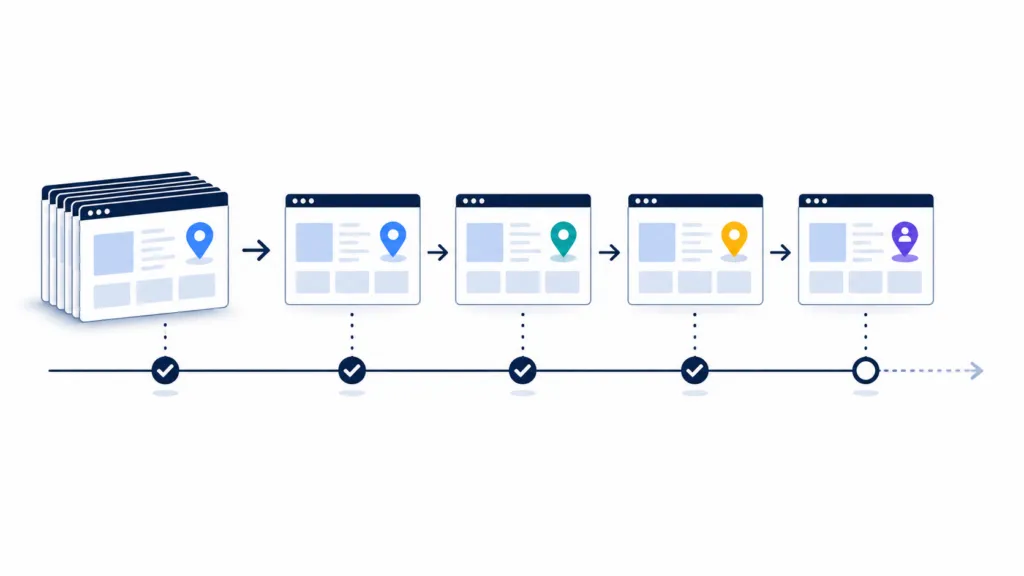
Keyword variant pages still work. If you serve 12 cities, 8 industries, or 5 use cases, you can build a page for each one and rank for each one.
Two things decide whether it works. One is the content you put on the pages. The other is how fast you publish them.
At TJ Digital we simulate about 4,000 prompts every day across ChatGPT, Gemini, and Perplexity to see which pages get cited before a brand gets recommended. Variant pages show up in those citations constantly. They’re also still one of the most reliable ways to pick up traditional search traffic, which is why I keep recommending them even though Google’s public guidance says not to.
Table of Contents
ToggleWhat Are Keyword Variant Pages?
Keyword variant pages are separate pages that say roughly the same thing while targeting a different version of the same search term. A roofing company with one page for Phoenix, one for Scottsdale, and one for Mesa is running variant pages. So is a SaaS company with one page for agencies, one for accountants, and one for law firms.
They usually show up in four forms:
- Location pages, one per city or service area
- Industry pages, one per vertical you serve
- Audience pages, one per customer type or demographic
- Use case pages, one per problem your product solves
Most businesses can subdivide these until they have thousands of pages. That’s where the trouble starts.
@tjrobertson52 Should I create a page for every location I serve? Google says no. Do it anyway, carefully. #SEO #LocalSEO #SmallBusinessMarketing #AISearch
♬ original sound – TJ Robertson – TJ Robertson
Why Does Google Discourage Location and Industry Pages?
Two reasons. Google doesn’t want to flood their index with pages containing similar content, and the tactic works well enough that plenty of people abuse it.
Google’s spam policies classify pages built for specific cities or regions that funnel visitors toward one destination as doorway abuse. Done correctly, though, targeting keyword variants is still one of the best ways to pick up search traffic and one of the best ways to get recommended by AI.
There are two ways you can upset Google here. Either you build the pages in a way the algorithm dislikes and they never get indexed, or you build them in a way the algorithm loves at a scale large enough that a human at Google notices.
The second one is rare and most businesses will never come close to it. If you’re publishing thousands of pages and they’re pulling serious traffic, a scaled content abuse penalty becomes a real concern. I covered where that line sits in how much content to publish.
Everything below covers the normal case, which is building a reasonable number of these pages in a way the algorithm rewards.
What Content Should Go on a Location or Industry Page?
You want content that’s unique and fact-dense. To understand why, you need to understand what Google is trying to keep out of their index.
They don’t want to index low-quality information, and they don’t want to index the same information twice. In their own words, they’re trying to prevent commodity content.
Here’s the thing. Google’s check for whether content is unique is pretty basic. As long as you’re not using the exact same words on each page, it won’t get flagged as duplicate.
That’s a low bar. If you’re having AI help you write the content, clearing it is trivial. Please don’t take the first output from ChatGPT and paste it onto your page.
Fact density works the same way. Google’s algorithm measures how much information sits on the page by counting numbers, claims, charts, tables, and pricing. It doesn’t check whether any of those facts are true or relevant.
Fact density is also the single biggest thing that will get your page cited by AI. A Princeton-led study presented at KDD 2024 found that adding statistics, citations, and quotes to a page lifted its visibility in AI-generated answers by up to 40%.
| Page element | The version that gets filtered out | The version that gets indexed and cited |
| Opening | Generic service description with the city swapped in | Direct answer naming the city, the service, and a specific number |
| Pricing | “Contact us for a quote” | Actual price ranges for that location or industry |
| Proof | The same three testimonials on every page | A named customer, project, or result from that area or vertical |
| Data | None | Permit costs, timelines, regulations, or benchmarks specific to the variant |
| Format | Blocks of paragraph text | Tables, bullet lists, and question headings |
How Many Pages Is Too Many?
No page count triggers a penalty. Google looks at whether the pages carry value, so a few dozen thin pages can cause problems while thousands of useful ones don’t.
For most businesses the real limit is authority. Your domain can only support so many pages before Google stops indexing new ones. If you’re publishing faster than Google is indexing, you’ve found your ceiling.
How Fast Should You Publish New Pages?
About one page per week is a safe cadence for most sites. Bigger sites with more traffic and more established authority can move faster than that.
Don’t publish 100 variants at the same time. If you’re just starting out, publish three or four and wait until they actually get indexed and start receiving traffic. Once you’re sure Google likes the pages, start publishing more.
The signal you’re watching is indexation, so check Search Console before you increase your output.
What Should You Do If Your New Pages Get No Traffic?
If you publish these pages and they get no traffic at all, Google doesn’t see them as authoritative. Two fixes work here.
The first is internal linking. Point more links at those pages from related pages on your site, and use the target term as the anchor text. Generic anchors like “read more” waste the signal.
I walked through that process in more detail in on-page SEO basics.
The second is domain authority. If your site as a whole doesn’t carry enough trust, internal links alone won’t carry a thin page into the results. That’s a longer project built on backlinks and brand mentions across the web.
If neither one moves the needle after a couple of months, the pages aren’t earning their keep. Merge them into a stronger page or remove them.
Does Google Penalize Location Pages for Duplicate Content?
No. Google’s John Mueller confirmed that localized content isn’t treated as duplicate content. Shared boilerplate like your company background and contact details can repeat across location pages without causing a problem.
The risk shows up when the entire page is boilerplate with a city name swapped in. At that point Google filters the pages out of the results, and the effect on your traffic is the same as a penalty.
Can You Use AI to Write Location Pages?
Yes, and for this specific job it’s the right tool. Producing 12 versions of the same page with different wording and different local facts is exactly the kind of work AI handles well.
The failure mode is publishing the raw output. Feed the model the specific details that make each page different, then review every page before it goes live. We use AI in every content workflow at TJ Digital, with humans reviewing everything, and the review step is what makes the difference.
What Is a Scaled Content Abuse Penalty?
A scaled content abuse penalty is what Google applies when a site generates large volumes of pages whose main purpose is manipulating rankings. It can be triggered algorithmically or by a manual review, and the result is deindexed pages and collapsed rankings.
No fixed page count triggers it. Google’s wording covers content produced at scale regardless of how it was created, so the trigger is quality and intent.
Should These Pages Live in a Subfolder?
One level deep at most. Google treats pages nested inside subfolders as less important than pages at the top level, so anything you want ranking for a competitive term shouldn’t sit three folders down.
Subfolders are still useful for separating content that speaks to different audiences. A structure like /locations/phoenix/ works fine. Something like /services/locations/arizona/phoenix/ buries the page.
How Do You Know If Your Site Can Support Variant Pages?
Most sites that fail at this fail on authority. The pages are fine, the domain can’t support them yet, and nobody checks before publishing 60 of them.
We look at that first. Request a free digital marketing audit and we’ll tell you how many variant pages your site can realistically support right now, and what has to happen before it can support more.