Should My Business Use AI-Generated Content in 2027?
By TJ Robertson, Founder and Lead Strategist at TJ Digital
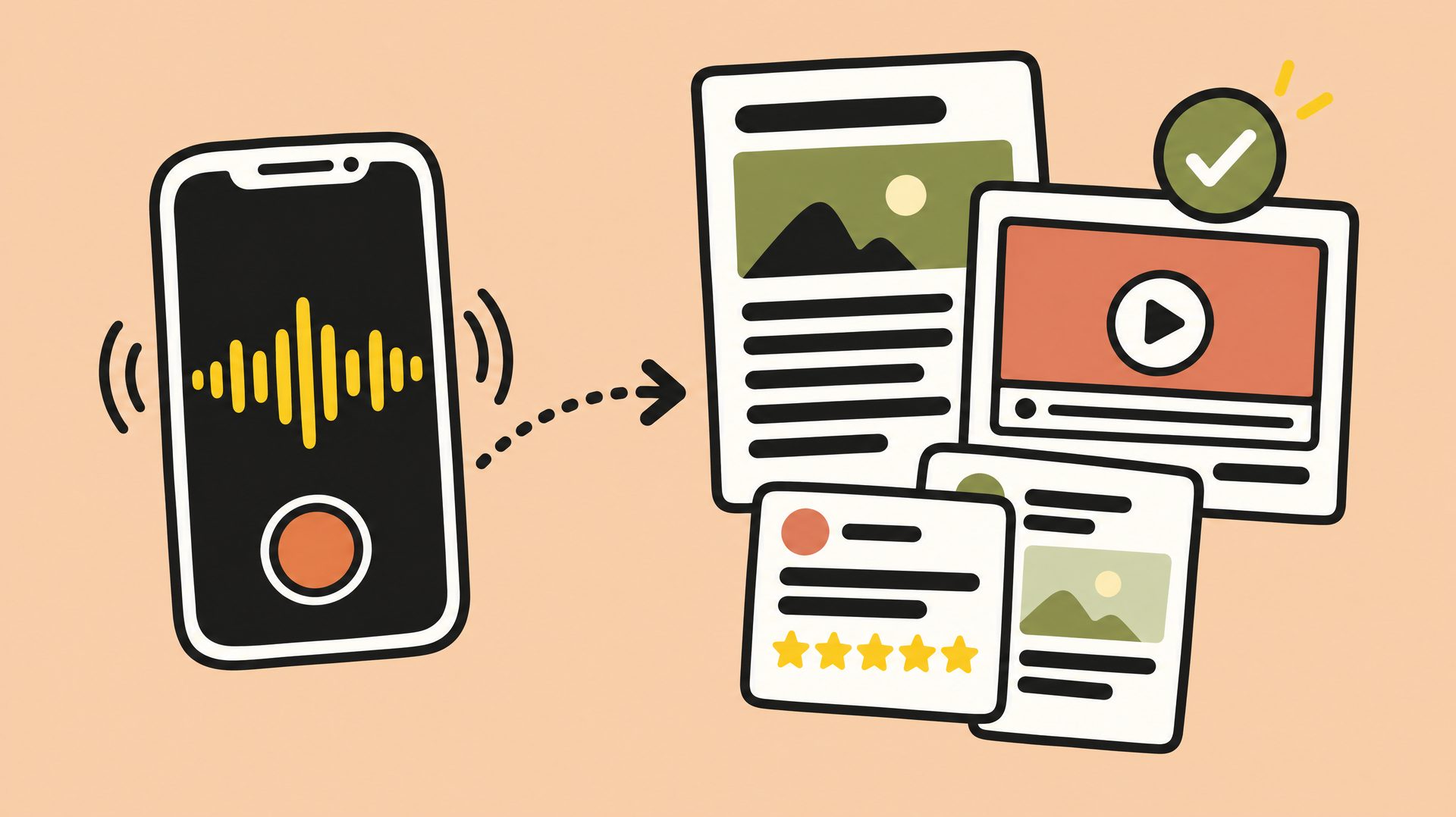
Yes, your business should use AI-generated content in 2027, and I think now is the right time to start. The way to do it is to have someone at your business who knows the subject answer a customer’s question in their own words, in a short video or a voice memo. AI turns that into a blog post, an edited video and social posts, and someone checks each piece before it goes out.
Using AI the right way isn’t against Google’s guidelines. Customers are harder to win over: many still distrust AI in marketing, though how much depends on what the AI is used for.
Right now, most people don’t go looking for AI-made content, because most of it is a novelty. My prediction for 2027 is that the average person will stop assuming AI-made content is slop. Some of our favorite content will be made with AI.
At TJ Digital, we make our own content with AI every day. I record a short video, and Claude, the AI we use for most of our work, edits it, posts it to six platforms and writes the social posts and a blog post for this site. We do the same for our clients, and their account manager reviews every piece before the client sees it.
Will Customers Trust My Business Less If It Uses AI Content?
Some customers will trust your business less today if they think its content was made with AI. In a Gartner survey of 1,006 US consumers in May and June 2026, 57% said AI-generated content in marketing has made them less trusting of brand messaging overall.
Gallup asked 3,270 US adults about businesses using AI in their ads in May 2026, and 49% viewed it negatively, against 19% positively. But their answers changed a lot depending on what the AI was used for:
| How a business used AI in its ads | What people said |
|---|---|
| Brainstorming and early drafts, clearly disclosed | 75% acceptable |
| Making the final text, images or video | 53% acceptable |
| Creating people or voices | 62% unacceptable, even when disclosed |
So most people are fine with AI helping on an ad, from early drafts to the final text, images or video. What most of them won’t accept is a fake person, even when they’re told.
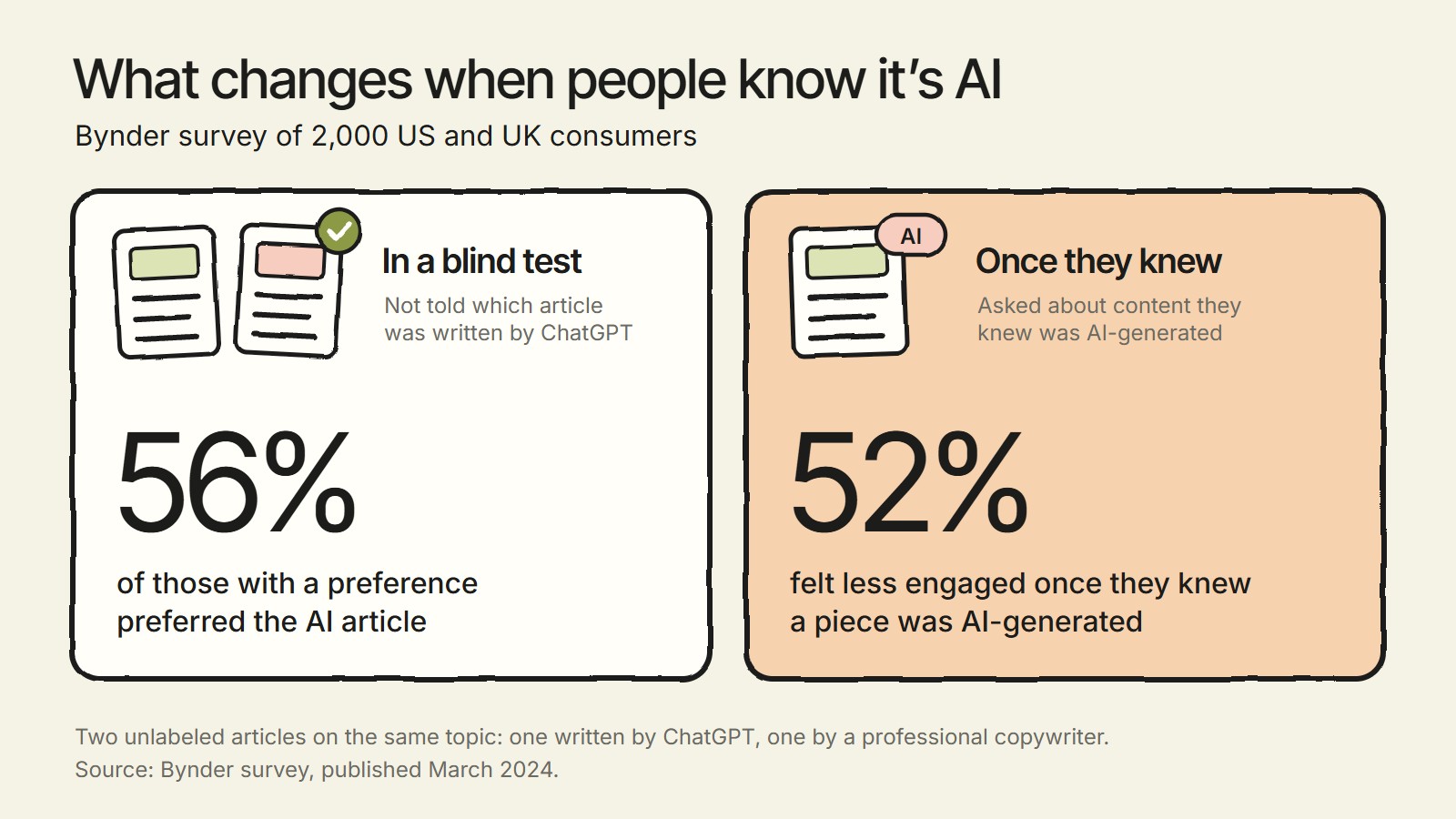
I think a lot of the distrust comes from knowing a piece was made with AI, more than from the quality of the piece. In a Bynder survey of 2,000 US and UK consumers, published in March 2024, people read two unlabeled articles on the same topic: one written by ChatGPT, one by a professional copywriter. Of those who had a preference, 56% preferred the AI article.
Yet 52% said they felt less engaged once they knew a piece was AI-generated. People have learned to expect less from AI content, and that expectation is what I think changes in 2027.
Is AI-Generated Content Good Enough Yet?
Yes, for the kind of content most businesses publish: blog posts and videos that explain things to customers. AI can write a clear blog post from a short video of you answering a question, and it can edit that video and write the social posts.
Where it still falls short is accuracy and sounding like you. It can get facts wrong, and without your input, it sounds like everyone else’s AI content.
AI-generated video is close, too: in a study Runway ran in January 2026 on its own video model, more than 90% of the people who took part couldn’t reliably tell its five-second clips from real video. But an independent study from UC Berkeley found that people spot AI-generated video more often the longer they watch. Across clips from a single frame to eight seconds long, the share of AI clips they caught rose from 58% to 75%.
I go into what AI video can do for a business in Can AI Make High-Quality Videos for My Business?
Why AI content will get much better in 2027
I believe we’re reaching a threshold: the point where AI content is good enough that people go looking for it. One reason is how much better people are getting at using AI.
My new personal addiction is making music videos with AI. What makes it so addicting is that every lesson I learn along the way automatically gets logged in a skill I’m building for Claude.
A skill is a set of written instructions Claude follows every time it does that task. Because the lessons keep adding up, every video is better than the last and takes up much less of my time. I wrote up the process in How to Make a Music Video With AI.
We haven’t made music videos for any clients yet. But a lot of what we learn applies to the videos we make for clients, so every time we make any kind of video, our system gets better at making videos.
From what I can see, there are thousands of creators building systems like this, or machines you might call them, that make higher and higher quality videos and blog posts. Each of these machines is a set of instructions running on an AI model like Claude or ChatGPT. People improve them with every lesson, and every time a new model comes out, all of them get an upgrade.
That happened to us in early October 2026, when Claude Opus 5.5 made our video editing much better. Video quickly became a much bigger part of what we do.
And the progress of new models seems to be speeding up. Better systems running on better models is why I expect a huge jump in the quality of content in 2027. That’s my own prediction, and I haven’t seen any data on how people will feel about AI content next year.
Does Google Penalize AI-Generated Content?
Google put it plainly in 2023: “Appropriate use of AI or automation is not against our guidelines.” Its spam policy is aimed at what it calls scaled content abuse, “when many pages are generated for the primary purpose of manipulating search rankings and not helping users.” The policy applies “no matter how it’s created,” and one of Google’s own examples is using generative AI tools to generate many pages without adding value for users.
So the risk is publishing lots of pages with little useful content on them, whoever or whatever wrote them. I go through what does get sites hit in Does Google Penalize AI Content?
Google’s guidance on AI content also says, “It is critical to manually factcheck and review all AI-generated content for accuracy and trustworthiness before publishing.” I’d have someone check every piece anyway, because whatever you publish under your name is on you.
What Should My Business Make With AI, and What Should Stay Human?
Let AI do most of the work of making your content. The knowledge and opinions in it should come from a real person at your business, and when someone appears on camera, it should be that person. AI can’t invent your experience: what you’ve seen working with your customers, and what you think about it.
That experience is also what will make your content stand out. In the same Gartner survey of 1,006 US consumers, from May and June 2026, 65% said brands are producing too much AI-generated content in their marketing materials.
As more businesses publish good AI content, it will take better content to stand out. I wrote about that in Is AI Raising the Marketing Quality Bar?
Here’s how we split the work, for our own content and for our clients:
| Content | What AI does | What a person at your business does |
|---|---|---|
| Blog posts that answer customer questions | Writes the post from your own words | Answers the question in a short video or voice memo, and checks the facts |
| Videos you record | Edits the video and posts it to the platforms that fit | Is on camera, in their own voice |
| Social posts | Writes them from the video or the blog post | Reads them before they go out |
| Videos made from a blog post | Makes a video from the post, without anyone filming | Checks that it says what you’d say |
If you’re worried that AI content will sound generic under your business’s name, starting from your own words fixes a lot of it. I cover what else helps in How to Make AI Sound More Human.
I’d keep AI-made people off the list entirely. We advise our clients against AI avatar videos, where an AI-generated version of them or their staff does the talking, because viewers tend to feel tricked.
Should I Tell People My Content Was Made With AI?
I’d tell your customers when AI helped make your content. We’re open about how we use AI, and I think every business should be. Most aren’t yet: in an Ahrefs survey published in September 2026, 78% of the marketers using AI said they don’t tell website visitors they used it.
Google’s guidance also says that “Sharing information about how a piece of content was created can help give your readers more context.”
Being open may cost you some engagement for now, because some people still think less of a piece once they know AI helped make it. I’d still take that over a customer finding out later that something wasn’t what it looked like. I explain how we think about this in Rules for Using AI at Work.
How Should My Business Start Using AI Content?
I’d start publishing AI content now, before 2027. In the same Ahrefs survey, 93% of the marketers who answered use AI to create or help create content, so you won’t be early. And the instructions you give your AI get better with every piece you make, so a business that starts now goes into 2027 with months of lessons already written down.
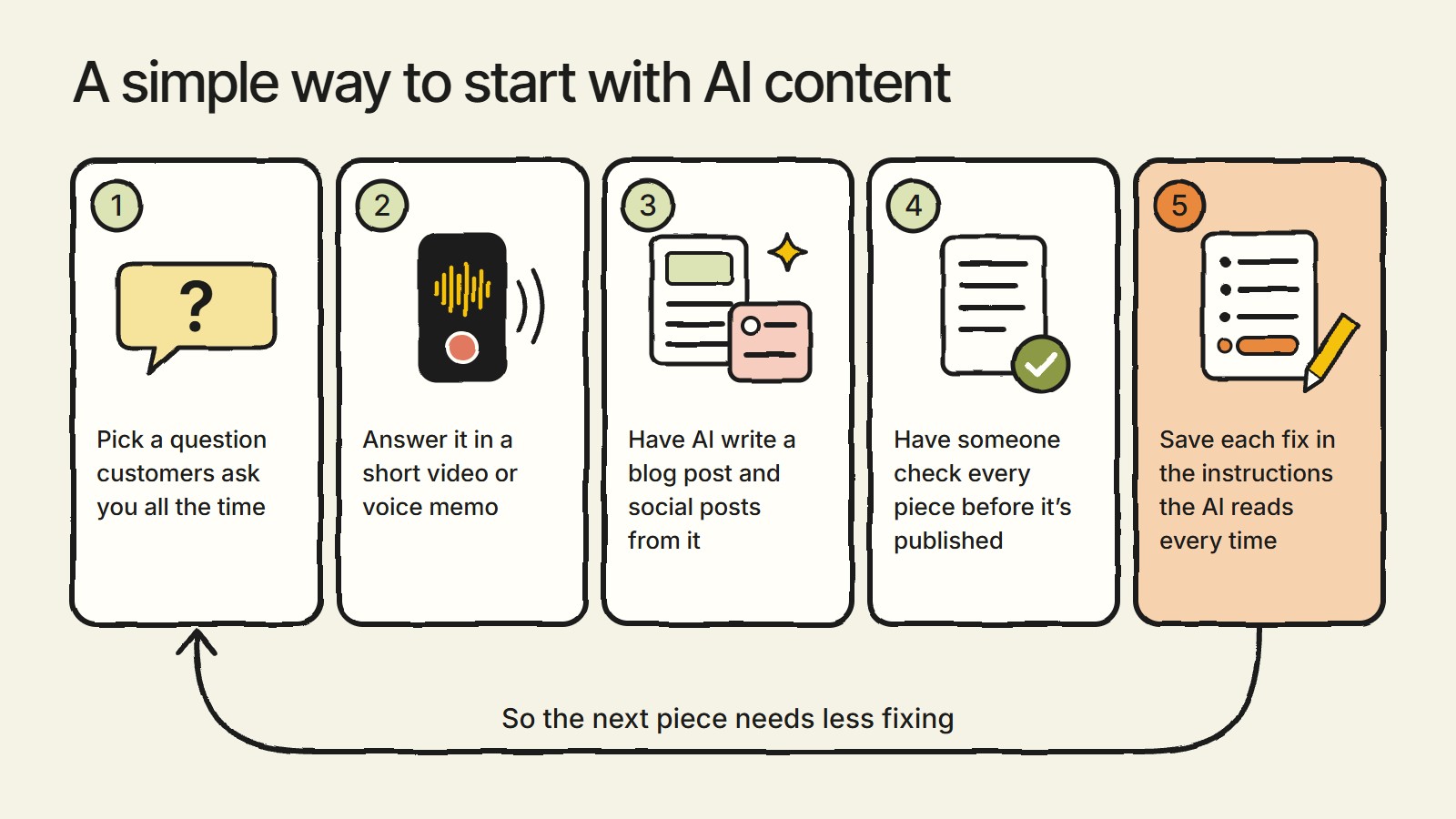
Here’s a simple way to begin:
- Pick a question your customers ask you all the time.
- Answer it in a short video or voice memo, the way you’d answer a customer.
- Give the transcript of that recording to Claude or ChatGPT, and have it write a blog post and a few social posts from it. Post the video, too.
- Have someone at your business check every piece before it’s published.
- Write down everything you had to fix, and save it in the instructions the AI reads every time (in Claude or ChatGPT, a project’s instructions work for this), so the next piece needs less fixing.
If you’re starting with blog posts, I go into more detail in Should You Use AI to Write Blog Posts?
I think now is the right time to get on the content train. The internet is about to fill up with high-quality AI-generated content, and some of it might as well come from your brand.
If you have questions about any of this, or about how we make content like this for our clients as part of their SEO and GEO campaigns, reach out through our contact page or email me at tj@tjrobertson.com.