
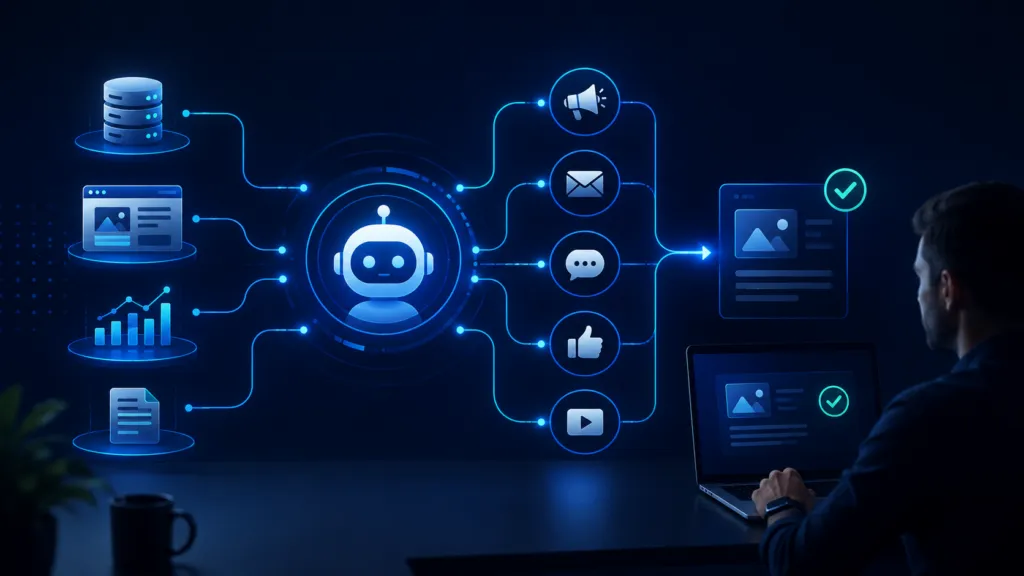
An AI marketing agent in 2027 will be an MCP connector that plugs into whatever AI you already use and runs your marketing from a structured knowledge base about your business. At TJ Digital we run AI search optimization for roughly 40 to 50 client campaigns, and this is the architecture we’re building toward. The agent handles the audits, the page creation, and the content repurposing, and you handle the review.
Every six months or so I make a video predicting what digital marketing will look like in 2027. Those have always been guesses. This one describes the system we’re building right now.
Table of Contents
ToggleWhat is an AI marketing agent?
An AI marketing agent is a bundle of instructions, skills, and connections that lets the AI you already use do your marketing work directly. It lives inside that AI as a connector, so there’s no separate app to log into.
The context and the processes that the agent carries are what make it useful. A model with no information about your business can write you a generic blog post. A model connected to a maintained record of your brand, your website, and your customers can run a campaign.
@tjrobertson52 What will digital marketing look like in 2027? Our agency’s actual plan DigitalMarketing AIMarketing #SmallBusiness
♬ original sound – TJ Robertson – TJ Robertson
Why does MCP matter for marketing automation?
Because your marketing needs to move with you when you switch AI tools. Today you might be working in Claude Code. Next year it could be Codex or a Grok bot, and rebuilding everything from scratch each time would defeat the purpose.
The Model Context Protocol is an open standard for connecting AI applications to outside tools and data. Anthropic released it in November 2024 and donated it to the Linux Foundation in December 2025. Every major AI platform supports it now, which means a marketing agent built as an MCP connector works in whichever model you happen to be using.
The connector itself is simple. It carries the instructions and the skills for handling digital marketing. Everything else comes from three connections:
- Context about your business
- Connections to your website and any other platforms you use
- Connections to your data sources
How does your business information get into the agent?
The same MCP connector walks you through onboarding and collects it. You dump in whatever messy information you already have about your business. It reads through that, interviews you to fill in the gaps, then organizes everything into a consistent format.
That last step is the one most businesses skip. The information also has to be maintained in that structure over time, because everything built on top of it depends on knowing where things live.
What does the knowledge base behind the agent look like?
It’s a set of canonical documents about your brand, stored so a machine can read them. We call ours a Brand Ambassador, and we build one for every client. The underlying structure follows Google’s Open Knowledge Format.
Those documents include:
- A brand voice document
- A website structure document
- Image generation guidelines
- A website brand kit for building new pages
That canonical structure is what makes skills possible. When we build a skill, we already know every client has a brand voice document sitting in the same place. The skill can reference it without being rewritten for each business.
Why does a shared document structure matter?
Because a network of brands using the same structure can share the work of improving the skills. If thousands of businesses store their brand voice document the same way, a content repurposing process that someone builds works for all of them.
That compounding is the part I find most interesting. Improvement shows up at three layers at once:
- The agent learns more about your company every time you give it feedback
- The community improves the skills built on the shared structure
- The underlying AI models keep getting smarter
What marketing work can an AI agent handle?
Once it’s connected and onboarded, it can handle most of the recurring work in an online marketing campaign. That includes:
- Running comprehensive website audits
- Optimizing your existing pages
- Identifying content opportunities
- Creating new pages on your website
- Repurposing content across channels
You’ll still want to review drafts and give feedback. Every time you do, that feedback updates the underlying processes. Any new information you hand over gets folded into the knowledge base that the skills are reading from.
What kind of messy data can an AI agent use?
Almost any of it. Call transcripts, scraped social media posts, video transcripts, and data pulled from your analytics platforms all work as inputs.
Most businesses are sitting on more of this material than they realize. You’ve probably recorded dozens of sales calls this year. You’ve probably posted videos with transcripts attached to them.
None of that has been usable at scale until recently. Our repurposing system takes one short video transcript and produces up to 10 finished pieces of content from it. The output sounds like the owner because it’s built from the owner’s own words.
What can’t AI agents do on their own?
They can’t decide what your business should be known for. Strategy, positioning, and the judgment call about which opportunity is worth your budget this quarter still sit with a person.
The other gap is taste. An agent working from a good brand voice document gets close on tone, and someone who knows the business still has to catch the drafts that read slightly wrong. That’s why review stays in the loop even as the execution gets automated.
I’ve said for a while that roughly 90% of the hands-on marketing work can be automated today. The remaining slice is where the value moved, and it’s worth more now than it was five years ago.
Do AI agents replace SEO?
No. The agent is how the work gets done, and SEO is still part of what it does. Site audits, page optimization, internal linking, and content production all stay on the list.
What changes is the target. Optimization now has to account for how AI search works alongside traditional rankings. An agent reading a well-structured knowledge base is better positioned for that than a human working from a keyword spreadsheet.
Will businesses still need a marketing agency in 2027?
Some will and some won’t. Plenty of business owners have no interest in thinking about any of this, and they’ll want an account manager doing it for them. Others will run the agent themselves and pull in outside help only for strategy.
Here’s how the two approaches compare.
| Running the agent yourself | Working with an account manager | |
| Onboarding | You answer the agent’s interview questions | The agency gathers and structures your material |
| Draft review | You review everything | The agency reviews first, then you approve |
| Strategy | You decide what to prioritize | A strategist builds the quarterly plan |
| Your involvement | You’re in the loop on every step | You review finished work |
| Best fit | Owners who enjoy the tools and want control | Owners who want marketing off their plate |
Both approaches run on the same connector and the same knowledge base. The difference is who sits in the review seat.
How do you prepare your business for AI agents?
Start collecting and organizing your company’s knowledge today. That knowledge is the input every one of these systems depends on, and gathering it is the slowest part of the process. The same work also gets your website ready for agents that read it directly.
There are still details to work out on our end, and I’ll keep sharing what we find as we build it. At this point I’m confident this is the way digital marketing gets done.
Contact TJ Digital for a free digital marketing audit. I’ll review your website, your content, and your current AI search visibility, then show you exactly where to start building the knowledge base your marketing will run on.