
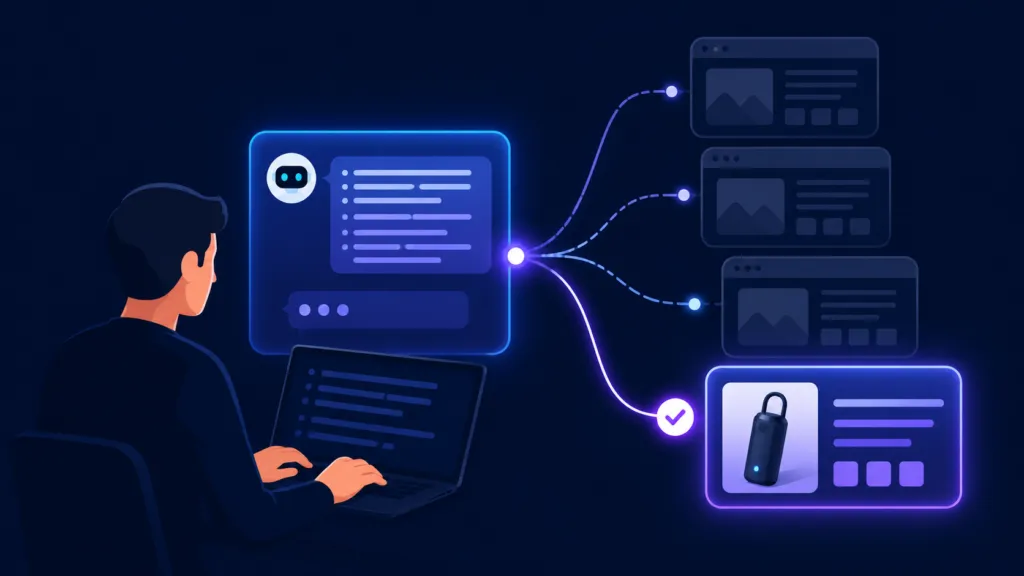
If nobody is searching for what you sell, AI search gives you entry points that keyword-based SEO never did. People now describe their whole problem to ChatGPT and get recommended a solution they never knew existed. At TJ Digital we track around 4,000 AI prompts per day across ChatGPT, Gemini, and Perplexity, and those prompts look nothing like the keyword lists we used to build campaigns around.
Build a list of prompts your customers would actually type. Track which pages AI cites when it answers those prompts, then get onto those pages or publish something better on a platform you control. Most of the opportunity sits in that last step.
Table of Contents
ToggleWhy Doesn’t Traditional SEO Work for Products People Don’t Search For?
Traditional SEO has one real entry point. Someone types a term related to your product, and you compete to rank for that term. When nobody types the term, there is nothing to rank for.
This has always been the hardest position to be in with search. You can sell something useful that solves a real problem and still get almost no search traffic, because your buyers have no word for the thing you sell. Ranking first for a term with 20 monthly searches brings in almost no leads.
I have been doing this for 17 years, and for most of them my advice to these businesses was to start with social media ads. I still think SEO isn’t right for everyone at every stage.
If you need leads this month and nobody knows your category exists, paid social is still usually faster. AI search changes what you build after that.
@tjrobertson52 How to get your business recommended by AI: track the prompts AI uses before it picks a competitor. #AISearch #SEO #GEO
♬ original sound – TJ Robertson – TJ Robertson
What Changed About Product Discovery in AI Search?
AI search added discovery to a channel that used to be pure retrieval. In Google, people entered keywords, and keywords require you to already know what something is called. In ChatGPT, people describe a situation, a constraint, and a budget, then let the model propose the category.
A Semrush clickstream study covering more than a billion lines of US panel data found that between 65% and 85% of ChatGPT prompts do not match standard search keywords. Those prompts are conversations. Conversations wander into solutions the person never asked for by name.
In traditional Google search you generally found exactly what you went looking for. In AI search it is common to learn about a solution you did not know existed.
How Do AI Search Entry Points Differ From Keyword Entry Points?
The biggest difference is where demand starts. Keyword SEO requires the buyer to already know what to call your product. AI search lets them describe a situation and get pointed toward a category they had not considered.
| Factor | Traditional keyword SEO | AI search |
| How demand starts | User already knows the product name or category | User describes a problem, budget, or situation |
| Number of entry points | One primary term plus close variations | Dozens of prompt scenarios per topic |
| Where you compete | Position in a list of blue links | Inclusion in the sources the model cites |
| Data source | Keyword volume tools | Prompt tracking and citation reports |
| Speed of results | Usually three to six months | Visibility can move within days of a new mention |
| Best fit | Products with established search demand | Products with real value and low search volume |
How Do You Build a Prompt List for AI Search Tracking?
Start with a long list of example prompts. There is still no reliable public data on what people type into ChatGPT and Google AI Mode, so you have to build the list yourself.
These are the sources worth pulling from:
- Your own imagination as the business owner, which is usually the strongest input. You already know the conversations customers have before they find you.
- Keyword data, which works as a loose starting point for phrasing.
- Reddit and other forums, where people describe problems in their own words.
- Sales calls and support tickets, where the phrasing tends to be closest to how buyers actually talk.
Write prompts as full scenarios. “Best way to keep a warehouse floor from getting slick in winter” is a prompt. “Floor coating” is a keyword.
How Do You Find the Pages AI Cites Before It Recommends a Brand?
You need software that runs your prompt list every day and records which websites the model cited before recommending you or a competitor. We use Peec.ai for this, and several AI rank tracking tools do the same job.
The citation list is the part that matters. Those pages are what the model reads before it decides what to say about your category. Once you know the exact pages, you have everything you need to build a plan for getting recommended more often.
What Should You Do With the Pages AI Is Citing?
Go through the list page by page and ask two questions in order.
The first question is whether you can get that exact page to recommend your brand. If the answer is yes or even maybe, act on it. Send the email, leave a helpful comment in the thread, or go get more reviews when the page is a directory listicle.
Listicle placements in AI search are often cheap and fast compared to anything else in search. A one-time placement fee on a heavily cited page can outperform months of ranking work.
The second question comes up when the first one fails. Look at the title of the page and the type of content, then ask whether you could create something better on your own website or another platform you control. If you can, create it.
What Kind of Content Wins These New Entry Points?
About 80% to 90% of the opportunities we find land in the create-your-own bucket. Some of that content resembles what you would have written for traditional SEO. The rest covers very specific niche topics you would never have considered before.
Humans were not searching for those topics. AI searches for them constantly after a conversation with a human. That is why they show up in citation data and never showed up in a keyword tool.
Fact density matters more than length on these pages. A short page with ten sourced data points tends to get cited more than a long page full of vague claims.
Does This Only Help Businesses Selling Obscure Products?
No. Every business gains entry points here, including businesses with strong existing search demand.
The most valuable searches are still the ones where someone asks for exactly what you sell. Those prompts stay at the top of the list for any campaign.
The prompt list keeps going after that. It runs into scenarios where your product is one reasonable answer among several. Almost none of your competitors are tracking those.
What Else Should You Know About AI Search Entry Points?
How long does it take to get cited by AI?
Mentions on pages AI already cites can move visibility within a day or two. Content you publish on your own site takes longer, usually weeks, because the page has to get discovered and trusted first.
Do you still need keyword research?
Yes, though it plays a smaller role here. Keyword data still helps you confirm demand and shape page titles. Prompt tracking tells you what AI reads before it answers.
How many prompts should you track?
Around 50 prompts per business is a workable starting point, which is roughly what we run per client. Expand the list once you see which scenarios return citations you can influence.
Should you still run social media ads?
Often yes, especially early on. Paid social creates demand for a category people cannot name yet. AI search work builds up in the background while those ads run.
Find the Entry Points in Your Industry
Most businesses have never seen the list of pages AI reads before answering questions in their category. That list is where the practical opportunities are. Contact TJ Digital for a free digital marketing audit, and we will show you which prompts matter in your industry and which pages AI cites before it makes a recommendation.