
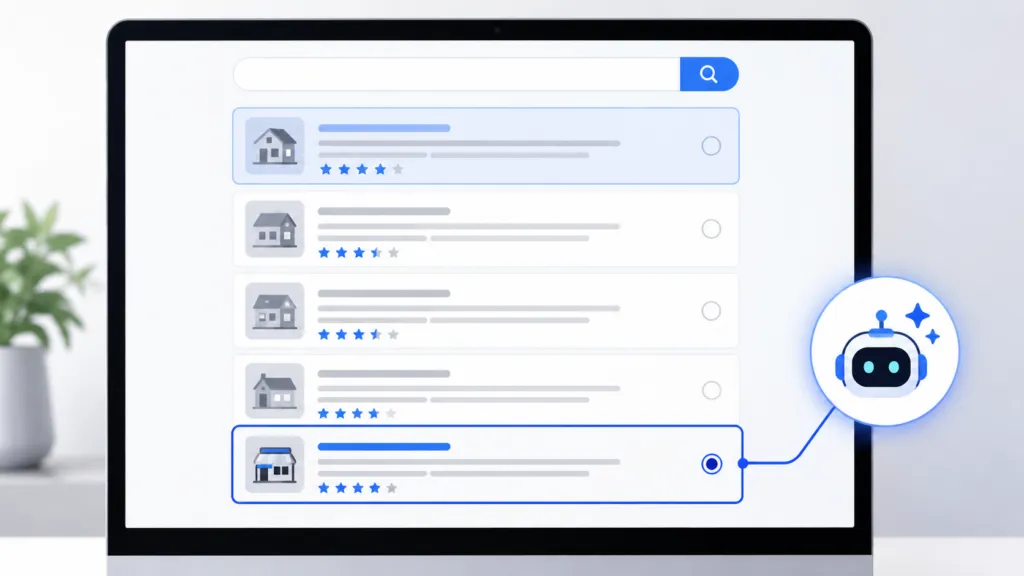
Self-promotional listicles still work, but mostly for discovery. If AI already treats your brand as a top choice in your category, publishing more of these pages is unlikely to increase how often you get recommended. If AI has never heard of you and you belong in that category, they can get you in the game.
At TJ Digital, we simulate about 4,000 AI prompts every day across ChatGPT, Gemini, and Perplexity for our clients. That volume is what let us spot the change. These pages started producing weaker results around the beginning of 2026, and we finally understand why.
Table of Contents
ToggleWhat Is a Self-Promotional Listicle?
A self-promotional listicle is a “best of” article a company publishes on its own website, ranking itself as the top choice. Think “Best Plumber in Dallas” or “Best CRM Solution for Universities,” written and published by the plumber or the CRM company.
These pages got popular in the early days of AI search optimization because they worked. AI finds the listicle, sees your brand listed first, and repeats that recommendation back to the user. Companies started publishing them at scale, and for a while the results were hard to argue with.
@tjrobertson52 Do listicles still work for AI search? Only if AI doesn’t already know your brand. #AISearch #AISEO #SEOTips #SmallBusinessMarketing
♬ original sound – TJ Robertson – TJ Robertson
Why Did Self-Promotional Listicles Stop Working as Well?
Two things changed at the same time. Google reduced organic visibility for sites publishing these pages at scale, and AI models stopped treating list order as a strong signal.
The visibility drops started around January 20, 2026. SEO researcher Lily Ray analyzed more than 40 sites running this tactic heavily and found declines of 30% to 50% within weeks, concentrated in blog, guide, and tutorial subfolders. Search Engine Land’s coverage of her findings has the full breakdown.
The second change is the one that matters more for AI search. AI is no longer blindly trusting the recommendations inside a listicle. It reads the page, then weighs it against everything else it already knows about your category.
What Did the Ahrefs Experiment Find?
Ahrefs recently published an experiment on this tactic, and the results match what we’ve seen across our own client campaigns. They put out 34 self-promotional pages across five domains promoting two very different things.
One was Brand Radar, their established AI visibility tool. The other was Ahrefs Evolve, a conference they had just launched.
They then analyzed 9,886 AI answers from ChatGPT, Gemini, Perplexity, and Copilot between February 7 and May 31, 2026. The results split cleanly by how well known the brand already was.
| Where new AI mentions came from | Ahrefs Evolve (new brand) | Brand Radar (established brand) |
| Answers citing Ahrefs’ own pages | 82% | 6% |
| Answers citing third-party content | 18% | 94% |
For the new conference, the self-promotional pages were the bridge between not being mentioned and being mentioned. For the established product, AI already had plenty of other sources to work from and barely needed them.
There was one more finding worth knowing about. Among answers that cited one of the conference pages, 43% never mentioned the conference at all. The AI read the page, then recommended a competitor listed further down it.
Will Google Penalize You for Self-Promotional Listicles?
The truth is, I’ve yet to see any evidence that Google is penalizing this algorithmically. Every penalty I’ve seen up close was a manual action against a site doing it at enormous scale.
In other words, the tactic worked well enough that a human at Google noticed and stepped in. Shopify is the best known example. They published more than 100 pages claiming to be the best ecommerce platform for various use cases, and eventually started deleting them.
Lily Ray has been the loudest voice warning people away from this, and my read on the mechanism differs from hers. On the practical advice we land in the same place. Publishing hundreds of pages that crown yourself the winner is a bad bet, whatever the mechanism turns out to be.
At a reasonable scale, though, I wouldn’t worry about a penalty at all. The risk shows up when you industrialize it.
How Does AI Use Yelp and Other Directories Now?
The same shift shows up on sites you don’t own. It used to be that when AI cited Yelp, its final recommendation closely matched Yelp’s own ordering.
That has changed. AI still goes to Yelp to read reviews and see what people are saying about you. It doesn’t seem to care much what position you hold on the list.
So getting listed still matters. Fighting for the number one slot on a third-party listicle matters a lot less than it did a year ago.
When Are Listicles Still Worth Pursuing?
Use one test. Is there a legitimate argument that your brand belongs among the top choices in your category, and is AI failing to see it that way?
When the answer is yes, listicles can make a big difference. They get you in the game. This holds for placements on listicles you don’t own as much as it does for anything you publish yourself.
When AI already names you consistently, put the effort somewhere else. More listicles won’t move the number much, and the Ahrefs data on Brand Radar shows exactly what that ceiling looks like.
The only way to know which situation you are in is to check. Run 10 to 20 prompts your customers would actually type, several times each, and log every source that comes back. We wrote a full walkthrough on auditing what AI knows about you.
How Do You Write a Listicle Without the Cringe Factor?
As an agency we never ran self-promotional listicles at scale, and for most clients we never ran them at all. Most brands feel a little cringe about having one on their site, and I think that instinct is correct.
We publish a different format. An article titled “How to Choose the Best Immigration Attorney” targets the same search term, positions the client as an advisor, and gives the reader something useful.
Here is what makes that format hold up:
- State the criteria you used to evaluate options, and why each one matters
- Name real alternatives, including ones that beat you for certain use cases
- Give an honest limitation of your own offering
- Cite third-party evidence like reviews and ratings to support your claims
- Keep the page current, since AI systems favor recently updated information
Even these articles started producing weaker results in early 2026. They still hold up better than anything that declares you the winner, and they carry none of the risk.
How Should Small Businesses Approach This in 2026?
How many self-promotional listicles is too many?
There’s no published threshold, but every penalized site I have seen was publishing dozens or hundreds. A handful of honest comparison pages is a completely different activity from running a content farm.
Does this work faster than traditional SEO?
Yes. New mentions on frequently cited pages can show up in AI answers within a day, while traditional SEO usually takes three to six months to show movement.
Should you pay for placement on someone else’s listicle?
It depends on how often that specific page gets cited in your category. Prioritize the pages that show up repeatedly in your own prompt testing, and skip the ones that appear once in a hundred runs.
Does being cited mean you’ll be recommended?
No. The Ahrefs experiment found that 43% of answers citing a self-promotional conference page recommended a different event entirely.
Get a Clear Read on Your AI Visibility
Listicles are one lever, and they only pay off when you know which pages AI actually reads in your category. We map that for every client before writing a single page. Send me a message and I’ll tell you what we’d do with your site.