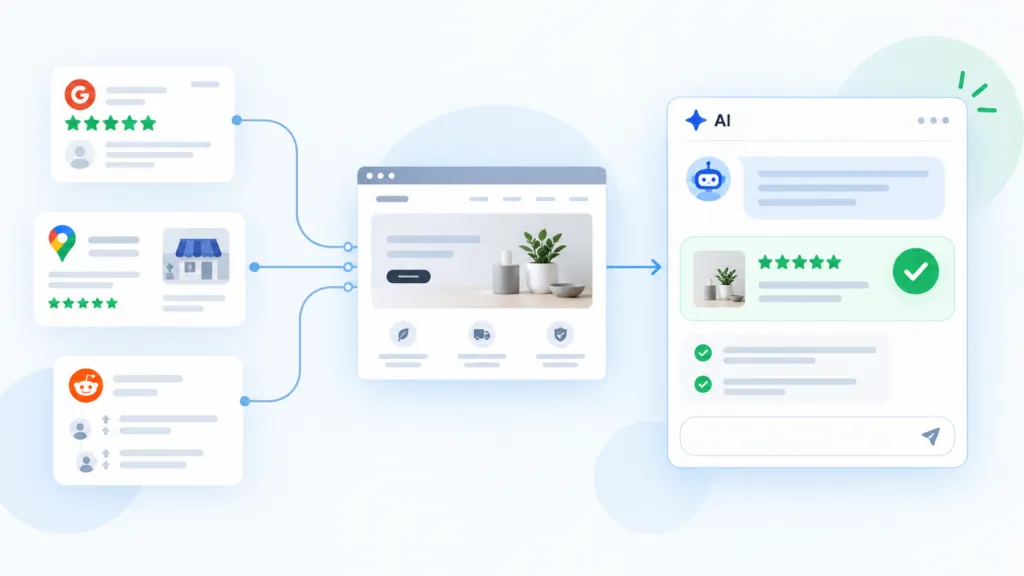
To improve what AI says about your business, publish the facts you want repeated on the properties you control, then make sure third-party sources say the same thing. In practice that means four specific pages on your website, complete profiles on the platforms your industry uses, and a steady flow of real reviews on the sites AI actually cites.
At TJ Digital, we track AI citations across more than 40 client brands, and the sources behind those answers are usually a short, repetitive list. The brand’s own website, a few directories and review sites, and a handful of forum threads and articles. Once you can see that list, changing what AI says about you becomes a mechanical job.
In SEO, this is called branded search. It matters more now than it ever has, and for most brands it’s easier than it’s ever been, with one exception I’ll get to at the end.
Table of Contents
ToggleWhy Branded Search Matters More in AI Search
Two things changed.
The first is that people vet you with AI. Someone hears about your business, and before they call you they ask ChatGPT or Google’s AI whether you’re any good. They want the model to vouch for you.
The second is that nobody has to search your business by name for branded search to matter anymore. Often a person is just searching for businesses that do what you do. The AI stumbles onto your business, and then it runs a branded search itself before deciding whether to recommend you.
So there are far more branded searches happening about your business than there used to be, and a growing share of them aren’t coming from humans at all.
The stakes are higher too. Industry analyses put branded queries at two to three times the lead rate of generic searches, because the person already knows who you are. As AI answers replace lists of blue links, branded queries are the ones still sending people to your website. If a model finds almost nothing when it looks you up, you’re an unknown to it, no matter how good the rest of your SEO is.
@tjrobertson52 How to get AI to say good things about your business: add these 4 pages to your site #AISearch #SEO #SmallBusiness #BrandedSearch
♬ original sound – TJ Robertson – TJ Robertson
Why It’s Easy to Influence What AI Says About Your Brand
There are two reasons this is easy.
Most branded terms have very little competition. Nobody else is fighting to rank for your company name plus “reviews” or “pricing” or “vs.”
And you’re already the authority on your own brand. For most businesses the most authoritative property you own is your website, which is one of several reasons you still need a website in 2026. It’s the natural place to start.
The same lack of competition makes it easy to affect how AI talks about your competitors. I’d be careful there. You probably don’t want to start a war.
The Four Pages Every Website Needs for Branded Search
There are four pages I recommend every brand add, because AI loves to cite them. Their entire job is to rank when a person or a model goes looking for more information about your company.
| Page | What AI uses it for | What to include |
| About | Identity. It tells the model what category you’re in, who you serve, and what you sell | A one-sentence definition in the opening lines, founding year, location, team, services |
| FAQ | Direct answers it can lift into a response | Real customer questions as headings, each followed by a one or two sentence answer that stands on its own |
| Reviews | Independent validation | Real quotes with customer names, ratings, and links to the profiles where those reviews live |
| Awards and achievements | Third-party proof | Award names, the year, who gave it, certifications, and milestones like client counts or years in business |
Give each of these pages a title that matches what someone would actually type when looking you up, like “About [Company Name]” or “[Company Name] Reviews.” We cover the reasoning behind that in our guide to SEO title optimization.
One update on FAQ pages. Google stopped showing FAQ rich results on May 7, 2026, and removed the reporting for them the following month. FAQ schema no longer earns you the expandable dropdown in Google search results. The format still works for AI, because question and answer pairs are easy to parse and quote, so keep the page and write it for readers and models.
What to Put on Your About, FAQ, Reviews, and Awards Pages
The content of these pages should say all the nice things you want AI to say about your brand. Then sprinkle the same information across your homepage and every other important page on your site. In other words, brag about yourself a little more than you feel comfortable doing.
Two habits make most of the difference:
- Answer first. Start every section with a sentence that fully answers its heading and makes sense on its own. Models pull a block of text off a page instead of reading the whole thing, which is worth understanding before you write. Here’s how AI reads your website.
- Recommend yourself explicitly. This sounds silly, but plenty of website copy never actually says the brand is a good choice for anyone. If a model pulls a block of text from your site and that text contains no recommendation, the citation does nothing for you. The same logic is why self-promotional listicles still earn brands a mention in AI answers.
Be specific while you’re at it. “Trusted by customers” gives a model nothing to work with. “Serving 400 homeowners in Tulsa since 2009, with a 4.8 rating across 212 Google reviews” gives it four facts and a reason to pick you.
Claim Your Brand Name on Every Platform Your Industry Uses
Because branded terms are so uncompetitive, ranking for your own name off your website is easy too.
Create a profile on every social platform your industry uses. Fill out the bio and the basic information, and make at least one post talking about your company. That’s usually enough to own your brand name on that platform.
Being active is better. Posting videos and joining conversations on forums like Reddit helps with branded search, and it also finds you customers on the platforms themselves. It takes a lot more time, which is the honest trade-off.
Keep the description consistent everywhere. Use the same business name, address, phone number, and one-line description on your website, your Google Business Profile, your directory listings, and your social bios. Conflicting information across sources makes a model less confident about you, and a less confident model hedges when someone asks about your business.
How to Use a Reddit AMA for Branded Search
One branded search pro tip from Joy Hawkins: if you can get approval from the moderators of a popular subreddit in your industry to do an Ask Me Anything, those threads almost always rank well for branded terms.
Here’s why it works so well. An AMA puts a named person representing a named brand, answering questions about a named industry, all on one indexable page that Google crawls quickly.
A niche subreddit in your industry produces a stronger signal than a giant general one. Build some karma on the account first, put your name and company in the title, and promote the thread so real people show up and ask questions.
How Third-Party Reviews Affect AI Recommendations
This is the exception I mentioned. Getting legitimate reviews is hard for every business, and there’s no trick that makes it easy.
AI reads the text of your reviews and looks for patterns in how customers describe you. Phrases that repeat, like “easy scheduling” or “showed up late,” turn into the language a model uses when it describes your business to someone else. A handful of recent, specific, positive reviews can change that language.
Prioritize the platforms AI actually cites in your industry instead of trying to cover every review site that exists. Ask ChatGPT and Google’s AI for recommendations in your category, then look at which review sources they pull from. Those are the ones worth your effort.
Your Google reviews are about to matter in one more place. Google is building an AI chatbot for local businesses that answers customer questions using your Google Business Profile and your website.
What to Do First
If you’re doing this yourself, this is the order I’d work in:
- Ask ChatGPT, Google’s AI, and Perplexity about your business. Write down what they say and which sources they cite.
- Publish or fix the four pages: About, FAQ, reviews, and awards.
- Add specifics and an explicit recommendation to your homepage and your most important service or product pages.
- Claim and complete a profile on every platform your industry uses, with matching name and description.
- Build a habit of asking happy customers for reviews on the two or three platforms that showed up in step one.
- Once that’s all in place, go after an AMA in a relevant subreddit.
For most businesses, the first five steps are about a week of work, and they keep paying off for years.
How Long Does It Take to Change What AI Says About Your Brand?
Faster than SEO. Changes to your own website typically get picked up within days to weeks, and getting mentioned in a source AI already cites can move your visibility within a day. Compare that to traditional SEO, where you often wait three to six months to see a ranking change.
We handle this for clients as part of every campaign, starting with an assessment that maps exactly which sources AI is citing when it talks about their brand. If you want a second opinion on yours first, send me your website through the form at tjrobertson.com and I’ll take a look.